
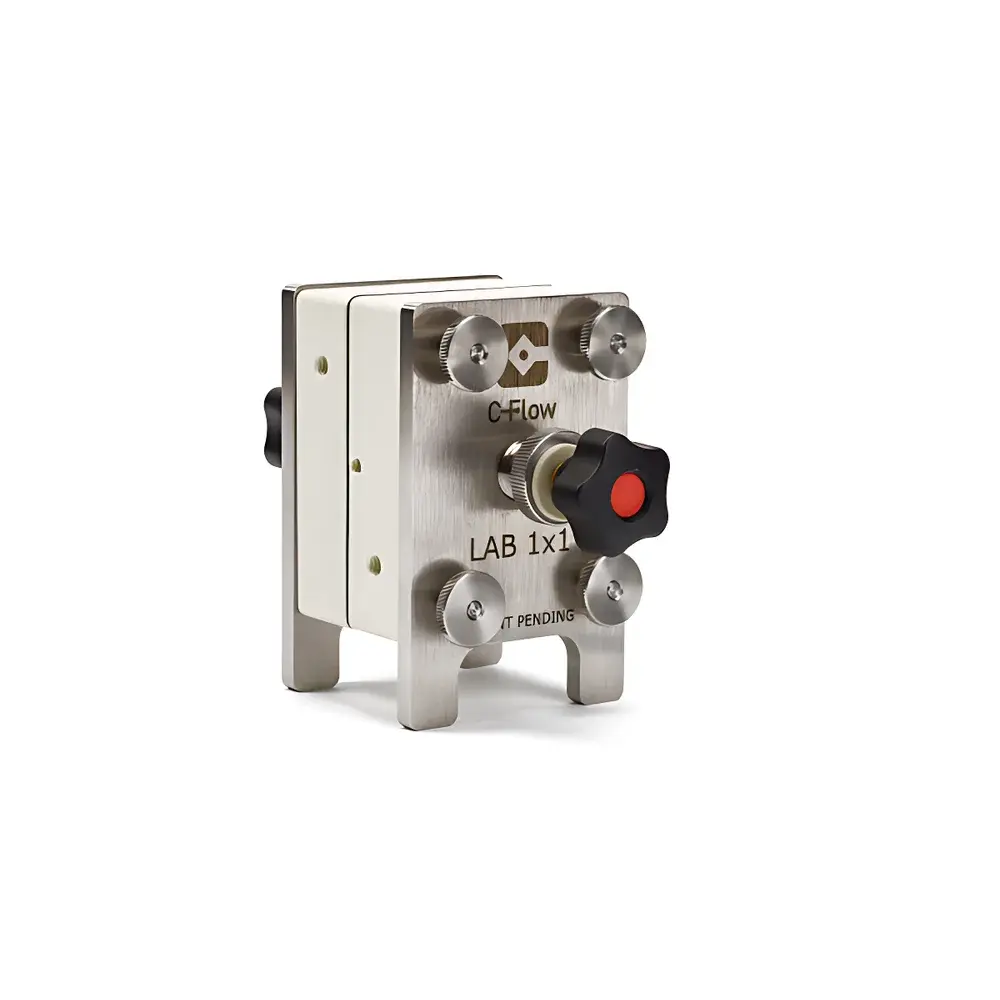
C-Flow Lab 1×1 Continuous-Flow Electrochemical Reactor
| Brand | C-Flow |
|---|---|
| Origin | United Kingdom |
| Manufacturer Type | Authorized Distributor |
| Product Category | Imported Instrument |
| Model | Lab 1×1 |
| Usable Volume | Small-scale (1–5 L, customizable) |
| Construction Material | 304 Stainless Steel Body with cPVC Cell Frame |
| Operating Pressure | Medium-pressure (up to 20 MPa, configurable) |
| Electrode Area | 10 mm × 10 mm |
| Electrolyte Flow Path Volume | 1 mL |
| Electrode Thickness Compatibility | 2 µm – 8 mm |
| Weight | 1200 g |
| Dimensions (W × D × H) | 70 mm × 60 mm × 110 mm (95 mm × 135 mm × 110 mm including PEEK fittings) |
| Electrode Current Collectors | Copper |
| Electrode Substrate | Flat graphite/carbon plates |
| Fluidic Interfaces | Standard PEEK tubing connectors |
| Vacuum Capability | Up to 20 MPa (system-rated, dependent on sealing configuration) |
Overview
The C-Flow Lab 1×1 Continuous-Flow Electrochemical Reactor is a precision-engineered, modular flow cell designed for laboratory-scale electrochemical process development and mechanistic investigation. Unlike conventional batch-type electrochemical cells, the Lab 1×1 operates on a continuous-flow principle grounded in controlled convective mass transport—enabling reproducible current density distribution, minimized concentration polarization, and precise residence time control. Its core architecture integrates two parallel electrode compartments separated by an ion-selective or proton-exchange membrane, permitting simultaneous and independent oxidation and reduction half-reactions under defined hydrodynamic conditions. This dual-compartment design supports fundamental studies of electrode kinetics, membrane transport properties, electrolyte stability, and coupled electrocatalytic transformations—particularly valuable in synthetic electrochemistry, electrosynthesis of fine chemicals, CO₂ reduction, and redox-flow battery component screening.
Key Features
- Modular, tool-free assembly: Rapid manual configuration and disassembly without torque tools or specialized fixtures.
- Universal electrode compatibility: Accommodates planar electrode substrates ranging from ultrathin (<2 µm) sputtered catalyst layers to thick (up to 8 mm) porous carbon or metal foams.
- Patented flow distributor and electrode mounting system: Ensures uniform electrolyte velocity profile across the full 10 mm × 10 mm active area, minimizing edge effects and enhancing current efficiency.
- Compact 1 mL inter-electrode flow path volume: Optimized for minimal reagent consumption—critical for screening high-value substrates, isotopically labeled compounds, or toxic intermediates.
- Laser-cut 304 stainless steel front panel and chemically resistant cPVC cell frame: Provides mechanical rigidity, corrosion resistance against acidic/alkaline electrolytes, and compatibility with common organic solvents (e.g., acetonitrile, DMF, THF).
- Standardized PEEK fluidic interfaces: Enables seamless integration with syringe pumps, HPLC systems, or automated liquid handling platforms; compatible with pressure-rated tubing up to 20 MPa.
- Included membrane and gasket cutting template: Facilitates repeatable, burr-free fabrication of custom-sized Nafion®, Fumasep®, or ceramic membranes for experimental consistency.
Sample Compatibility & Compliance
The Lab 1×1 supports aqueous, non-aqueous, and mixed-solvent electrolyte systems—including LiPF₆ in EC/DMC, KOH, H₂SO₄, Bu₄NBF₄ in CH₃CN, and ionic liquids. Its construction complies with ISO 8502-3 (surface cleanliness for metallic components) and meets material traceability requirements per ASTM E2917 for laboratory instrumentation. While not certified as explosion-proof, its medium-pressure rating (up to 20 MPa) aligns with ASME B31.3 Process Piping guidelines when operated within validated parameter envelopes. The device is routinely deployed in GLP-compliant electrochemical method development workflows and satisfies foundational documentation requirements for FDA 21 CFR Part 11–aligned data integrity protocols when paired with validated acquisition software.
Software & Data Management
The Lab 1×1 is hardware-agnostic and interfaces directly with third-party potentiostats (e.g., BioLogic SP-300, Metrohm Autolab PGSTAT302N) and flow controllers (e.g., Harvard Apparatus PHD Ultra, ISMATEC IPC). Real-time current/voltage logging, flow rate synchronization, and temperature monitoring are coordinated via LabVIEW-based or Python-controlled acquisition scripts. All raw electrochemical transients and flow metadata are stored in HDF5 or MDF4 formats—ensuring long-term readability, metadata embedding (electrode history, membrane lot number, calibration date), and audit-trail readiness for regulatory submissions. Optional firmware upgrades support timestamped event tagging (e.g., “membrane replacement”, “electrode polishing”) to maintain chain-of-custody records.
Applications
- Electrosynthetic route scouting: Optimization of Faradaic efficiency and selectivity for C–N bond formation, dehydrogenative couplings, and asymmetric electrocatalysis.
- Membrane electrode assembly (MEA) characterization: In situ assessment of proton conductivity, crossover rates, and interfacial charge transfer resistance under dynamic flow conditions.
- Electrochemical degradation studies: Accelerated aging of battery electrolytes or organic mediators under controlled potential hold and variable residence time.
- Redox-flow battery component validation: Screening of novel anolyte/catholyte couples, current collector corrosion behavior, and stack-level voltage efficiency modeling.
- Teaching and methodology training: Hands-on instruction in hydrodynamic electrochemistry, dimensionless number analysis (e.g., Reynolds, Sherwood), and scale-up principles from microfluidic to pilot-scale reactors.
FAQ
What is the maximum recommended operating pressure for routine use?
The Lab 1×1 is rated for continuous operation at ≤10 MPa with standard PEEK seals; short-term excursions to 20 MPa are permissible with fluorosilicone O-rings and torque-verified fittings.
Can the reactor be used with corrosive halide-containing electrolytes?
Yes—cPVC framing and 304 stainless steel panels provide robust resistance to Cl⁻, Br⁻, and I⁻ solutions below 80 °C; extended exposure above pH 12 requires optional Hastelloy C-276 electrode inserts.
Is electrode surface area limited strictly to 10 mm × 10 mm?
The active window is fixed at 100 mm², but custom-machined electrode carriers supporting larger geometric areas (e.g., 20 mm × 20 mm) are available under engineering consultation.
How is temperature controlled during operation?
The unit does not include integrated heating/cooling; external jacketed flow lines or Peltier-cooled inlet reservoirs are recommended for thermal management between 5 °C and 60 °C.
Does C-Flow provide application notes or method templates?
Yes—registered users receive access to a secure portal containing SOPs for CO₂RR screening, nitroarene reduction, and membrane resistance mapping, all aligned with ASTM D7232 and ISO 12907 standards.



