
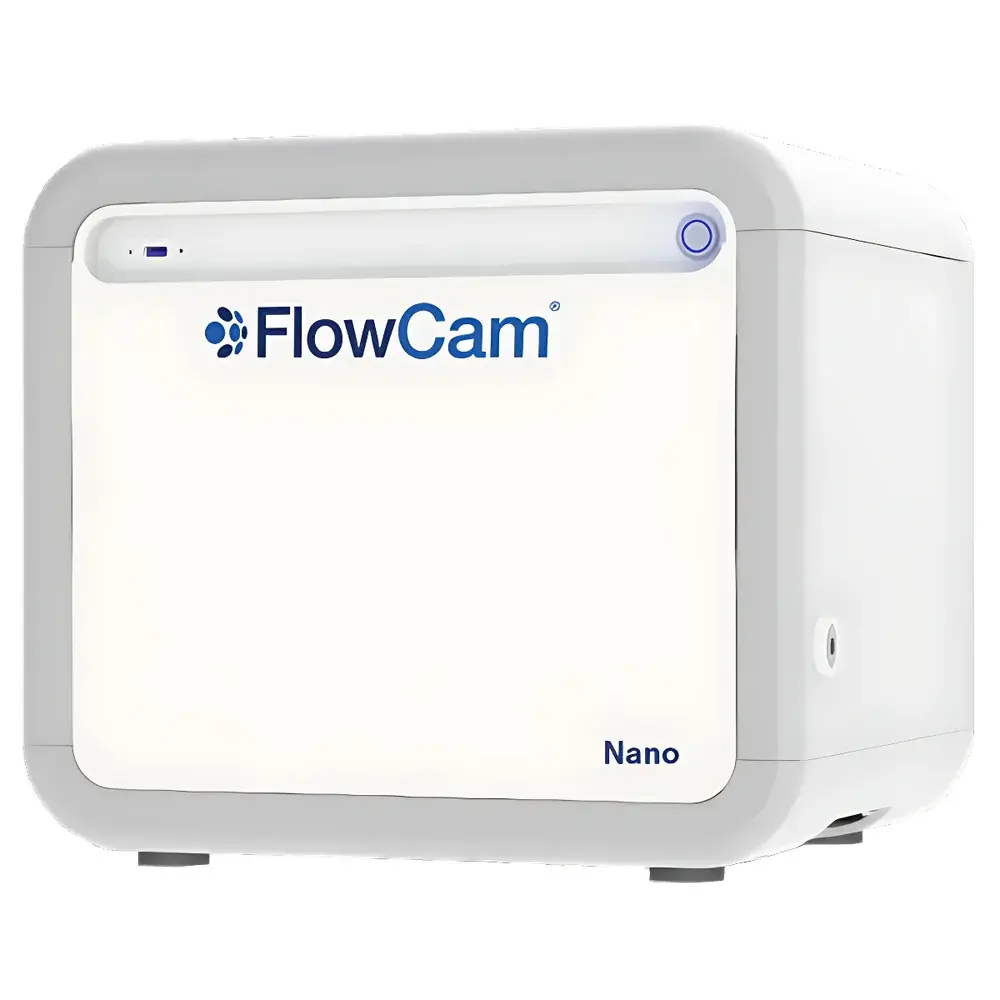
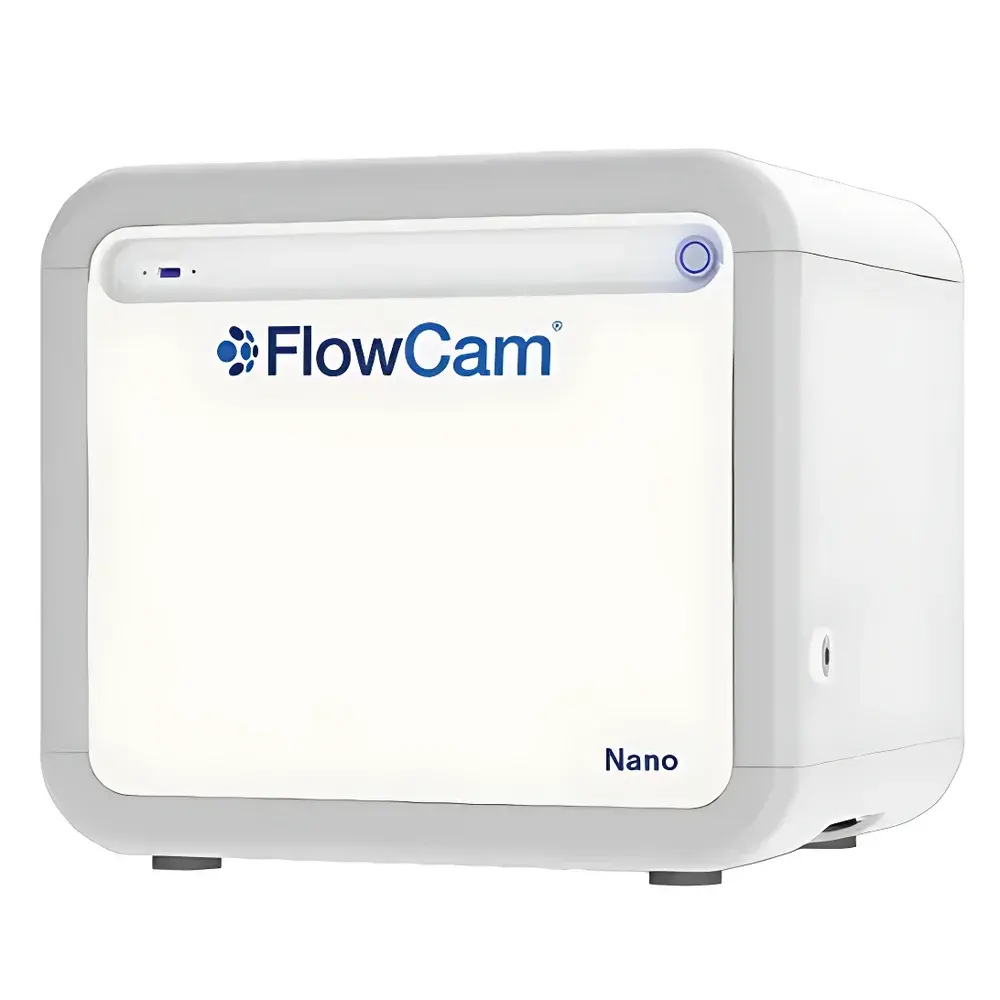
FlowCam Nano Nanoscale Flow Imaging Particle Analyzer
| Brand | FlowCam |
|---|---|
| Origin | USA |
| Manufacturer Type | Original Equipment Manufacturer (OEM) |
| Category | Imported Instrument |
| Model | FlowCam Nano |
| Detection Range | 100 nm – 2 µm |
| Optical Magnification | 40× with Immersion Oil |
| Flow Cell Depth | 60 µm |
| Minimum Sample Volume | 50 µL |
| Flow Rate | 25 µL/min |
| Camera | Monochrome CMOS, 1440 × 1080 pixels, up to 130 fps |
| Software | VisualSpreadsheet® with 21 CFR Part 11 Compliance Option |
| Dimensions | 44 cm (W) × 36 cm (D) × 39 cm (H) |
| Weight | 23 kg (shipping weight: 45 kg) |
| Power | 100–240 VAC, 50/60 Hz, max. 92 W |
Overview
The FlowCam Nano is a nanoscale flow imaging particle analyzer engineered for high-fidelity visualization and quantitative morphological characterization of submicron particles in liquid suspension. Unlike conventional flow imaging systems limited to ≥300 nm detection, the FlowCam Nano employs a proprietary oil-immersion optical architecture—matching the refractive index of the carrier fluid—to eliminate spherical aberration at high magnification (40×), enabling diffraction-limited resolution down to 100 nm. This principle leverages the physics of light transmission through immersion media to maximize numerical aperture and signal-to-noise ratio, making it uniquely suited for applications demanding rigorous analysis of nanoparticulates, protein aggregates, liposomes, exosomes, and colloidal dispersions. As a dynamic imaging platform, it captures full-field, real-time images of particles traversing a precision-machined 60 µm-deep flow cell, preserving native morphology without centrifugation, filtration, or drying artifacts. The system complies with USP as an orthogonal method to light obscuration for subvisible particle assessment in biopharmaceuticals.
Key Features
- Oil-immersion optical path optimized for 40× magnification, delivering verified resolution at 100 nm particle diameter
- Automated focus control ensuring consistent depth-of-field across sequential acquisitions and long-duration runs
- High-speed monochrome CMOS camera (1440 × 1080 px, up to 130 fps) with adjustable shutter speed and low-noise readout
- Micro-infusion pump (250 µL syringe capacity) enabling precise, pulse-free sample delivery at 25 µL/min flow rate
- Integrated fluidic sensor triggering image capture only during laminar, particle-rich flow—minimizing background noise and data redundancy
- Comprehensive morphometric engine calculating >40 shape, texture, and intensity parameters per particle—including Hu circularity, convexity, aspect ratio, fiber straightness, and biovolume estimates
- Regulatory-ready software configuration supporting 21 CFR Part 11 compliance with electronic signatures, audit trails, and role-based access control
Sample Compatibility & Compliance
The FlowCam Nano accommodates aqueous and organic suspensions across pharmaceutical, environmental, and materials science workflows. It has been validated for use with monoclonal antibody formulations, viral vector preparations, nanoparticle drug carriers, microplastic extracts, algal cultures, and CMP slurries. Sample integrity is preserved via non-destructive, label-free analysis—no fixation, staining, or dilution required. The instrument meets ASTM E2456–22 (Standard Guide for Flow Imaging Microscopy of Particles), ISO 13322-2:2013 (Particle size analysis — Image analysis methods — Part 2: Dynamic image analysis), and aligns with ICH Q5A(R2) and Q5C guidelines for particulate assessment in biologics. IQ/OQ documentation packages are available and support GLP/GMP laboratory validation protocols.
Software & Data Management
VisualSpreadsheet® serves as the unified analytical environment for method development, acquisition, classification, and reporting. Users define particle classes using Boolean logic across multiple morphological thresholds (e.g., “circularity 0.5 µm²”) or apply machine learning-assisted clustering to discover unknown populations. All raw images, metadata, and processing history are stored in a relational SQLite database with immutable timestamps. Export formats include CSV, PDF reports, histogram plots (size, circularity, intensity), and annotated TIFF stacks. For regulated environments, optional 21 CFR Part 11 mode enforces user authentication, session locking, electronic signature workflows, and tamper-evident audit logs covering all data modifications, parameter changes, and report generation events.
Applications
- Biopharmaceutical Development: Early detection of soluble and insoluble protein aggregates; quantification of silicone oil droplets, glass delamination fragments, and leachables in prefilled syringes per USP and
- Nanomedicine Characterization: Size distribution, shape anisotropy, and batch-to-batch consistency assessment of lipid nanoparticles (LNPs), polymeric micelles, and extracellular vesicles
- Environmental Monitoring: Taxonomic identification and enumeration of phytoplankton, cyanobacteria (e.g., Microcystis, Dolichospermum), and microplastics in freshwater, seawater, and drinking water sources
- Materials Science: Morphology-driven quality control of toner particles, catalyst supports, ceramic precursors, and conductive carbon blacks
- Food & Beverage: Yeast viability scoring, starch granule integrity, and contaminant screening (e.g., cellulose fibers, insect fragments)
- Academic Research: Time-resolved aggregation kinetics, biofilm fragment analysis, and sediment particle settling behavior modeling
FAQ
What is the smallest particle size reliably imaged and measured by the FlowCam Nano?
The system achieves robust detection and morphometric analysis of particles ≥100 nm in diameter under optimized conditions (e.g., appropriate contrast, stable flow, and calibrated immersion oil).
Can the FlowCam Nano distinguish between individual nanoparticles and their aggregates?
Yes—high-resolution imaging combined with multi-parameter thresholding enables clear separation of monodisperse nanoparticles from dimeric, trimeric, or higher-order clusters based on area, perimeter, convexity, and solidity metrics.
Is VisualSpreadsheet® compatible with LIMS integration?
Yes—through configurable CSV export templates and RESTful API endpoints (available in enterprise licensing tiers), enabling bidirectional data exchange with major laboratory information management systems.
Does the system require routine optical recalibration?
No—factory-calibrated optics and automated focus routines eliminate daily recalibration. Annual preventive maintenance includes verification of flow cell alignment, pump accuracy, and camera gain stability.
How is data integrity ensured during long-duration acquisitions?
Each image frame is timestamped, checksummed, and linked to its corresponding hydrodynamic event. Raw data files are write-once, and processed results retain full traceability to source images and applied algorithms.



