
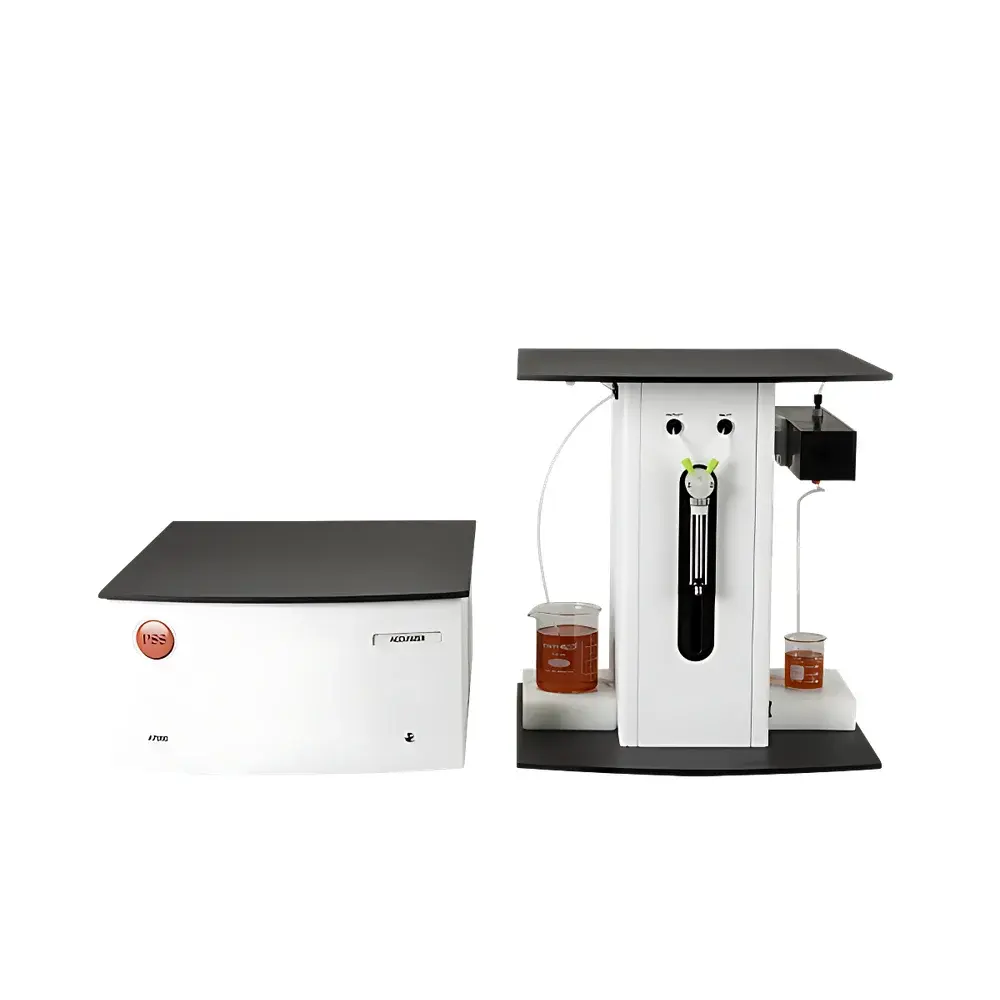
PSS AccuSizer A2000 SIS / USP Compliant Insoluble Particle Analyzer
| Brand | PSS (Particle Sizing Systems) |
|---|---|
| Origin | USA |
| Model | AccuSizer A2000 SIS |
| Detection Principle | Single Particle Optical Sensing (SPOS) |
| Regulatory Compliance | USP <788>, USP <789>, EP 2.9.19, JP 6.07 |
| Particle Size Range | 1.5 µm – 400 µm |
| Counting Sensitivity | ≤10 ppt (particles/mL) |
| Size Accuracy | ≤±2% |
| Counting Accuracy | ≤±10% |
| Max Sample Concentration (pre-dilution) | 50% w/w solids |
| Automated Functions | Auto-sampling, Auto-dilution, Auto-flushing, Auto-calibration, Data Reporting per USP/EP Standards |
Overview
The PSS AccuSizer A2000 SIS is a USP and compliant insoluble particle analyzer engineered for high-precision, quantitative detection of individual particles in parenteral drug products, ophthalmic solutions, biologics, and other sterile injectables. Unlike ensemble-based techniques such as light obscuration (LO) or laser diffraction, the A2000 SIS employs Single Particle Optical Sensing (SPOS)—a direct-imaging, resistive-pulse-adjacent optical counting method—where each particle passes individually through a precisely defined sensing zone illuminated by a collimated laser beam. This principle ensures unambiguous resolution of discrete particles, eliminating coincidence error and enabling statistically robust quantification of low-abundance, high-risk outliers in the upper tail of the distribution (e.g., ≥10 µm and ≥25 µm particles). The system’s architecture is purpose-built for pharmaceutical quality control laboratories operating under cGMP, with hardware and firmware validated to support audit-ready data integrity per FDA 21 CFR Part 11 and EU Annex 11 requirements.
Key Features
- USP and compliance out-of-the-box—including preconfigured reporting templates, pass/fail logic, and batch-level summary dashboards aligned with regulatory thresholds.
- Integrated dual-stage automatic dilution system capable of handling undiluted samples up to 50% w/w solid content—enabling direct analysis of viscous suspensions, nanoparticle dispersions, and CMP slurries without manual intervention.
- SPOS detection with calibrated photodetector array delivering size resolution down to 1.5 µm and upper range extension to 400 µm—critical for identifying subvisible aggregates, silicone oil droplets, and glass delamination fragments.
- Full automation sequence: auto-sampling, programmable dilution factor selection, real-time particle-by-particle acquisition, post-run system flush, and sensor recalibration—all initiated via single-click workflow in the validated software interface.
- Robust fluidic path constructed from USP Class VI-certified materials (e.g., PEEK, fused silica capillaries) with non-metallic wetted surfaces to prevent catalytic degradation or leachables interference.
Sample Compatibility & Compliance
The AccuSizer A2000 SIS accommodates a broad spectrum of pharmaceutical formulations, including but not limited to: aqueous and non-aqueous injectables, lyophilized reconstitutes, liposomal suspensions, monoclonal antibody formulations, vaccine adjuvants, and ophthalmic emulsions. Its SPOS methodology eliminates reliance on Mie scattering assumptions, making it insensitive to refractive index mismatch—a known limitation of light obscuration methods when analyzing low-contrast particles (e.g., lipid vesicles in saline). All analytical procedures are documented in accordance with ICH Q5A(R2), ICH Q5C, and ASTM E2456–22. System qualification includes Installation Qualification (IQ), Operational Qualification (OQ), and Performance Qualification (PQ) protocols traceable to NIST-traceable particle standards (e.g., Duke Scientific 3000 series). Full compliance with EU GMP Annex 15 and WHO TRS 986 is supported through configurable electronic signatures and ALCOA+ data governance controls.
Software & Data Management
The instrument operates under PSS AccuSizer v4.x software—a 21 CFR Part 11-compliant platform featuring role-based user access, electronic signature capture, full audit trail (including parameter changes, report generation, and calibration events), and immutable raw-data archiving. Reports are exportable in PDF/A-1b and CSV formats, with metadata embedded per ISO 15189 requirements. Batch-level summaries include cumulative particle counts per USP threshold bins (≥10 µm, ≥25 µm), histogram overlays, and statistical process control (SPC) charts. Optional integration with LIMS (via ASTM E1482-compliant API) enables automated result transfer and trend analysis across manufacturing sites.
Applications
- Final container testing of sterile injectables per USP and pharmacopoeial equivalency requirements.
- Detection and sizing of protein aggregates, subvisible particulates, and extrinsic contaminants (e.g., rubber stopper fragments, stainless steel wear debris) in biologics fill-finish development.
- Stability-indicating monitoring of particle growth during accelerated and real-time shelf-life studies.
- Root cause analysis of filter clogging, vial breakage, or visible particulate incidents via forensic particle morphology correlation (when coupled with optional imaging module).
- Process validation support for depyrogenation tunnels, sterilizing-grade filtration, and terminal sterilization cycles.
FAQ
How does the AccuSizer A2000 SIS differ from traditional light obscuration (LO) analyzers?
It uses Single Particle Optical Sensing (SPOS), which detects and sizes each particle individually—eliminating coincidence error and providing superior sensitivity for rare large particles (>10 µm) that LO systems may undercount due to signal saturation or pulse coincidence.
Is the system suitable for analyzing opaque or highly concentrated samples?
Yes. Its two-stage automated dilution system handles samples up to 50% w/w solids, and SPOS detection is unaffected by sample turbidity or color, unlike transmission-based optical methods.
Can the instrument be qualified for GMP-regulated environments?
Yes. Full IQ/OQ/PQ documentation packages, 21 CFR Part 11 configuration files, and vendor-supervised validation support are provided as standard.
What particle standards are used for calibration and verification?
NIST-traceable polystyrene latex (PSL) and silica microspheres certified per ISO 21501-4, with size ranges spanning 1.5 µm to 400 µm and certified uncertainty ≤1.2%.
Does the software support multi-user environments with audit trail requirements?
Yes. Role-based permissions, electronic signatures, time-stamped audit logs, and immutable raw-data storage comply with FDA 21 CFR Part 11 and EU Annex 11.







