
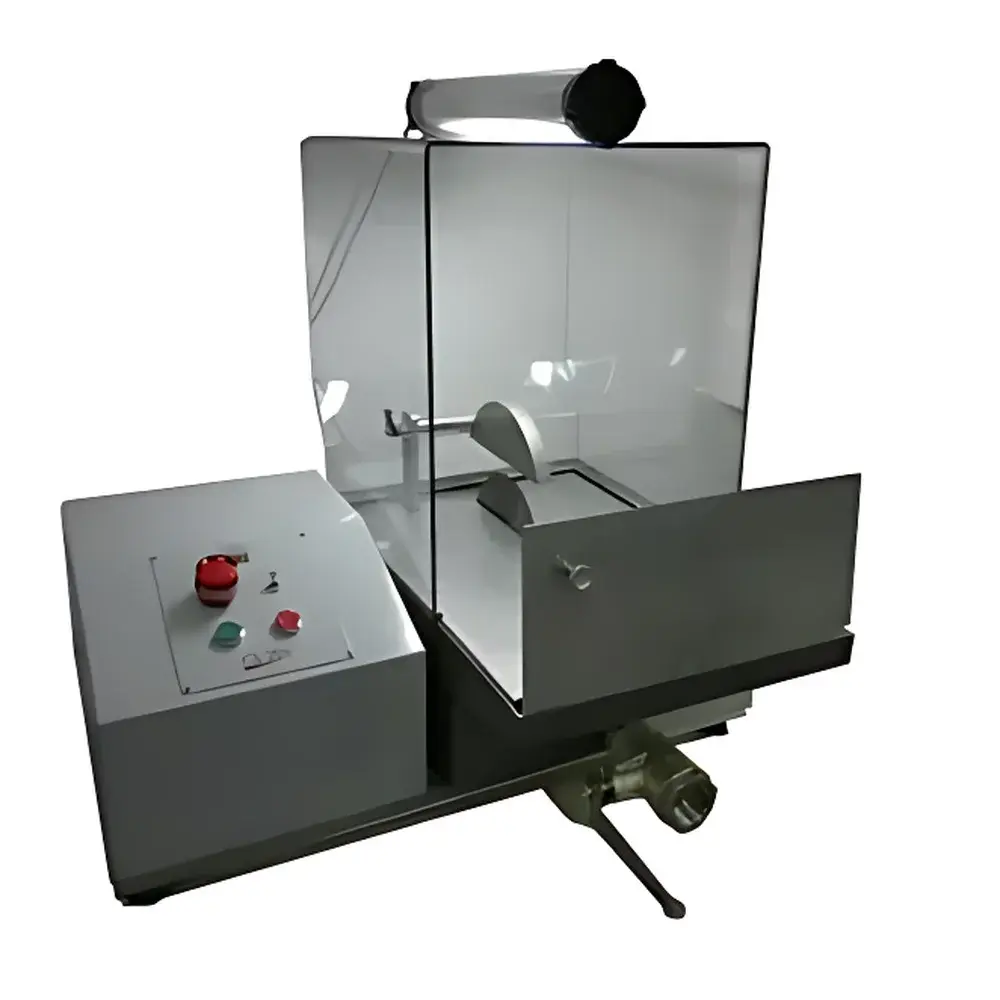
FLOXLAB CS 200 Diamond Rock Cutting Saw
| Brand | FLOXLAB |
|---|---|
| Origin | France |
| Model | CS 200 |
| Saw Blade Diameter | 200 mm (8") |
| Blade Thickness | 2 mm |
| Cooling Medium | Water |
| Power Supply | 220 V, 50/60 Hz |
| Motor Power | 550 W |
| Motor Speed | 3000 RPM |
| Weight | 70 kg |
| Dimensions (L×W×H) | 765 × 750 × 660 mm |
Overview
The FLOXLAB CS 200 Diamond Rock Cutting Saw is a precision-engineered, benchtop rock preparation instrument designed for controlled, low-damage sectioning of geological specimens in petroleum geoscience laboratories, core analysis facilities, and academic earth science departments. It operates on the principle of abrasive diamond-impregnated blade cutting under continuous water cooling—ensuring thermal stability, minimizing micro-fracturing, and preserving petrographic integrity during sample preparation. Unlike high-speed industrial saws optimized for throughput, the CS 200 prioritizes dimensional accuracy and surface finish reproducibility for downstream applications including thin-section microscopy, SEM-EDS analysis, porosity-permeability correlation studies, and reservoir rock characterization per ASTM D3149 and ISO 14688-1 protocols.
Key Features
- Diamond-impregnated circular blade (200 mm diameter, 2 mm thickness) with uniform bond matrix for consistent wear resistance and straight-line kerf geometry
- Manually operated feed mechanism with calibrated depth-stop and lateral alignment guide to ensure repeatable cut positioning within ±0.15 mm tolerance
- Integrated water delivery system with adjustable flow rate and nozzle positioning to maintain blade temperature below 60 °C during extended operation
- Brushless induction motor delivering stable 3000 RPM at rated 550 W output—engineered for torque consistency across varying load conditions encountered in heterogeneous lithologies
- Robust cast-aluminum base frame and vibration-damped mounting platform to suppress resonant harmonics that compromise cut parallelism
- CE-compliant electrical architecture with IP22-rated enclosure, emergency stop button, and blade guard interlock meeting EN 62061 functional safety requirements
Sample Compatibility & Compliance
The CS 200 accommodates cylindrical core samples up to Ø100 mm × 250 mm length, irregular outcrop clasts ≤150 mm in maximum dimension, and consolidated sedimentary blocks with unconfined compressive strength (UCS) ranging from 20 MPa (e.g., chalk, siltstone) to 180 MPa (e.g., quartzite, basalt). Its mechanical design conforms to ISO 14688-1:2018 for geotechnical description of soils and rocks, and supports GLP-aligned documentation workflows when integrated with laboratory information management systems (LIMS). All wet-cutting operations comply with OSHA 1926.55 Subpart E (hazardous dust control) and EU Directive 2004/37/EC (carcinogens and mutagens), as water suppression reduces respirable crystalline silica (RCS) generation to <0.025 mg/m³ over an 8-hour TWA.
Software & Data Management
As a manually operated mechanical instrument, the CS 200 does not incorporate embedded firmware or digital control interfaces. However, it is fully compatible with external digital documentation systems used in regulated environments: cut logs, specimen IDs, operator signatures, and timestamped photographic records can be captured via LIMS-integrated mobile tablets or desktop workstations. The device supports audit-trail-ready workflows compliant with FDA 21 CFR Part 11 when paired with validated electronic record systems—particularly relevant for upstream petroleum labs undergoing API RP 14C or ISO/IEC 17025 accreditation audits.
Applications
- Preparation of petrographic thin sections (30 µm) for optical mineralogy and cathodoluminescence imaging
- Sectioning of drill core for plug extraction in routine core analysis (RCA) programs aligned with API RP 40
- Controlled fragmentation of shale samples prior to TOC and Rock-Eval pyrolysis testing
- Production of polished slabs for micro-CT scanning and digital rock physics modeling
- Geomechanical sample conditioning for triaxial testing per ASTM D7012
- Field-lab transitional processing of exploration samples where portability and power independence are secondary to precision
FAQ
Is the CS 200 suitable for cutting unconsolidated or highly fractured formations?
No—its mechanical feed system requires minimum sample cohesion; loose sands, weathered tuffs, or heavily jointed carbonates must first be impregnated with low-viscosity epoxy prior to cutting.
Can the blade be replaced with non-diamond alternatives?
No—only FLOXLAB-certified diamond blades with specified bond hardness (designated “B” grade for medium-hardness rocks) are approved for use; substitution voids CE compliance and compromises thermal safety margins.
What maintenance intervals are recommended for sustained accuracy?
Blade truing and arbor runout verification every 200 operational hours; coolant system descaling every 6 months; linear bearing lubrication per ISO 6743-9 Class L-XCBG 2 specifications.
Does the CS 200 meet explosion-proof requirements for offshore rig labs?
No—it lacks ATEX or IECEx certification; installation in Zone 1/2 hazardous areas requires third-party encapsulation or relocation to classified safe zones per API RP 500.





