
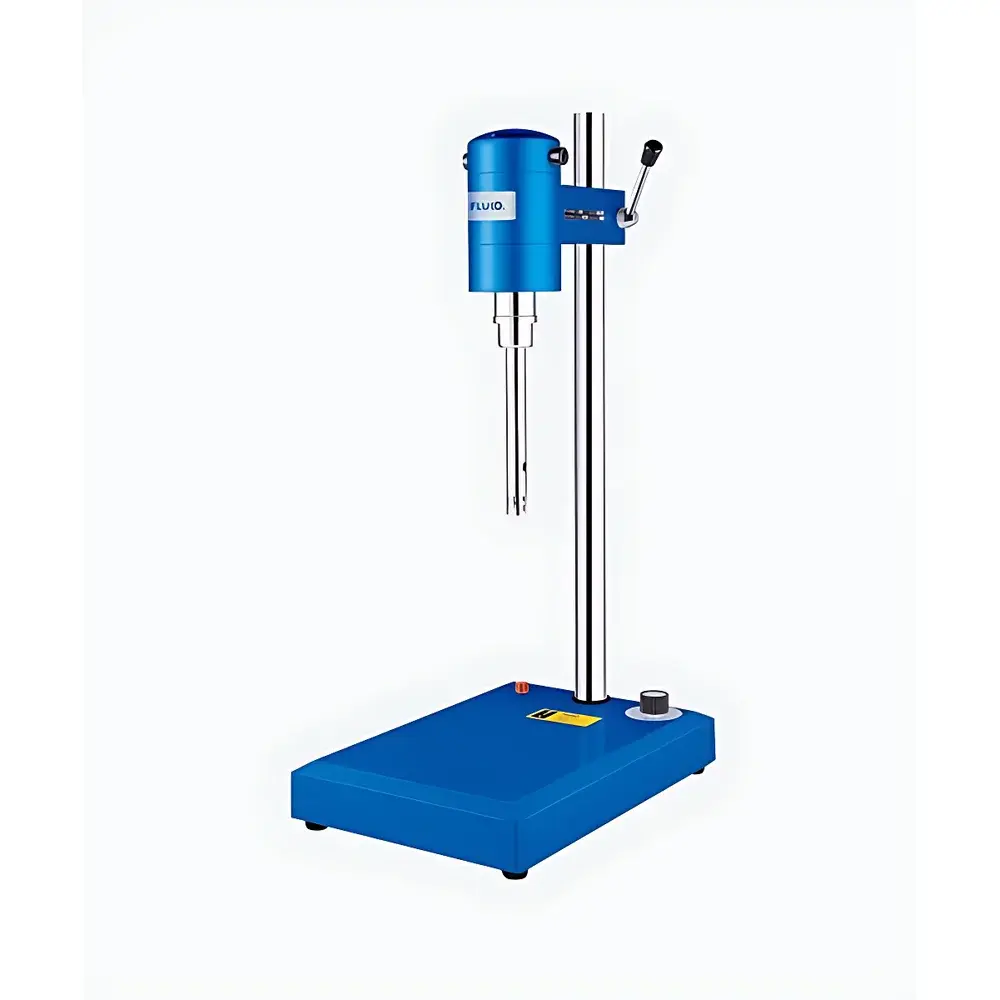
FLUKO F18 High-Shear Disperser & Homogenizer
| Brand | FLUKO |
|---|---|
| Origin | Shanghai, China |
| Model | F18 |
| Instrument Type | Probe-type Rotor-Stator Homogenizer |
| Power | 200 W |
| Voltage/Frequency | 220 V, 50 Hz |
| Processing Volume (H₂O) | 100–2000 mL |
| Maximum Viscosity | 8000 cP |
| Speed Range | 300–23000 rpm |
| Speed Display | Analog Scale |
| Speed Control | Continuous (Infinitely Variable) |
| Contact Material | SS304 Stainless Steel |
| Shaft Sleeve Material | PTFE |
| Ambient Temperature Range | 5–40 °C |
| Relative Humidity Limit | ≤80% |
| Operation Mode | Batch |
| Standard Work Probes | 12G and 18G |
| Dimensions (W×D×H) | 225 × 328 × 600 mm |
| Weight | ~9 kg |
Overview
The FLUKO F18 High-Shear Disperser & Homogenizer is a precision-engineered laboratory-scale rotor-stator system designed for reproducible, scalable processing of heterogeneous liquid systems. Operating on the principle of controlled hydrodynamic shear—generated by high-velocity rotation of a precision-machined probe within a fixed stator—the F18 induces intense mechanical energy transfer across fluid interfaces. This mechanism enables efficient particle size reduction, droplet breakup, and interfacial stabilization critical in emulsion formation, colloidal dispersion, and cell lysis applications. Its design conforms to fundamental requirements for benchtop homogenization under GLP-aligned workflows, supporting method development prior to pilot- or production-scale implementation. The unit is not intended for continuous-flow operation but optimized for discrete batch processing with consistent shear history control.
Key Features
- Infinitely variable speed control (300–23,000 rpm) allows precise tuning of shear rate to match rheological behavior of diverse samples—from low-viscosity aqueous solutions to non-Newtonian suspensions up to 8,000 cP.
- Dual-standard probe configuration (12G and 18G) provides flexibility across volume ranges: the 12G probe delivers optimal efficiency for volumes between 100–500 mL, while the 18G probe maintains uniform energy distribution in larger batches up to 2000 mL.
- All wetted surfaces are constructed from AISI 304 stainless steel, ensuring corrosion resistance against common solvents, buffers, and mild acids; the PTFE shaft sleeve guarantees chemical inertness and thermal stability under sustained operation.
- Low-noise motor assembly (<65 dB(A) at 1 m) and vibration-damped base design support extended use in shared laboratory environments without compromising acoustic comfort or measurement integrity.
- Analog tachometer scale offers immediate visual feedback of rotational speed—eliminating digital latency and supporting real-time manual adjustment during process optimization.
- Integrated support stand and clamping base ensure secure vertical alignment during operation, minimizing probe wobble and enhancing repeatability across replicates.
Sample Compatibility & Compliance
The F18 accommodates a broad spectrum of sample types including oil-in-water and water-in-oil emulsions, pigment dispersions, polymer nanocomposites, microbial lysates, and pharmaceutical suspensions. It is routinely deployed in formulation labs validating ASTM D2703 (Standard Practice for Emulsion Stability Testing) and ISO 7619-1 (Rubber—Determination of Hardness) sample prep protocols. While the instrument itself does not carry CE or UL certification, its electrical architecture complies with IEC 61010-1 safety standards for laboratory equipment. Users implementing the F18 in regulated environments (e.g., USP , FDA 21 CFR Part 11–aligned workflows) must document probe calibration intervals, maintenance logs, and batch-specific operating parameters to satisfy audit requirements.
Software & Data Management
The F18 operates as a standalone analog-controlled instrument and does not incorporate embedded firmware, touchscreen interface, or digital data export capability. All operational parameters—including speed setting, duration, probe geometry, and sample volume—are manually recorded per batch in laboratory notebooks or LIMS-integrated electronic records. For traceability in GxP settings, users are advised to pair the F18 with external RPM logging devices or video-based motion analysis tools where speed verification is required. No proprietary software drivers or cloud connectivity are provided; however, the unit’s mechanical simplicity ensures long-term serviceability and compatibility with legacy lab infrastructure.
Applications
- Preparation of stable nanoemulsions for topical drug delivery systems, requiring sub-200 nm droplet size distributions verified by dynamic light scattering (DLS).
- Dispersion of carbon black, TiO₂, or SiO₂ nanoparticles into polymer matrices for rheological characterization and tensile testing per ASTM D3574.
- Homogenization of bacterial cultures prior to DNA extraction, achieving >95% cell disruption efficiency confirmed via optical density decay assays.
- Development of food-grade mayonnaise analogs and plant-based dairy alternatives, where sensory panel evaluation correlates strongly with F18-specified shear history.
- Accelerated aging studies of lithium-ion battery slurry formulations, where particle agglomeration kinetics are quantified via laser diffraction before/after F18 treatment.
FAQ
Is the F18 suitable for sterile processing?
No—the unit is not autoclavable or SIP-capable. Sterile applications require post-homogenization filtration (e.g., 0.22 µm PVDF membrane) and aseptic probe handling in laminar flow hoods.
Can the F18 be used with corrosive solvents like chloroform or THF?
SS304 contact materials provide limited resistance to halogenated organics; prolonged exposure may cause pitting. For aggressive solvents, optional Hastelloy-C276 probe upgrades are available through FLUKO authorized distributors.
What maintenance intervals are recommended for routine use?
Inspect PTFE shaft sleeves and probe/stator clearances every 200 operating hours; replace bearings if axial play exceeds 0.1 mm or audible grinding occurs during rotation.
Does FLUKO provide IQ/OQ documentation for the F18?
Factory-issued IQ templates and OQ test protocols (including speed accuracy verification, temperature rise assessment, and probe concentricity checks) are available upon request for regulated laboratories.
How does probe geometry affect shear rate distribution?
Shear rate (γ̇) scales linearly with tip speed (v = π·d·N) and inversely with stator clearance (h); the 12G probe (d = 12 mm) generates higher local γ̇ than the 18G (d = 18 mm) at identical rpm, making it preferable for viscous, shear-thinning systems.



