
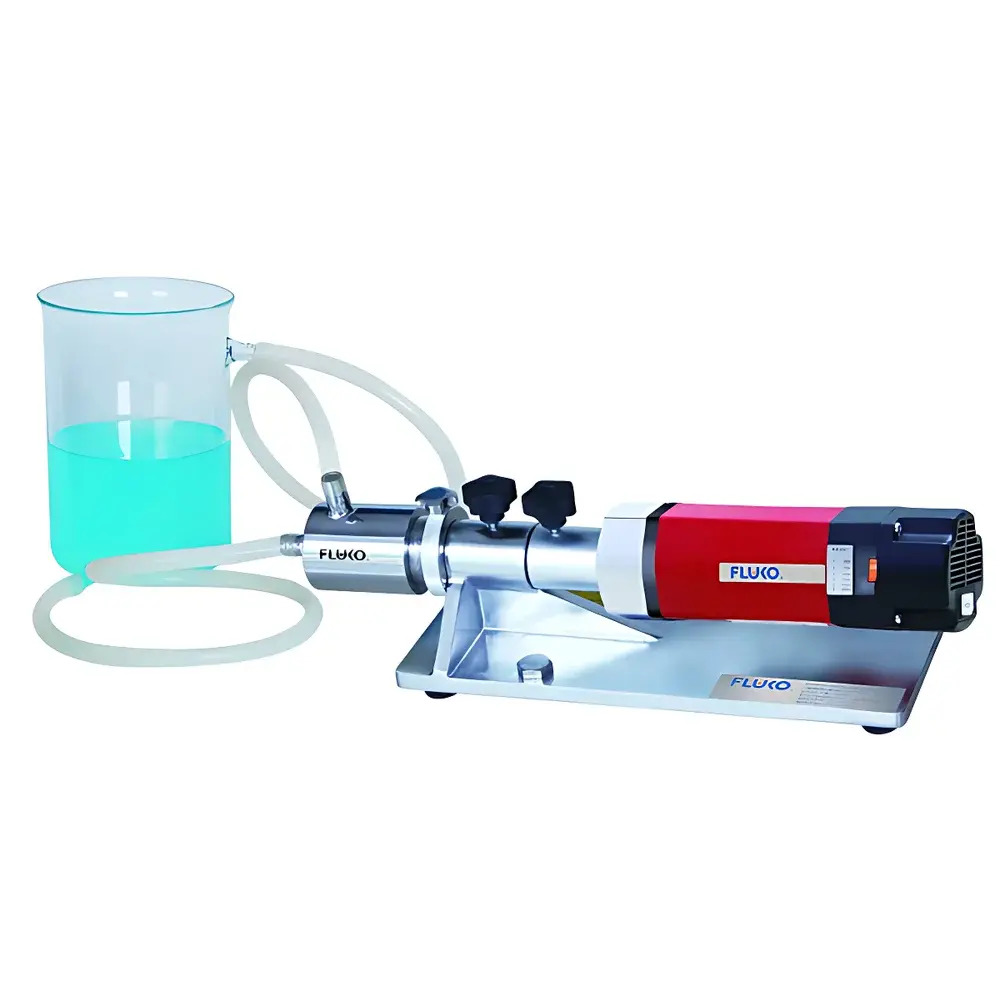
FLUKO F22Z-571-S Inline High-Shear Disperser & Homogenizer
| Brand | FLUKO |
|---|---|
| Origin | Shanghai, China |
| Model | F22Z-571-S |
| Instrument Type | Probe-type Rotor-Stator Homogenizer |
| Dimensions (W×D×H) | 477 × 120 × 122 mm |
| Processing Capacity | 15 L |
| Power | 500 W |
| Voltage/Frequency | 220 V, 50/60 Hz |
| Flow Rate (Water) | 1–15 L/min |
| Max. Viscosity | 1000 cP |
| Speed Range | 10,000–28,000 rpm |
| Max. Operating Temperature | 120 °C |
| Wetted Materials | SS316L, FKM, SiC |
| Inlet/Outlet OD | 14 mm (hose barb) |
| Base Material | SS304 |
| Weight | ~6 kg |
Overview
The FLUKO F22Z-571-S is an inline high-shear disperser and homogenizer engineered for precise, scalable process development in laboratory and pilot-scale environments. It operates on the principle of rotor-stator hydrodynamic shear: a high-speed rotating element (rotor) generates intense fluid acceleration within a precisely engineered stationary stator, inducing turbulent flow, cavitation, and extensional deformation. This mechanism enables rapid droplet or particle size reduction—critical for stable emulsions, fine suspensions, nano-dispersions, and uniform colloidal systems. Unlike batch homogenizers, the F22Z-571-S supports true continuous or recirculation operation, allowing users to replicate industrial inline processing conditions directly in the lab. Its compact footprint and modular design integrate seamlessly into existing fluid-handling setups, including peristaltic pump loops, jacketed reactors, or automated process skids.
Key Features
- High-performance brushless motor delivering consistent torque across the full speed range (10,000–28,000 rpm), optimized for reproducible shear intensity control.
- Rotor-stator geometry with tight clearance (standard 20DG head) designed to maximize energy dissipation per unit volume, ensuring efficient micro-mixing and sub-micron dispersion.
- Fully wetted components constructed from corrosion- and wear-resistant materials: SS316L housing and flow path, FKM elastomers for sealing, and silicon carbide (SiC) mechanical seals rated for continuous operation up to 120 °C.
- Inline configuration with 14 mm hose-barb inlet/outlet ports enables rapid integration into closed-loop systems without dead-legs or stagnant zones—minimizing contamination risk and supporting GMP-aligned workflows.
- Robust SS304 base and low-profile chassis (477 × 120 × 122 mm, ~6 kg) ensure vibration-damped operation on standard lab benches or mobile carts.
- Two operational variants available: analog scale-based speed indication (F22Z) or digital tachometric display (F22Z-D), both supporting manual analog speed adjustment without external controllers.
Sample Compatibility & Compliance
The F22Z-571-S accommodates a broad spectrum of Newtonian and moderately non-Newtonian fluids, including aqueous and organic-phase emulsions, polymer solutions (up to 1000 cP), pigment dispersions, liposome formulations, and cell lysates. Its SS316L contact surfaces comply with ASTM A276 and EN 10088-1 standards for stainless steel equipment used in pharmaceutical and food-grade applications. While not certified as a Class I medical device, its material traceability, cleanable geometry, and absence of lubricants in the wetted zone support adherence to GLP documentation requirements and facilitate validation under ISO 22000 or USP analytical instrument qualification frameworks. The absence of electronic speed regulation means it does not meet FDA 21 CFR Part 11 data integrity criteria unless paired with an external validated controller and audit-trail-capable SCADA system.
Software & Data Management
The base F22Z-571-S operates as a standalone electromechanical unit with no embedded firmware, communication ports, or onboard data logging. Speed is manually adjusted via potentiometer; real-time rotational speed is indicated either by calibrated analog dial (F22Z) or digital LED display (F22Z-D). For process-critical applications requiring traceability, users commonly integrate the unit with third-party flow meters, temperature sensors, and programmable logic controllers (PLCs). When deployed in validated environments, speed setpoints, runtime duration, and thermal profiles are recorded externally—enabling alignment with ALCOA+ principles (Attributable, Legible, Contemporaneous, Original, Accurate, Complete, Consistent, Enduring, Available) during regulatory audits.
Applications
- Emulsion development: Preparation of oil-in-water and water-in-oil systems for cosmetics, agrochemicals, and pharmaceutical nanocarriers.
- Particle size reduction: Deagglomeration of nanomaterials (e.g., TiO₂, SiO₂), ceramic slurries, and battery electrode precursors.
- Cell disruption: Mechanical lysis of microbial cultures and yeast for protein extraction—complementing enzymatic or sonication methods.
- Reaction intensification: Enhancing mass transfer in heterogeneous catalytic reactions or interfacial polymerization processes.
- Process simulation: Bridging lab-scale formulation studies to pilot-plant trials by matching shear rate profiles (γ̇ ≈ 10⁴–10⁵ s⁻¹) typical of industrial colloid mills and high-pressure homogenizers.
FAQ
Can the F22Z-571-S be used for sterile processing?
Sterility cannot be guaranteed solely by the unit’s construction; however, its SS316L wetted path and autoclavable (121 °C, 20 min) compatibility—when equipped with appropriate FKM or EPDM seals—support SIP (steam-in-place) protocols when integrated into validated closed-loop systems.
What is the recommended maintenance interval for the mechanical seal?
Under continuous operation at ≤10,000 rpm and ≤80 °C, SiC/FKM seals typically require inspection every 500 operating hours; service life decreases significantly above 110 °C or with abrasive particulates >50 µm.
Is the F22Z-571-S suitable for viscous polymer melts?
No—it is rated for maximum viscosity of 1000 cP (water-equivalent); polymer melts (often >10⁴ cP) exceed its hydraulic capacity and may cause motor overload or seal extrusion.
Does FLUKO provide IQ/OQ documentation templates?
Yes—FLUKO offers generic instrument qualification templates aligned with ISO/IEC 17025 and ASTM E2500, which users adapt to site-specific URS (User Requirement Specifications) and installation conditions.
Can multiple F22Z units be synchronized in a cascade configuration?
Mechanically, yes—via shared PLC control of individual speed inputs; electrically, no native synchronization protocol exists, so phase alignment must be managed externally using encoder feedback or time-based sequencing logic.



