
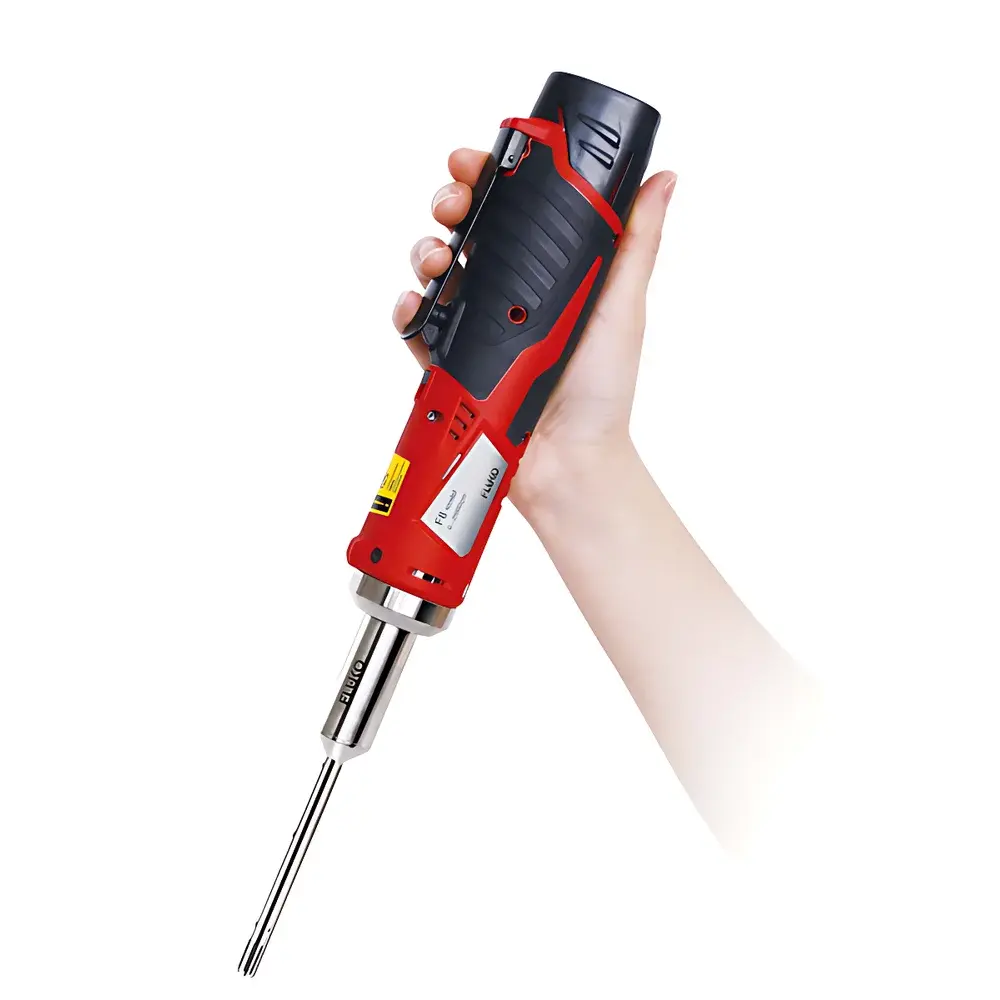
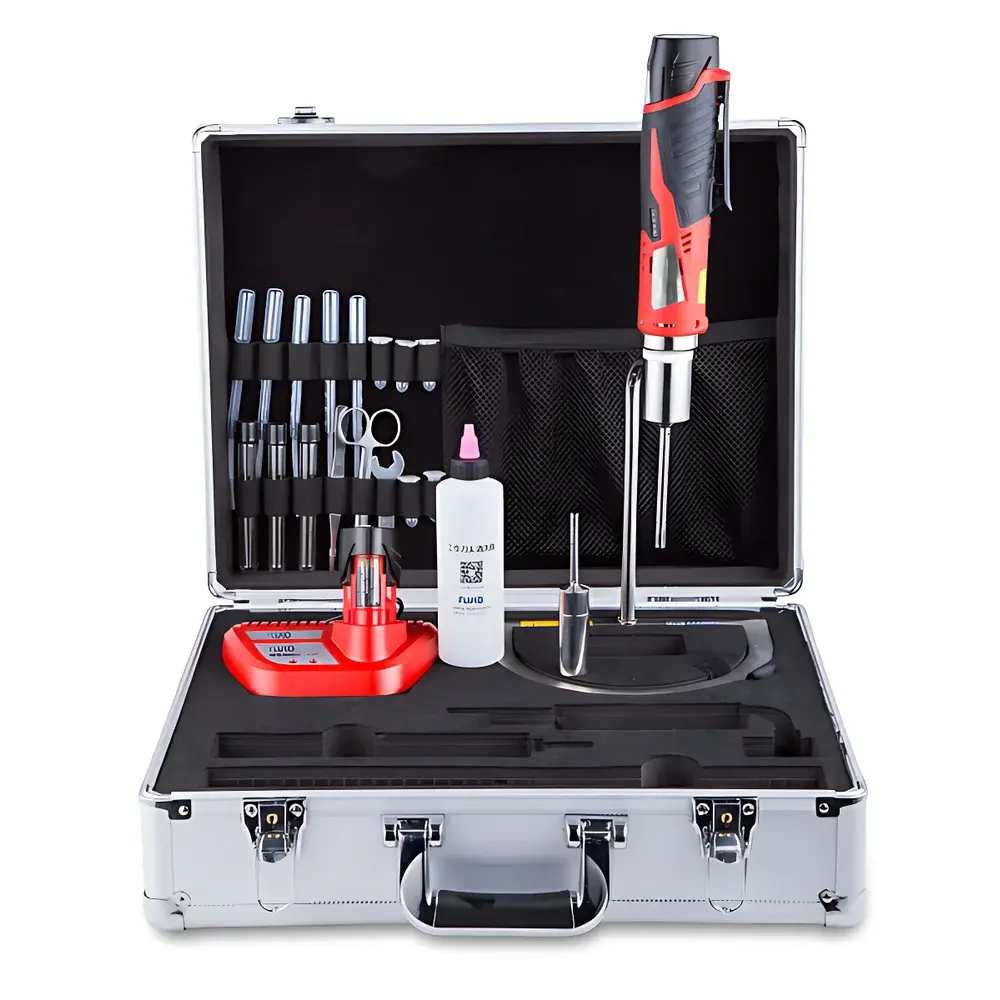
FLUKO F8 Portable Cordless Homogenizer
| Brand | FLUKO |
|---|---|
| Origin | Shanghai, China |
| Model | F8-085-S |
| Instrument Type | Probe-type Rotor-Stator Homogenizer |
| Dimensions (W×D×H) | 375 × 65 × 50 mm |
| Processing Volume | 1.5–60 mL |
| Power Supply | 12 V DC Rechargeable Li-ion Battery (2 Ah) |
| Charging Input | 220–240 V AC, 50–60 Hz |
| Charging Output | 12 V DC, 3 A |
| Speed Range | 0–25,000 rpm |
| Speed Control | Continuous Variable |
| Max. Viscosity | 100 cP |
| Continuous Run Time (Water) | ~1 h |
| Contact Material | SS316L |
| Shaft Sleeve Material | PTFE |
| Standard Probes | 6GZL-1, 8GZL-1 |
| Operating Environment | 5–40 °C, ≤80% RH |
| Net Weight (Host + Probe) | ~1 kg |
| Package Weight | ~6.5 kg |
| Case | Aluminum Carry Case (475 × 400 × 150 mm) |
| Compliance | CE-marked for laboratory use under IEC 61010-1 |
Overview
The FLUKO F8 Portable Cordless Homogenizer is an engineered solution for precise, low-volume homogenization and dispersion in demanding life science and clinical laboratory environments. Based on the proven rotor-stator principle—where high-shear forces are generated by the relative motion of a rapidly rotating probe tip within a fixed stator sleeve—the F8 delivers consistent mechanical energy transfer to samples without thermal runaway or cross-contamination risks. Its cordless architecture eliminates dependency on fixed power outlets, enabling seamless operation during field-based sample collection, point-of-care diagnostics, or benchtop workflows where mobility and spatial flexibility are critical. Designed specifically for micro-scale applications, the F8 targets volumes from 1.5 mL to 60 mL, making it ideal for processing small tissue biopsies, blood fractions, bacterial pellets, or nanoparticle suspensions where reproducibility at sub-milliliter scale is non-negotiable.
Key Features
- True cordless operation powered by a 12 V, 2 Ah rechargeable lithium-ion battery—supports up to 60 minutes of continuous homogenization in aqueous media at mid-range speeds.
- Continuous variable speed control (0–25,000 rpm) with real-time feedback via integrated LED charge and operational status indicators.
- Two precision-machined stainless steel (SS316L) probes included: 6GZL-1 (6 mm diameter) for ultra-low-volume tissue disruption and 8GZL-1 (8 mm) for higher throughput emulsification and cell lysis.
- Chemically inert PTFE shaft sleeve ensures compatibility with organic solvents, acidic/basic buffers, and sterilization protocols including autoclaving (probe-only).
- Ergonomic handheld form factor (375 × 65 × 50 mm; ~1 kg net weight) optimized for one-handed control and reduced operator fatigue during repetitive sampling.
- Full accessory kit includes medical-grade scissors, tissue forceps, calibrated pipettes, centrifuge tubes, sampling vials, and a rugged aluminum carry case (475 × 400 × 150 mm) compliant with IATA transport guidelines for lab equipment.
Sample Compatibility & Compliance
The F8 supports a broad spectrum of biological and synthetic matrices—including soft animal tissues (liver, spleen), plant leaves, cultured cells, microbial cultures, liposomal dispersions, and polymer nanoemulsions—within its defined viscosity limit of 100 cP. All wetted parts conform to USP Class VI and ISO 10993-5 cytotoxicity standards. The device complies with IEC 61010-1:2010 for safety in laboratory electrical equipment and carries CE marking for conformity with EU health, safety, and environmental protection directives. While not validated for GMP manufacturing environments, its design supports GLP-aligned documentation practices through traceable probe usage logs and battery cycle tracking when integrated with external lab information systems.
Software & Data Management
The F8 operates as a standalone instrument with no embedded firmware or digital interface. However, its mechanical repeatability—validated across ≥500 cycles per probe under standardized load conditions—facilitates integration into audit-ready workflows. Users may document operating parameters (speed, duration, probe type, sample ID) manually or via LIMS-compatible templates. For laboratories requiring electronic records compliance (e.g., FDA 21 CFR Part 11), external time-stamped video logging or third-party sensor-enabled stands (e.g., torque/temperature add-ons) can be deployed to generate ALCOA+–compliant metadata without modifying the core device.
Applications
- Routine homogenization of rodent tissue biopsies prior to RNA extraction or ELISA sample preparation.
- Pre-analytical processing of whole blood or PBMC isolates for flow cytometry or PCR-based pathogen detection.
- Dispersion of graphene oxide or metal-organic frameworks (MOFs) in aqueous or ethanol-based carriers for nanomaterial characterization.
- Emulsification of vaccine adjuvants (e.g., squalene-in-water) at pilot scale under sterile laminar flow hood conditions.
- Fragmentation of biofilm-coated surfaces for microbiome profiling using low-shear, short-duration pulses.
FAQ
Is the F8 suitable for sterilization between uses?
Yes—probes and detachable components are autoclavable at 121 °C, 15 psi for 20 minutes. The main housing must not be autoclaved; surface disinfection with 70% ethanol or hydrogen peroxide wipes is recommended.
Can the F8 process viscous samples like hydrogels or pastes?
No—maximum recommended viscosity is 100 cP (e.g., 1% w/v methylcellulose in water). Higher viscosities risk motor stall, inconsistent shear distribution, and premature probe wear.
What is the expected service life of the battery under normal lab use?
With proper charge cycling (avoiding full discharge), the Li-ion battery retains ≥80% capacity after 300–500 charge cycles, corresponding to approximately 18–24 months of daily use in a medium-throughput lab.
Are replacement probes and spare batteries available through FLUKO’s global distribution network?
Yes—original FLUKO 6GZL-1 and 8GZL-1 probes, as well as certified 12 V / 2 Ah replacement batteries, are stocked by authorized distributors in North America, EMEA, and APAC regions under part numbers F8-BAT-REPL and F8-PROBE-KIT.
Does the F8 meet requirements for ISO/IEC 17025-accredited testing labs?
While the instrument itself is not individually accredited, its performance characteristics (speed accuracy ±3%, probe geometry tolerance ±0.05 mm) support method validation per ISO/IEC 17025:2017 Clause 7.2.2 when used with documented calibration procedures and traceable reference materials.



