
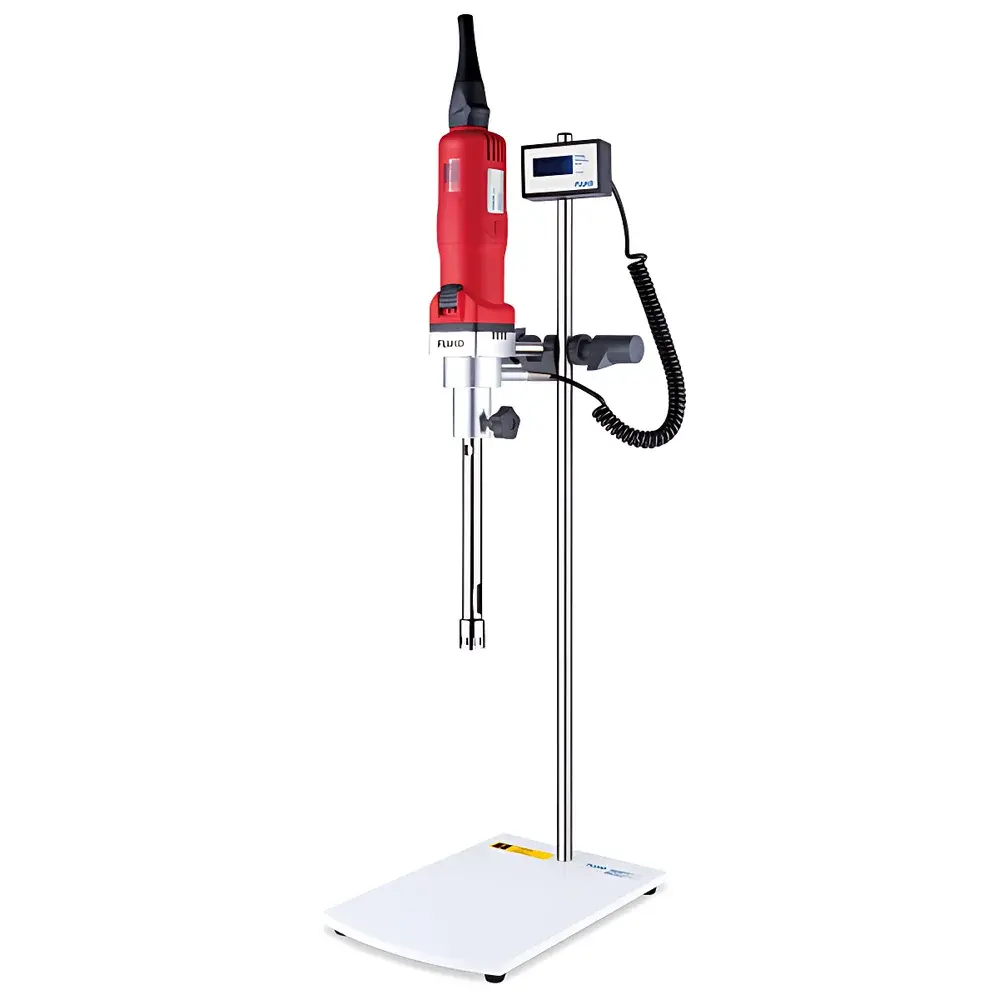
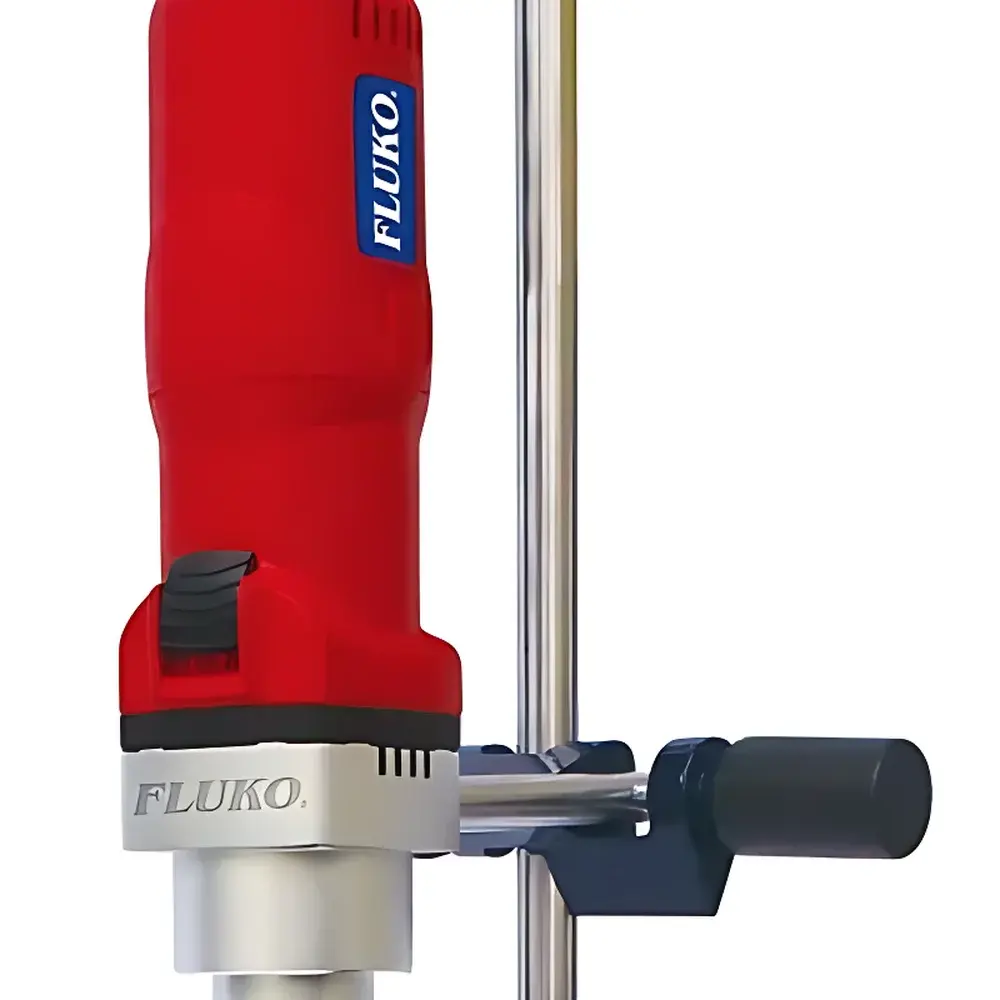
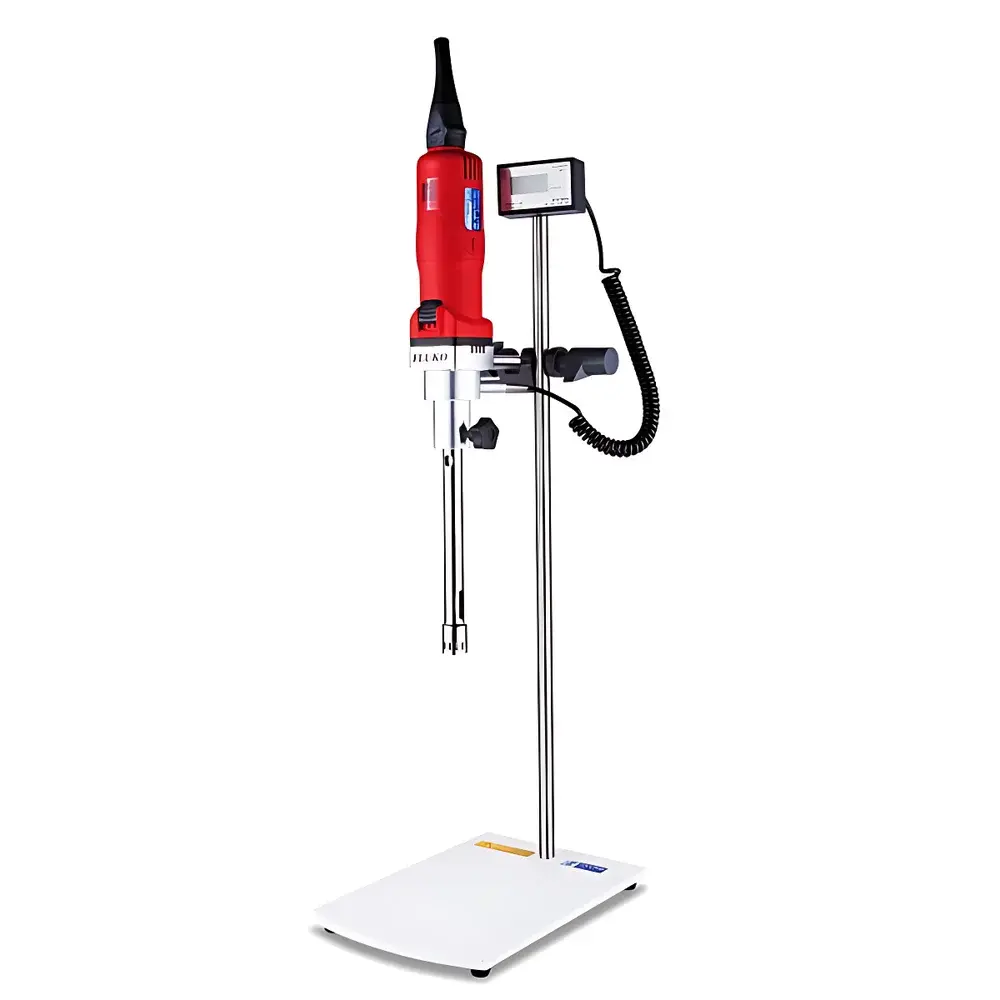
FLUKO FA25-D Digital High-Shear Disperser & Homogenizer
| Brand | FLUKO |
|---|---|
| Origin | Shanghai, China |
| Model | FA25D-052-S |
| Instrument Type | Probe-type rotor-stator homogenizer |
| Dimensions (W×D×H) | 215 × 310 × 730 mm |
| Processing Volume Range | 0.2–7000 mL |
| Power | 500 W |
| Voltage/Frequency | 220 V, 50 Hz |
| Speed Range (no-load) | 10,000–28,000 rpm |
| Max. Tip Speed | 27 m/s |
| Display | Digital RPM readout |
| Speed Control | Continuous electronic adjustment |
| Contact Material | SS316L |
| Shaft Sleeve Material | PTFE |
| Standard Probe | 25F |
| Ambient Temperature Range | 5–40 °C |
| Relative Humidity Limit | ≤80% |
| Operation Mode | Batch processing |
| Weight | ~7.1 kg |
Overview
The FLUKO FA25-D Digital High-Shear Disperser & Homogenizer is a precision-engineered laboratory instrument designed for reproducible, scalable high-shear processing of liquid and semi-liquid samples. Operating on the rotor-stator principle—where a rapidly rotating probe (rotor) shears material against a stationary concentric sleeve (stator)—this system generates intense hydrodynamic forces including cavitation, turbulent flow, and extensional stress. These mechanisms enable efficient particle size reduction, droplet breakup, cell disruption, and uniform dispersion of immiscible phases. The FA25-D is particularly suited for applications requiring tight control over shear history, such as nanoemulsion formulation, colloidal stabilization, polymer blending, and tissue homogenization in life science workflows. Its modular architecture supports rapid probe interchangeability without tooling, facilitating method transfer across volume scales—from microliter-scale biological lysates to multi-liter pharmaceutical pre-formulations.
Key Features
- Digitally controlled variable-speed motor delivering precise, repeatable rotational speeds from 10,000 to 28,000 rpm—with real-time RPM feedback via integrated LED display.
- High-power 500 W brushless motor engineered for continuous duty cycles under load, minimizing thermal drift and ensuring long-term operational stability.
- Interchangeable stainless steel (SS316L) probes—including 6G (0.2–10 mL), 8G (1–60 mL), 10G (30–150 mL), 18F (50–1500 mL), and 25F (100–5000 mL) configurations—each optimized for specific viscosity ranges and process objectives.
- PTFE-coated shaft sleeves provide chemical resistance and low-friction operation, reducing wear and preventing cross-contamination between samples.
- Compact footprint (215 × 310 × 730 mm) with integrated base and universal clamp mount allows secure placement on standard lab benches or within biosafety cabinets.
- No external cooling required for typical batch durations; built-in ventilation and thermal cutoff safeguard against motor overload during extended use.
Sample Compatibility & Compliance
The FA25-D accommodates aqueous, organic, and high-viscosity media up to 8,000 cP, supporting diverse sample matrices including cell suspensions, polymer melts, pigment dispersions, and food emulsions. All wetted parts comply with ISO 8507 (stainless steel surface finish standards) and meet general requirements for laboratory equipment per IEC 61010-1:2010 (safety of electrical equipment). While not certified for GMP production environments, the unit supports GLP-aligned documentation practices through traceable speed settings, defined probe geometry, and consistent operating parameters. It is routinely employed in R&D labs conducting ASTM D2887 (petroleum distillation), USP (light scattering for emulsion droplet sizing), and ISO 13320 (laser diffraction particle analysis) preparatory steps.
Software & Data Management
The FA25-D operates as a standalone analog-controlled instrument with digital speed monitoring—no proprietary software or driver installation required. All operational parameters (setpoint rpm, runtime, probe type) are manually recorded by the user to support audit-ready lab notebooks. For laboratories implementing electronic lab notebooks (ELN) or LIMS integration, the device’s deterministic speed-response curve enables reliable parameter mapping and protocol replication. Optional accessories—including timer modules and foot-switch controls—support hands-free operation and timed endpoint processing, enhancing repeatability in regulated environments where 21 CFR Part 11 compliance is pursued via procedural controls rather than embedded software.
Applications
- Cell lysis and nuclear extraction in molecular biology (e.g., mammalian, bacterial, yeast, plant tissues).
- Preparation of stable oil-in-water and water-in-oil emulsions for cosmetic, food, and pharmaceutical development.
- Dispersion of nanomaterials (carbon nanotubes, graphene oxide, metal oxides) into polymeric or aqueous carriers.
- Homogenization of viscous pastes and gels prior to rheological or spectroscopic characterization.
- Deagglomeration of pigment and filler suspensions in coatings, inks, and adhesives R&D.
- Standardized sample preparation for downstream analytical techniques including HPLC, DLS, SEM, and TEM.
FAQ
What is the maximum viscosity this instrument can process?
The FA25-D is rated for materials up to 8,000 cP when used with appropriately sized probes (e.g., 25F or 18F) and at lower speed ranges (≤15,000 rpm). Viscosity tolerance decreases with smaller probe geometries.
Can the FA25-D be used for sterile applications?
Yes—SS316L probes and PTFE sleeves are autoclavable at 121 °C for 20 minutes. Users must verify compatibility of specific probe models with their sterilization cycle and avoid thermal shock during cooldown.
Is calibration required before use?
No factory calibration is provided; however, users may validate speed accuracy using an external tachometer. Repeatability is maintained via electronic speed regulation and robust motor design.
How does probe selection affect shear rate distribution?
Shear rate scales approximately with tip speed and inversely with stator clearance. Smaller-diameter probes (e.g., 6G, 8G) generate higher localized shear rates ideal for low-volume, high-intensity tasks, while larger probes (18F, 25F) optimize bulk mixing efficiency and heat dissipation.
Does FLUKO offer validation documentation for QA/QC labs?
Instrument-specific IQ/OQ templates are available upon request for internal validation protocols. Performance qualification must be conducted in situ using user-defined reference materials and acceptance criteria aligned with application requirements.



