
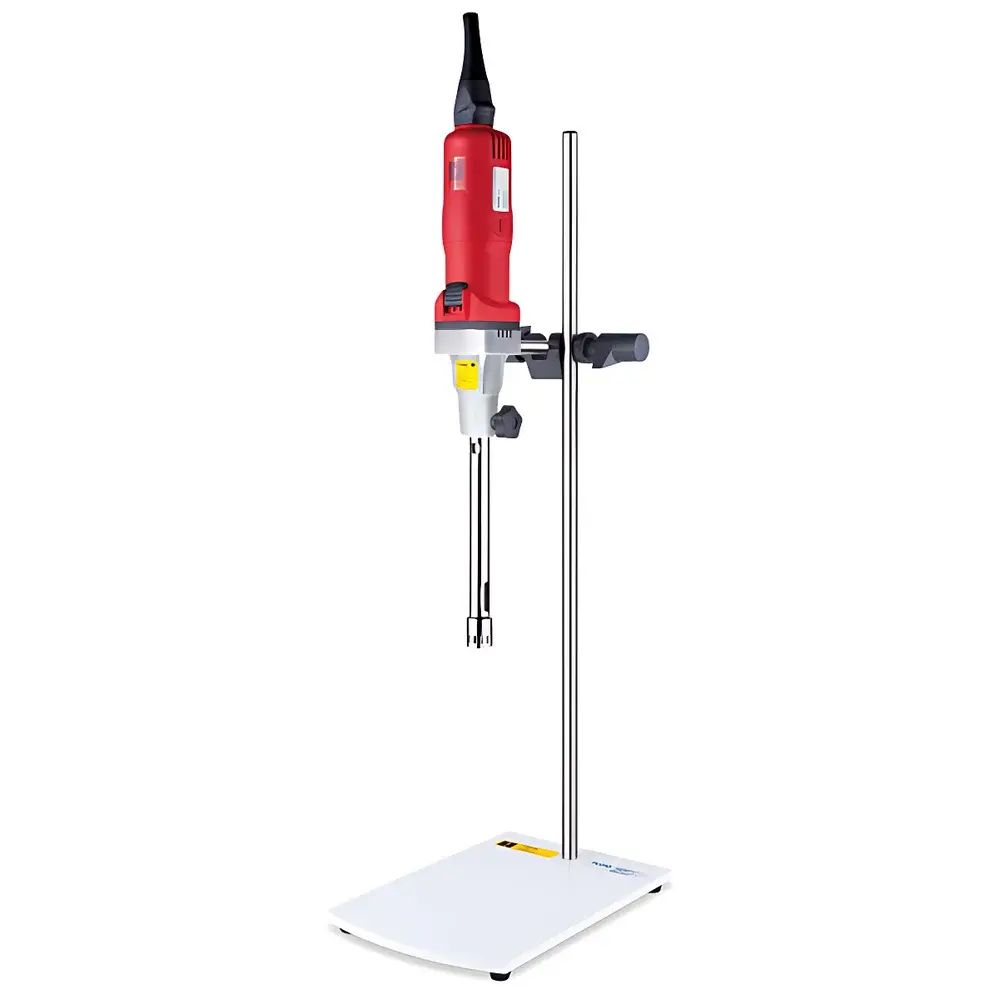
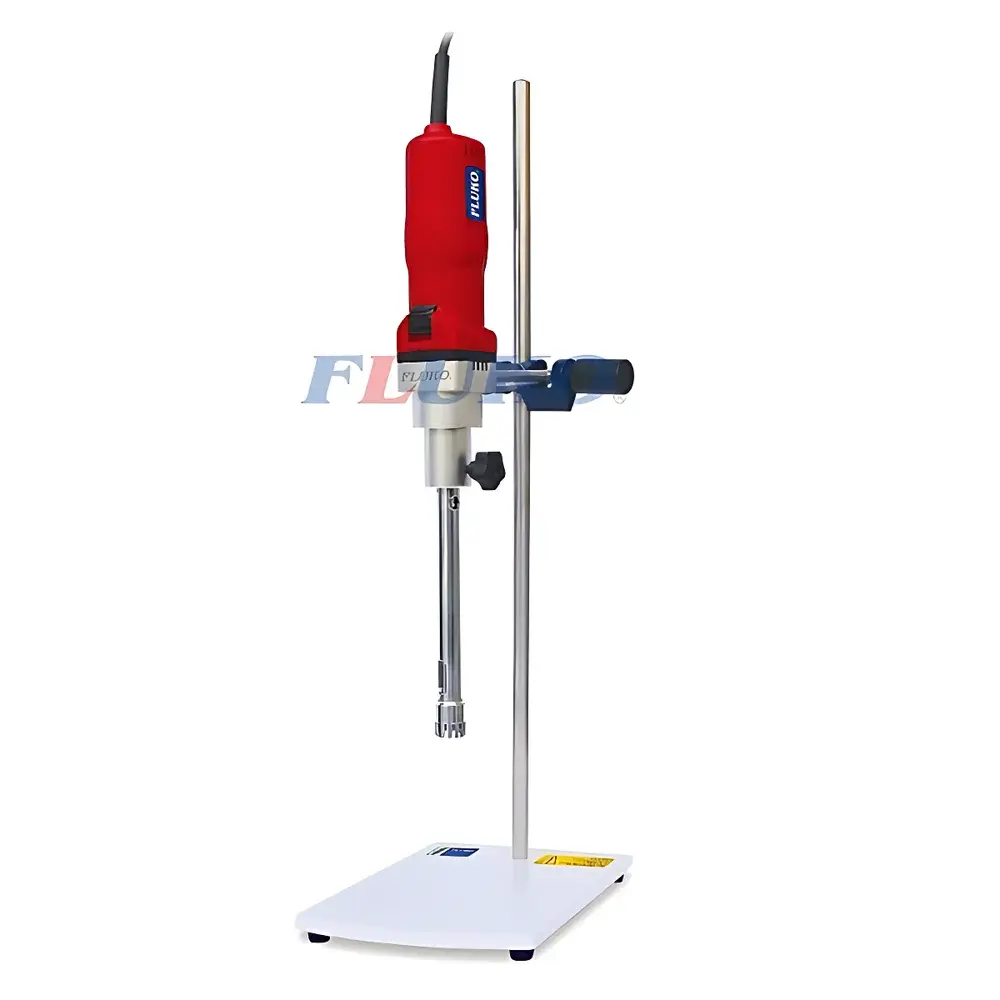
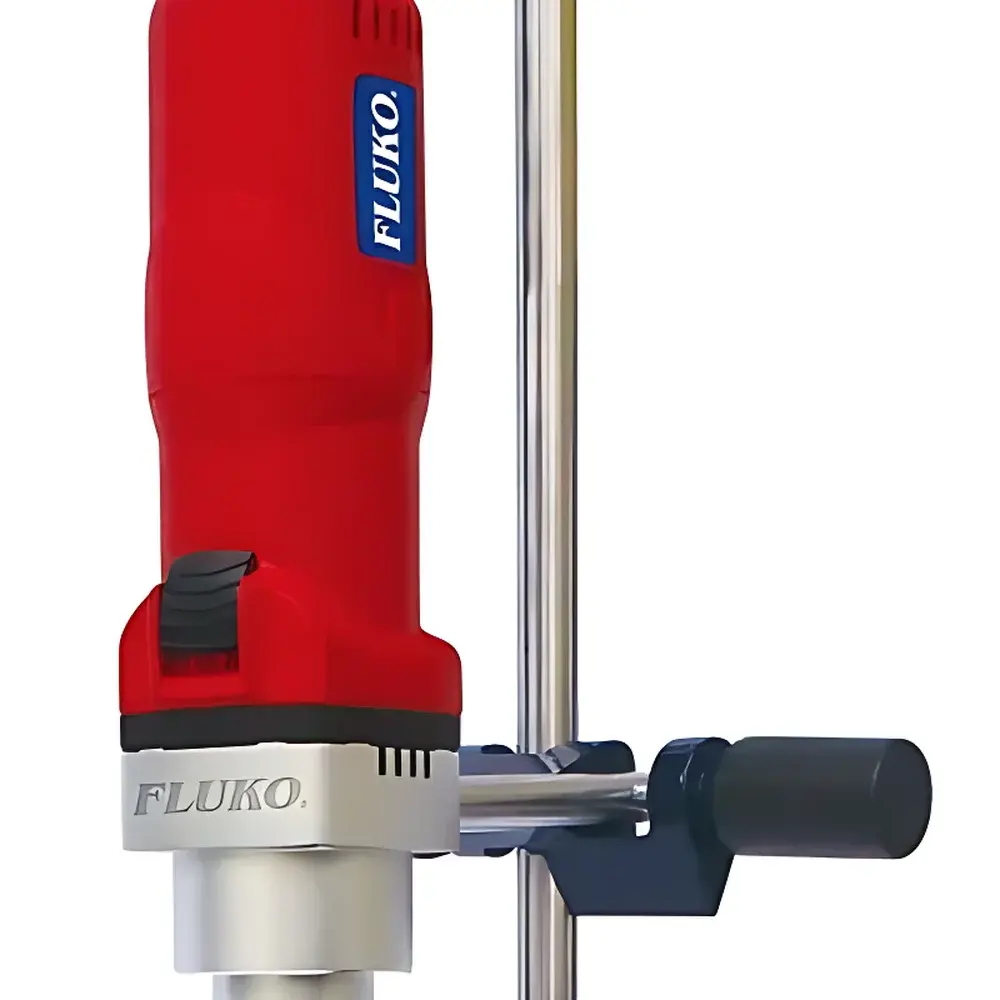
FLUKO FA25 High-Shear Disperser & Homogenizer
| Brand | FLUKO |
|---|---|
| Origin | Shanghai, China |
| Manufacturer Type | Authorized Distributor |
| Product Category | Domestic |
| Model | FA25-052-S |
| Instrument Type | Probe-Type Rotor-Stator Homogenizer |
| Dimensions (W×D×H) | 215 × 310 × 730 mm |
| Processing Volume Range | 0.2–7000 mL (H₂O) |
| Power | 500 W |
| Voltage/Frequency | 220 V, 50 Hz / 110 V, 60 Hz |
| Speed Range (No-Load) | 10,000–28,000 rpm |
| Max. Viscosity | 8,000 cP |
| Speed Display | Digital |
| Speed Control | Continuous Variable |
| Wetted Materials | SS316L |
| Shaft Sleeve Material | PTFE |
| Standard Probe | 25F |
| Ambient Temperature Range | 5–40 °C |
| Relative Humidity Limit | ≤80% |
| Process Mode | Batch |
| Stand & Base | Included |
| Weight | ~7.1 kg |
Overview
The FLUKO FA25 High-Shear Disperser & Homogenizer is an engineered laboratory-scale rotor-stator system designed for reproducible, scalable high-intensity mixing, emulsification, dispersion, and cell disruption. Operating on the principle of controlled hydrodynamic shear generated between a rapidly rotating probe tip and a fixed stator sleeve, the FA25 delivers consistent energy input across variable sample volumes. Its modular architecture supports rapid probe interchangeability—enabling seamless transition between low-volume tissue homogenization and high-volume emulsion preparation—without compromising mechanical stability or thermal management. The device is not intended for continuous-flow operation but excels in batch-mode processing where precise control over shear rate, residence time, and temperature-sensitive integrity is required.
Key Features
- 500 W brushless motor delivering stable torque output up to 28,000 rpm (no-load), with digital speed display and infinitely variable electronic speed control
- Rotor-stator geometry optimized for high shear stress generation—achieving linear tip speeds up to 27 m/s at maximum rotation
- SS316L wetted components ensure corrosion resistance and compliance with ISO 8573-1 and USP Class VI material compatibility requirements for pharmaceutical and biotech applications
- PTFE shaft sleeve provides chemical inertness, low friction, and thermal insulation—critical for extended operation with heat-sensitive samples
- Modular probe system compatible with multiple interchangeable heads (e.g., 25F standard probe, micro-probes, high-viscosity anchors); all probes feature precision-machined clearance tolerances ≤0.2 mm
- Integrated support stand with adjustable height and clamping mechanism ensures vibration-damped positioning during prolonged operation
- Compact footprint (215 × 310 × 730 mm) and lightweight design (~7.1 kg) facilitate placement in biosafety cabinets, cold rooms, or shared instrumentation suites
Sample Compatibility & Compliance
The FA25 accommodates aqueous, organic, and semi-solid matrices—including cell suspensions, polymer solutions, nanoemulsions, and soft tissue homogenates—within its validated volume range of 0.2–7000 mL (water-equivalent). It meets general-purpose laboratory safety standards per IEC 61010-1:2010 and carries CE marking for electromagnetic compatibility (EMC Directive 2014/30/EU). While not certified for GMP manufacturing environments, its construction supports GLP-aligned documentation practices: traceable probe lot numbers, material certifications (EN 10204 3.1), and calibration-ready speed verification protocols. For regulated workflows involving drug product development or analytical reference standards, users may implement instrument-specific SOPs referencing ASTM D4290 (emulsion stability testing) and ISO 13320 (particle size analysis pre-treatment).
Software & Data Management
The FA25 operates as a standalone analog-controlled instrument without embedded firmware or network connectivity. Speed settings are manually selected via front-panel rotary encoder; no data logging, USB export, or remote interface is provided. However, its consistent mechanical response enables integration into externally monitored workflows: analog tachometer outputs (0–10 V) can be interfaced with third-party DAQ systems for real-time RPM logging, and external temperature probes (e.g., Pt100) may be positioned adjacent to the vessel to correlate shear input with thermal drift. For audit-ready environments, users are advised to maintain manual logbooks recording probe ID, speed setpoint, duration, sample identity, and environmental conditions—supporting 21 CFR Part 11–compliant record retention when paired with scanned signatures and version-controlled templates.
Applications
- Pre-analytical sample preparation: lysis of mammalian, bacterial, and plant cells for protein extraction or nucleic acid isolation
- Formulation development: oil-in-water and water-in-oil emulsions for topical, oral, or injectable dosage forms
- Nanomaterial dispersion: deagglomeration of carbon nanotubes, metal oxides, and layered silicates in polymeric or aqueous carriers
- Food science research: stabilization of functional ingredient suspensions (e.g., curcumin, resveratrol) and texture-modified emulsions
- Materials science: blending of conductive fillers into thermoplastic matrices prior to rheological or mechanical testing
- Veterinary diagnostics: homogenization of tissue biopsies for pathogen detection assays requiring uniform analyte distribution
FAQ
What is the minimum recommended sample volume for reliable operation with the 25F probe?
For optimal shear transfer and vortex suppression, a minimum working volume of 100 mL is recommended when using the standard 25F probe. Volumes below 50 mL require use of micro-probes (e.g., 10F or 12F) to maintain consistent energy density.
Can the FA25 be used with corrosive solvents such as chloroform or concentrated acids?
SS316L and PTFE offer broad chemical resistance, but exposure to halogenated solvents above 60 °C or strong oxidizers (e.g., >30% HNO₃) is not advised without prior compatibility validation per ASTM D543 guidelines.
Is speed calibration traceable to national standards?
FLUKO provides factory calibration certificates (NIST-traceable tachometer verification) upon request; users should perform periodic verification using an optical tachometer calibrated against ISO/IEC 17025-accredited references.
Does the FA25 support sterile processing?
The 25F probe and SS316L housing are autoclavable at 121 °C for 20 minutes (steam sterilization only); PTFE components must be replaced after repeated autoclaving due to creep deformation.
How does ambient humidity affect long-term reliability?
Operation above 80% RH may accelerate electrical contact oxidation and reduce motor brush life; use in climate-controlled labs (≤60% RH) is recommended for >5,000-hour service intervals.



