
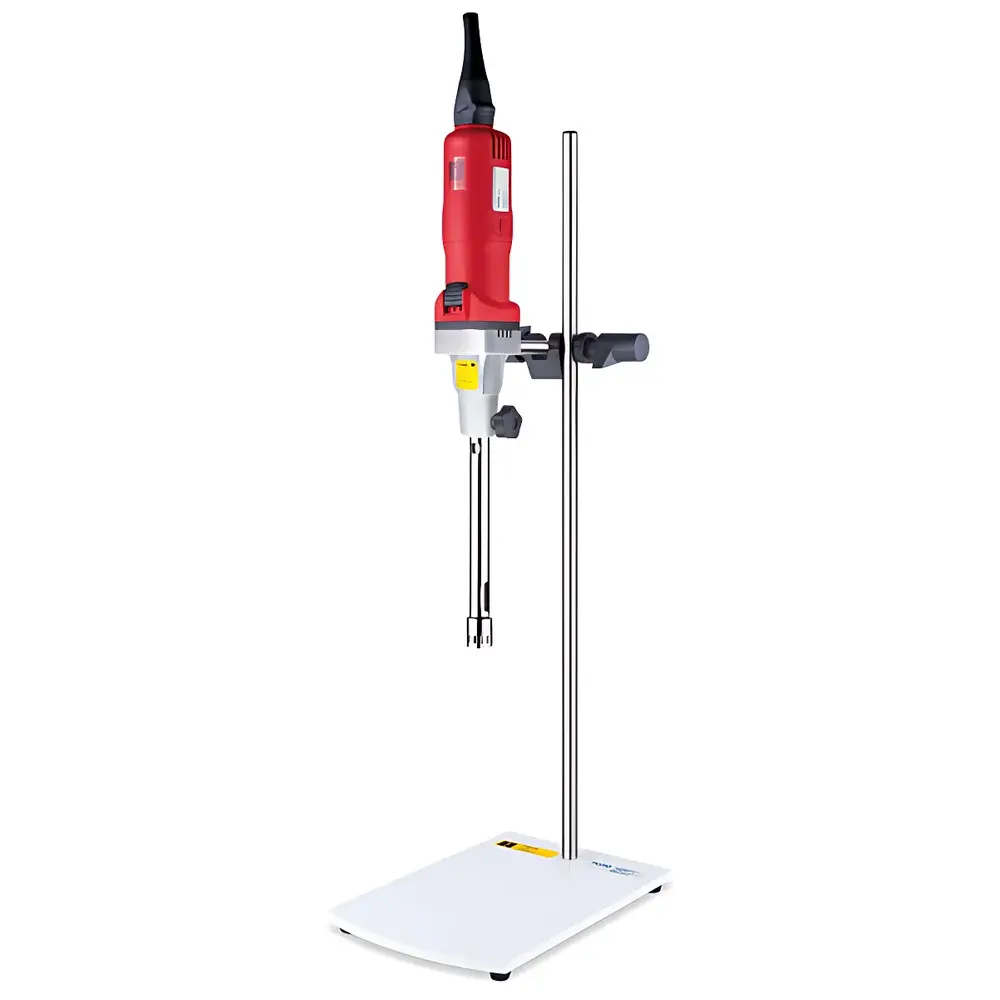
FLUKO FA25 High-Shear Dispersion Homogenizer
| Brand | FLUKO |
|---|---|
| Origin | Shanghai, China |
| Model | FA25-001-S |
| Instrument Type | Probe-type rotor-stator homogenizer |
| Dimensions (W×D×H) | 215 × 310 × 730 mm |
| Processing Volume | 0.2–7000 mL |
| Power | 500 W |
| Voltage/Frequency | 220 V, 50 Hz |
| Speed Range (no-load) | 10,000–28,000 rpm |
| Max. Tip Speed | 27 m/s |
| Viscosity Limit | 8,000 cP |
| Material in Contact | SS316L |
| Shaft Sleeve Material | PTFE |
| Display | Digital speed readout |
| Speed Control | Continuous electronic adjustment |
| Operating Temperature | 5–40 °C |
| Relative Humidity Limit | ≤80% |
| Duty Cycle | Continuous operation |
| Weight | ~7.1 kg |
Overview
The FLUKO FA25 High-Shear Dispersion Homogenizer is a precision-engineered laboratory-scale rotor-stator system designed for reproducible, scalable high-shear processing of liquid and semi-liquid samples. Based on the Couette flow principle, it generates intense hydrodynamic shear forces through controlled relative motion between a rapidly rotating rotor and a stationary stator—enabling efficient particle size reduction, emulsification, cell disruption, and homogenization across diverse sample matrices. Its modular architecture supports rapid interchange of probe geometries to match specific process requirements, from low-volume micro-homogenization (down to 0.2 mL) to batch processing up to 7 L. The FA25 series is widely deployed in R&D laboratories for formulation development, quality control, and preclinical sample preparation where consistent energy input, minimal thermal load, and traceable operational parameters are critical.
Key Features
- High-performance 500 W brushless motor delivering stable torque across the full speed range (10,000–28,000 rpm), with tip speeds up to 27 m/s for effective mechanical dispersion.
- Digital speed display and continuous electronic speed control ensure precise, repeatable setpoint execution—essential for method transfer and regulatory compliance.
- Modular probe system compatible with six standardized rotor-stator configurations (6G, 8G, 10G, 18F, 25F), each optimized for distinct volume ranges, viscosity profiles, and application objectives.
- Wetted parts constructed from electropolished SS316L stainless steel and PTFE shaft sleeves—ensuring chemical resistance, cleanability, and compatibility with GLP/GMP environments.
- Robust aluminum-alloy housing with integrated cooling fins and low-noise design enables extended continuous operation without thermal derating.
- Standardized mounting interface supports universal clamping on laboratory stands; all kits include adjustable support arm, universal clamp, and base plate for stable positioning.
Sample Compatibility & Compliance
The FA25 accommodates aqueous, organic, and biphasic systems—including suspensions, emulsions, colloids, polymer solutions, biological lysates, and tissue homogenates. Its validated performance spans viscosities up to 8,000 cP and solids content up to 40% w/w, depending on probe selection and process duration. The instrument meets general safety requirements per IEC 61010-1 for laboratory electrical equipment. While not certified to ISO/IEC 17025 or FDA 21 CFR Part 11 out-of-the-box, its digital speed logging, stable calibration traceability, and material documentation support integration into auditable workflows compliant with ISO 9001, USP , and internal SOPs governing analytical sample preparation.
Software & Data Management
The FA25 operates as a standalone benchtop device with no embedded software or network connectivity. Speed settings and runtime are manually controlled and monitored via front-panel digital display. For laboratories requiring audit trails, optional external data loggers can capture real-time RPM output via analog voltage signal (0–10 V). All models ship with comprehensive technical documentation—including CE Declaration of Conformity, material certificates for wetted components, and maintenance protocols aligned with ISO 13485 principles for instrument lifecycle management.
Applications
- Preparation of nanoemulsions and submicron dispersions for pharmaceutical and cosmetic formulations.
- Cell lysis and nuclear extraction from mammalian, bacterial, and yeast cultures under controlled shear conditions.
- Homogenization of plant and animal tissues for proteomic, genomic, and metabolomic analysis.
- Dispersion of nanomaterials (e.g., graphene oxide, metal oxides) into polymer matrices and solvents.
- Rapid deagglomeration of pigments, fillers, and catalysts in R&D-scale coating and adhesive development.
- Batch standardization of reference suspensions used in particle sizing validation (ISO 13320, ASTM D446).
FAQ
What is the minimum and maximum processing volume for the FA25-001-S configuration?
The 6G probe (FA25-001-S) is optimized for volumes between 0.2 mL and 10 mL, making it suitable for micro-scale homogenization of precious or highly potent samples.
Can the FA25 be used for sterile applications?
Yes—provided that sterilizable probes (e.g., autoclavable 6G/10G heads) are selected and validated per ISO 17665; SS316L construction and smooth surface finish support routine SIP and CIP procedures.
Is speed calibration traceable to national standards?
FLUKO provides factory calibration reports with uncertainty statements referenced to NIST-traceable tachometers; users may perform periodic verification using calibrated handheld laser tachometers.
Does the FA25 support variable-speed ramping or programmable protocols?
No—the FA25 does not feature built-in programmable logic or ramp profiles; speed adjustments must be made manually during operation.
How often should the rotor-stator assembly be inspected or replaced?
Inspection is recommended after every 200 hours of cumulative use or following processing of abrasive or high-solids-content samples; typical service life exceeds 1,000 hours under standard aqueous conditions with proper cleaning.



