
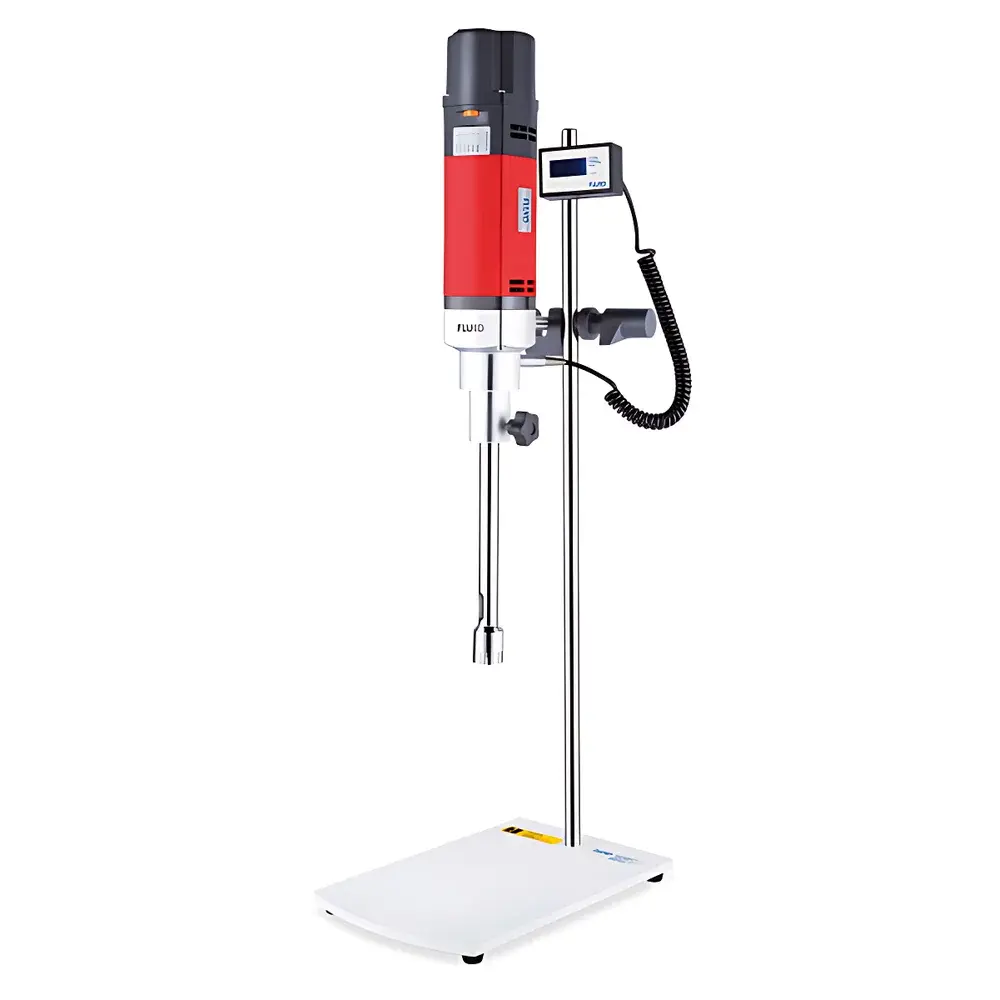
FLUKO FA30D-111-S High-Shear Dispersing Homogenizer
| Brand | FLUKO |
|---|---|
| Origin | Shanghai, China |
| Model | FA30D-111-S |
| Instrument Type | Probe-type Rotor-Stator Homogenizer |
| Dimensions (W×D×H) | 215 × 310 × 730 mm |
| Processing Volume | 0.2–10,000 mL |
| Power | 1050 W |
| Voltage/Frequency | 220 V, 50/60 Hz |
| Speed Range | 3500–25,000 rpm |
| Max. Tip Speed | 35 m/s |
| Max. Viscosity | 8000 cP |
| Display | Digital RPM Readout |
| Speed Control | Continuous Variable |
| Wetted Materials | SS316L |
| Shaft Sleeve Material | PTFE |
| Standard Probe | 30G |
| Ambient Temperature Range | 5–40 °C |
| Relative Humidity Limit | ≤80% |
| Protection Class | IP20 |
| Weight | ~9.8 kg |
Overview
The FLUKO FA30D-111-S is a high-performance, benchtop high-shear dispersing homogenizer engineered for rigorous laboratory-scale processing of complex fluid systems. It operates on the rotor-stator principle—a well-established hydrodynamic mechanism in which a rapidly rotating probe (rotor) generates intense shear gradients within a stationary sleeve (stator), inducing turbulent flow, cavitation, and controlled mechanical disruption. This physics-based action enables efficient particle size reduction, emulsion stabilization, dispersion of nanomaterials, and uniform phase integration across diverse formulations. Designed for reproducible scalability from milliliter to 10-liter volumes, the FA30D-111-S serves as a critical unit operation in formulation development, quality control, and pre-pilot process validation—particularly where consistent microstructure control is required under non-sterile, ambient conditions.
Key Features
- High-torque 1050 W motor delivering stable rotational performance across the full speed range (3500–25,000 rpm), with digital RPM feedback ensuring precise operational repeatability.
- Maximum tip speed of 35 m/s at rated speed, generating localized shear rates exceeding 10⁵ s⁻¹—sufficient to overcome interfacial energy barriers in viscous or structured media up to 8000 cP.
- Modular probe architecture compatible with the FLUKO FA25 series; standard configuration includes the 30G rotor-stator assembly (diameter: 30 mm), optimized for balanced throughput and fine dispersion in volumes ≥50 mL.
- All wetted surfaces constructed from electropolished ASTM A276 SS316L stainless steel, offering superior corrosion resistance and cleanability—essential for compliance with GLP-aligned lab practices and multi-product use.
- PTFE shaft sleeve provides low-friction, chemically inert sealing between drive shaft and stator housing, minimizing thermal buildup and extending service life during extended duty cycles.
- Integrated vertical stand with adjustable clamping and calibrated height positioning supports ergonomic setup, consistent probe immersion depth, and vibration-damped operation.
Sample Compatibility & Compliance
The FA30D-111-S accommodates a broad spectrum of sample types—including aqueous suspensions, oil-in-water and water-in-oil emulsions, polymer solutions, ceramic slurries, pigment dispersions, and biological lysates—within its 0.2–10,000 mL processing envelope. Its design conforms to IEC 61000-6-2 (immunity) and IEC 61000-6-4 (emission) standards for laboratory equipment. While not certified for sterile or GMP manufacturing environments, the unit supports traceable operation under ISO/IEC 17025-accredited testing laboratories when paired with documented calibration procedures for speed and immersion depth. The SS316L/PTFE material set meets USP Class VI biocompatibility requirements for non-implantable contact applications.
Software & Data Management
This analog-controlled homogenizer does not incorporate embedded software or digital data logging. Speed is adjusted via a precision potentiometer with real-time digital RPM display, enabling manual protocol execution with operator-recorded parameters. For audit-ready workflows, users are advised to integrate external timing devices and log speed, duration, probe geometry, and sample volume in electronic lab notebooks (ELNs) compliant with 21 CFR Part 11 requirements. Optional third-party torque sensors or inline particle analyzers may be coupled for correlation studies—though such configurations fall outside FLUKO’s factory validation scope.
Applications
- Preparation of stable nanoemulsions and Pickering emulsions for pharmaceutical excipient screening.
- Dispersion of carbon nanotubes, graphene oxide, or metal oxide nanoparticles into polymeric matrices.
- Rapid homogenization of tissue samples prior to nucleic acid or protein extraction protocols.
- Development and optimization of industrial coatings, inks, adhesives, and functional pastes requiring narrow particle size distribution.
- Viscosity-dependent process mapping for scale-up modeling—leveraging consistent shear rate profiles across FA-series platforms.
FAQ
What is the recommended minimum and maximum fill level for optimal shear transfer?
For the 30G probe, maintain liquid levels between 20 mm and 120 mm above the stator base. Below 20 mm, vortex formation reduces efficiency; above 120 mm, power dissipation increases without proportional shear gain.
Can the FA30D-111-S be used with corrosive solvents such as chlorinated hydrocarbons or strong acids?
SS316L offers moderate resistance to organic solvents but is not suitable for prolonged exposure to hydrochloric, hydrofluoric, or warm sulfuric acid. Consult FLUKO’s chemical compatibility chart before use.
Is routine calibration of the RPM display required?
Yes—annual verification against a NIST-traceable tachometer is recommended to ensure speed accuracy remains within ±2% tolerance, especially for regulated method transfers.
Does the unit support continuous operation beyond 5 minutes?
Continuous duty is permissible up to 10 minutes per cycle at speeds >15,000 rpm; allow ≥15-minute cooldown between cycles to prevent thermal degradation of PTFE components.
How does the FA30D-111-S compare to ultrasonic homogenizers for nanoparticle deagglomeration?
Rotor-stator systems provide higher volumetric throughput and better heat dissipation than ultrasonics, but offer less localized cavitation intensity—making them preferable for scalable dispersion rather than primary particle fracture.



