
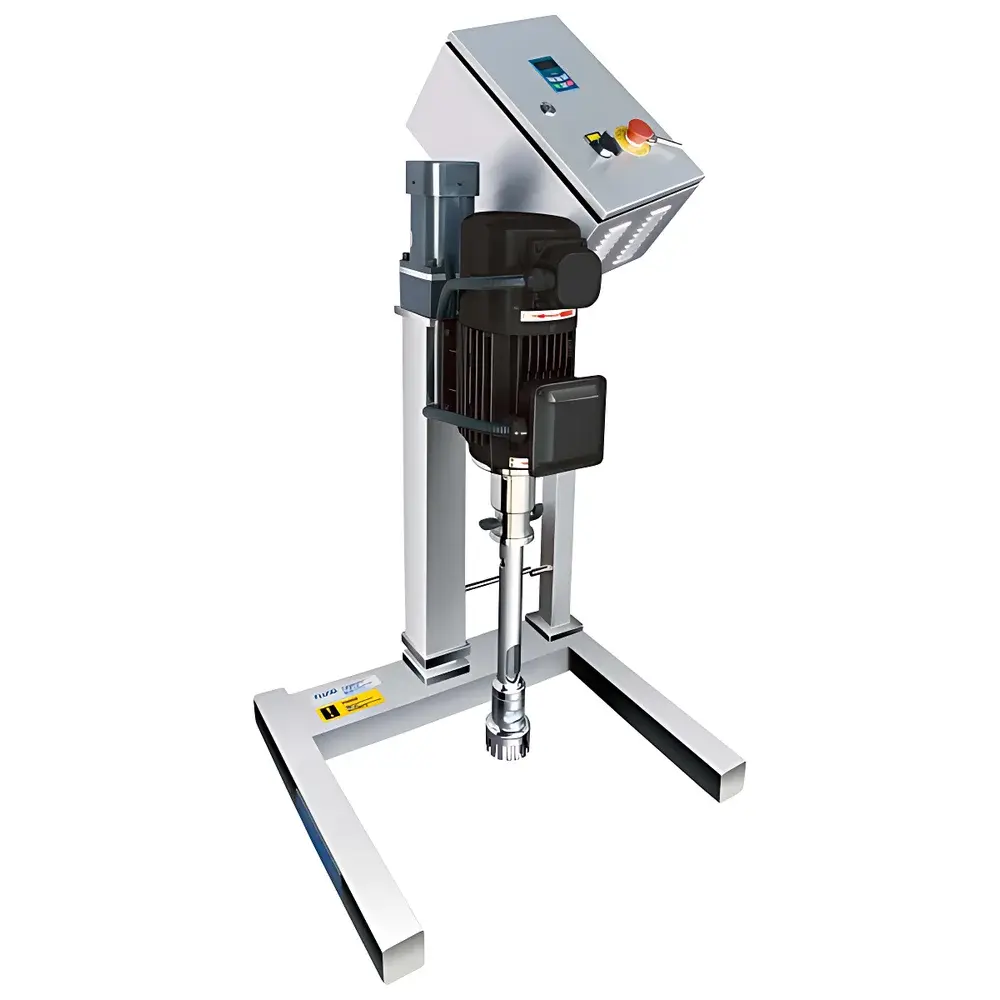
FLUKO FA60-161-E High-Shear Dispersing Emulsifier with Electric Lifting Column
| Brand | FLUKO |
|---|---|
| Origin | Shanghai, China |
| Manufacturer Type | Authorized Distributor |
| Country of Origin | China |
| Model | FA60-161-E |
| Instrument Type | Probe-type Rotor-Stator Homogenizer |
| Dimensions (W×D×H) | 500 × 400 × 915 mm |
| Processing Volume | 5–30 L |
| Power | 750 W |
| Voltage/Frequency | 220 V, 50 Hz |
| Speed Range | 300–6000 rpm |
| Speed Display | Digital |
| Speed Control | Frequency Inverter |
| Contact Material | SS316L |
| Shaft Sleeve Material | PTFE |
| Standard Working Head | 60F |
| Ambient Temperature Range | 5–40 °C |
| Relative Humidity Limit | ≤80% |
| Motor Protection Rating | IP54 |
| Overload Protection | Integrated |
| Operation Mode | Batch |
| Lift Mechanism | Electric Column (Stroke: 350 mm) |
| Frame & Base Material | SS304 |
| Weight | ~35 kg |
Overview
The FLUKO FA60-161-E is a laboratory-scale high-shear dispersing emulsifier engineered for scalable process development and pilot-stage formulation validation. It operates on the rotor-stator principle—where a rapidly rotating probe (rotor) generates intense hydrodynamic shear within a fixed stator sleeve—enabling efficient particle size reduction, droplet breakup, and interfacial stabilization in multiphase systems. Designed to bridge the gap between benchtop experimentation and industrial-scale production, the FA60-161-E supports reproducible batch processing of volumes from 5 to 30 L, making it suitable for applications ranging from pharmaceutical emulsion screening and cosmetic formulation optimization to battery slurry dispersion and advanced material synthesis. Its modular architecture allows seamless transition from small-scale feasibility studies to engineering data generation required for equipment specification and scale-up modeling.
Key Features
- Integrated frequency inverter drive delivering precise, stepless speed control across 300–6000 rpm with real-time digital RPM readout—critical for correlating shear rate (s⁻¹) with rheological outcomes.
- Electric lifting column with 350 mm stroke and SS304 structural frame, enabling repeatable vertical positioning of the rotor-stator assembly for consistent immersion depth and shear zone geometry.
- Interchangeable working heads—including the standard 60F rotor-stator configuration—supporting application-specific optimization for emulsification, dispersion, homogenization, or solid-liquid suspension without hardware replacement of the main drive unit.
- Wetted parts constructed from electropolished SS316L and chemically inert PTFE shaft sleeves, ensuring compatibility with mildly aggressive solvents, aqueous surfactant systems, and pH-sensitive formulations under GLP-aligned handling protocols.
- IP54-rated motor housing with built-in thermal overload protection, supporting continuous operation in standard laboratory environments (5–40 °C, ≤80% RH) without forced cooling or external ventilation.
- Compact footprint (500 × 400 × 915 mm) and 35 kg mass facilitate integration into fume hoods, laminar flow cabinets, or ISO-classified cleanroom-adjacent prep areas.
Sample Compatibility & Compliance
The FA60-161-E accommodates Newtonian and non-Newtonian fluids up to 5000 cP viscosity, including polymer solutions, pigment dispersions, nanoemulsions, and ceramic slurries. Its SS316L/PTFE contact surface meets USP Class VI biocompatibility criteria for preliminary excipient compatibility assessment. While not certified to IEC 61000-6-2/6-4 or FDA 21 CFR Part 11 out-of-the-box, the system’s analog speed interface and absence of embedded data storage allow full alignment with GMP-compliant SOPs when operated within validated procedural controls. It supports ASTM D2703 (Standard Test Method for Determining Emulsion Stability), ISO 7502 (Emulsions—Determination of Droplet Size Distribution), and ISO 13320 (Laser Diffraction Particle Size Analysis) sample preparation workflows.
Software & Data Management
The FA60-161-E operates as a standalone electromechanical instrument with no onboard firmware or proprietary software dependency. Speed setpoints and runtime are manually configured via front-panel controls; all operational parameters—including actual RPM, duration, and head type—are documented externally per laboratory record-keeping requirements. For traceability in regulated environments, users may integrate optional third-party data loggers (e.g., Omega OM-DAQPRO-5300) connected to the analog tachometer output. Audit trails, electronic signatures, and metadata tagging require external LIMS or ELN integration—consistent with ALCOA+ principles for raw data integrity.
Applications
- Pharmaceutical: Pre-formulation of oil-in-water microemulsions, nanoparticle suspensions, and topical gel bases requiring narrow polydispersity index (PDI < 0.3).
- Chemical: Carbon black dispersion in elastomer masterbatches, pigment grinding in water-based coatings, and catalyst slurry deagglomeration prior to spray drying.
- Food & Nutraceuticals: Soy lecithin-stabilized omega-3 emulsions, protein-fortified beverage bases, and functional ingredient encapsulation matrices.
- Energy Materials: Uniform dispersion of conductive carbon additives in Li-ion cathode slurries (NMC, LFP), minimizing agglomerate-induced electrode defects.
- Academic Research: Fundamental studies of shear-induced coalescence kinetics, interfacial tension relaxation, and turbulent energy dissipation in stirred multiphase reactors.
FAQ
What is the maximum viscosity this unit can process?
The FA60-161-E is rated for fluids up to 5000 cP at 300 rpm with the 60F head; performance beyond this threshold depends on density, thermal load, and duty cycle.
Can the FA60-161-E be used for sterile processing?
No—this model lacks steam-in-place (SIP) capability, autoclavable head assemblies, or ISO 5-certified sealing; it is intended for non-sterile R&D and pilot work.
Is speed calibration traceable to NIST standards?
The digital tachometer is factory-calibrated; users may perform periodic verification using an independent optical tachometer referenced to NIST-traceable standards.
Does FLUKO supply IQ/OQ documentation packages?
Yes—validated installation qualification (IQ) and operational qualification (OQ) protocols are available upon request for GMP-regulated installations.
How does rotor-stator geometry affect droplet size distribution?
Smaller stator orifice diameters and tighter rotor-stator clearances increase local shear rate and promote narrower Dv₅₀ distributions, but require careful torque management to avoid motor saturation at high viscosities.



