
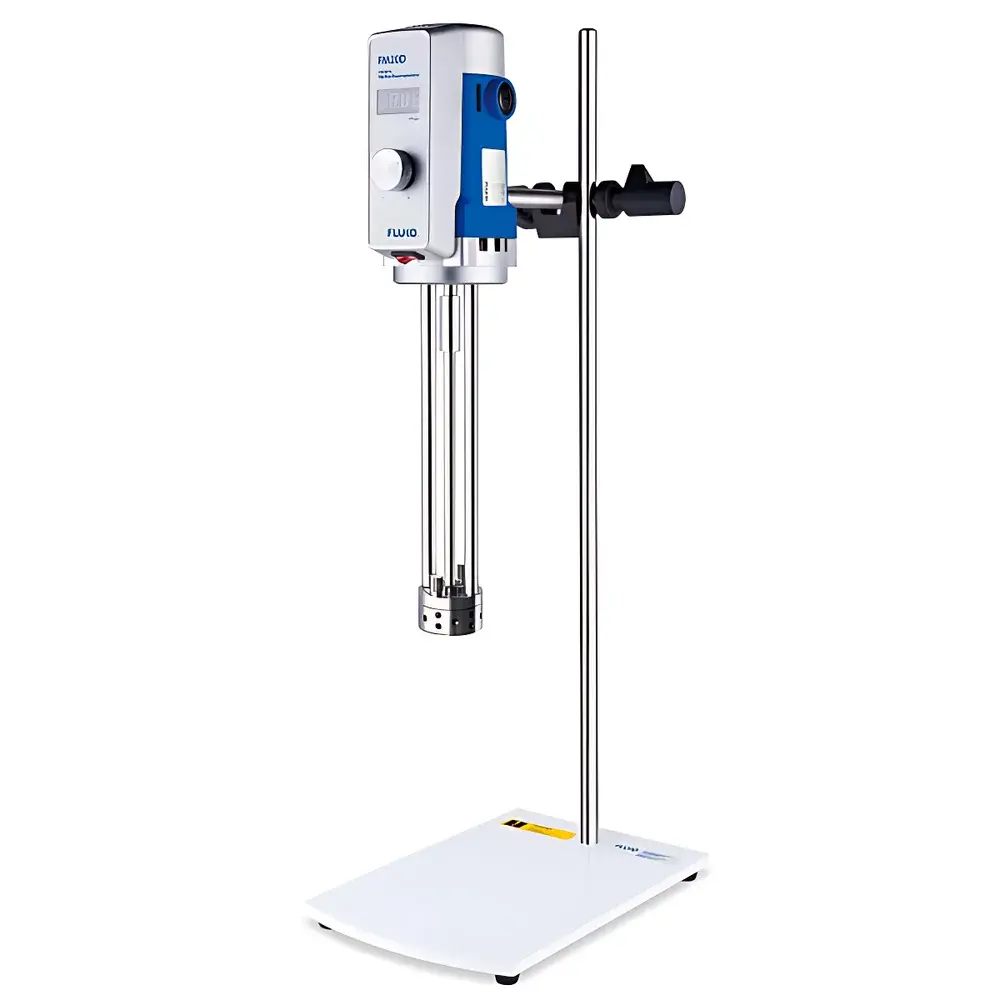
FLUKO FM20D-S-S Digital Display High-Shear Disperser and Homogenizer
| Brand | FLUKO |
|---|---|
| Origin | Shanghai, China |
| Model | FM20D-S-S |
| Instrument Type | Probe-type Rotor-Stator Homogenizer |
| Dimensions (W×D×H) | 210 × 290 × 675 mm |
| Processing Volume | 150–3000 mL |
| Power | 500 W |
| Voltage/Frequency | 220 V, 50 Hz |
| Speed Range | 2000–14,000 rpm |
| Speed Display | Digital LED |
| Speed Control | Continuously Variable |
| Torque Output | High |
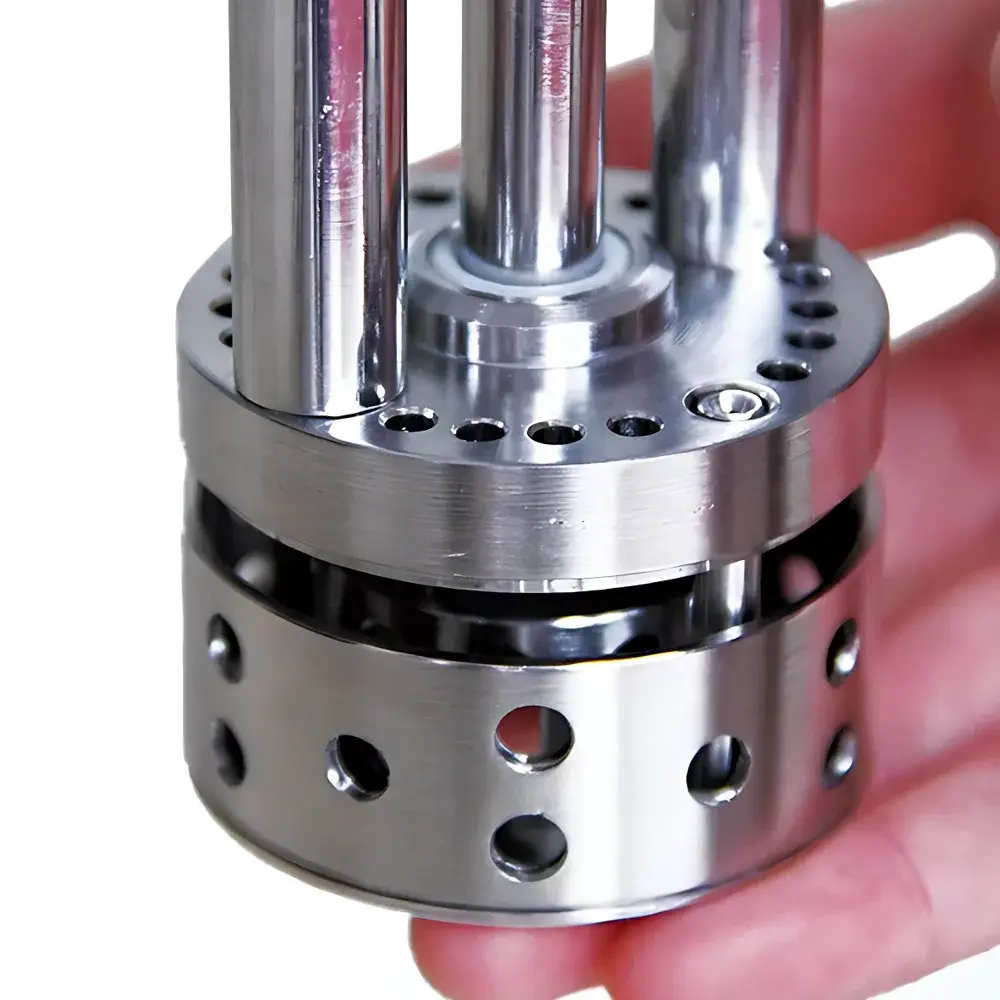
| Rotor-Stator Configuration | Dual-stator design |
| Wetted Materials | SS316L |
| Shaft Sleeve Material | Copper Alloy |
| Max. Viscosity | 5000 cP |
| Ambient Temperature Range | 5–40 °C |
| Relative Humidity Limit | ≤80% |
| Operation Mode | Batch |
| Weight | ~10 kg |
Overview
The FLUKO FM20D-S-S is a digitally controlled, high-shear rotor-stator homogenizer engineered for precision dispersion, emulsification, and homogenization of moderate-viscosity liquids and solid-in-liquid suspensions in laboratory and pilot-scale environments. Operating on the principle of controlled hydrodynamic cavitation and intense mechanical shear within a narrow rotor-stator gap, the system generates localized energy densities sufficient to break down agglomerates, reduce particle size distribution, and stabilize multiphase systems. Its dual-stator configuration enhances flow recirculation and extends residence time in the high-shear zone—critical for achieving reproducible sub-micron emulsions and uniform colloidal dispersions. Designed for batch-mode operation, the FM20D-S-S delivers consistent performance across variable sample volumes (150–3000 mL), making it suitable for formulation development, quality control testing, and process scalability studies in pharmaceutical, cosmetic, food, and materials science laboratories.
Key Features
- Continuously variable speed control (2000–14,000 rpm) with high-resolution digital LED display for real-time monitoring and precise parameter replication.
- Dual-stator architecture—increases effective shear surface area and improves fluid dynamics compared to single-stator equivalents, resulting in enhanced process efficiency and reduced processing time.
- Interchangeable stator geometries (e.g., fine, medium, coarse) allow optimization for specific applications including nanoparticle dispersion, polymer blending, or cell lysis—without requiring hardware replacement.
- SS316L wetted components ensure chemical resistance, corrosion tolerance, and compliance with material compatibility requirements for GMP-relevant processes.
- Integrated dual safety mechanisms: automatic motor shutdown upon abnormal load detection and mechanical overload protection at the drive shaft interface.
- Robust cast-aluminum housing with vibration-damping base and adjustable support arm; accommodates standard lab stands and clamps for secure vertical alignment during operation.
Sample Compatibility & Compliance
The FM20D-S-S is validated for use with aqueous, organic, and mixed-phase systems up to 5000 cP viscosity. It supports processing of heat-sensitive biologics, thermoplastic polymer melts, ceramic slurries, and nanoemulsion precursors—provided thermal management (e.g., external cooling jackets or ice baths) is applied where required. While not certified to ISO/IEC 17025 or ASTM D4290 as a standalone analytical instrument, its operational repeatability meets internal QC criteria defined under GLP and pre-GMP workflows. All electrical components comply with IEC 61010-1 safety standards for laboratory equipment. Documentation includes CE marking (per 2014/30/EU EMC Directive and 2014/35/EU LVD Directive), RoHS-compliant materials declaration, and traceable calibration certificates for speed output verification.
Software & Data Management
The FM20D-S-S operates as a stand-alone analog-controlled unit without embedded firmware or network connectivity. However, its digital speed readout enables seamless integration with third-party data acquisition systems via analog voltage output (0–10 V) or optional RS-485 interface (available upon request). Users may log rotational speed, run duration, and manual parameter entries into electronic lab notebooks (ELNs) compliant with 21 CFR Part 11 when paired with validated timestamping and user-authenticated entry protocols. Audit trails for speed settings and operational history can be maintained manually or through external PLC-based control modules used in regulated pilot-line setups.
Applications
- Pharmaceutical: Preparation of oil-in-water and water-in-oil microemulsions for drug delivery; dispersion of poorly soluble APIs into nanosuspensions; homogenization of vaccine adjuvant formulations.
- Materials Science: Exfoliation of graphene and MXene nanosheets in solvent systems; deagglomeration of metal oxide nanoparticles (e.g., TiO₂, SiO₂); stabilization of conductive ink precursors.
- Food & Beverage: Development of plant-based dairy alternatives with uniform fat globule distribution; homogenization of functional ingredient suspensions (e.g., curcumin, resveratrol).
- Academic Research: Rheological preconditioning of viscoelastic polymer solutions prior to rheometry; cell disruption studies requiring controlled mechanical lysis without enzymatic or thermal artifacts.
FAQ
What is the recommended maintenance interval for the rotor-stator assembly?
Routine inspection and cleaning after each use are required. Full disassembly, ultrasonic cleaning, and visual inspection for wear or pitting should occur every 200 operating hours or quarterly—whichever comes first.
Can the FM20D-S-S be used for sterile processing?
No. The device lacks steam-in-place (SIP) capability, autoclavable probe assemblies, or ISO Class 5 environmental enclosures. Sterile applications require downstream filtration or integration with aseptic transfer systems.
Is speed calibration traceable to NIST or other national standards?
Yes. Optional factory calibration services include traceable verification against NIST-traceable tachometers, with certificate of calibration issued per ISO/IEC 17025-accredited procedures.
Does FLUKO provide application-specific stator recommendations?
Yes. Technical support documentation includes empirical stator selection guidelines based on viscosity, particle size target, and throughput—validated across >120 published case studies in peer-reviewed journals and technical white papers.
What is the maximum continuous run time at 14,000 rpm?
For thermal stability, continuous operation at top speed is limited to 5 minutes. Extended processing requires duty cycling (e.g., 3 min on / 2 min off) or active cooling of the sample vessel.



