
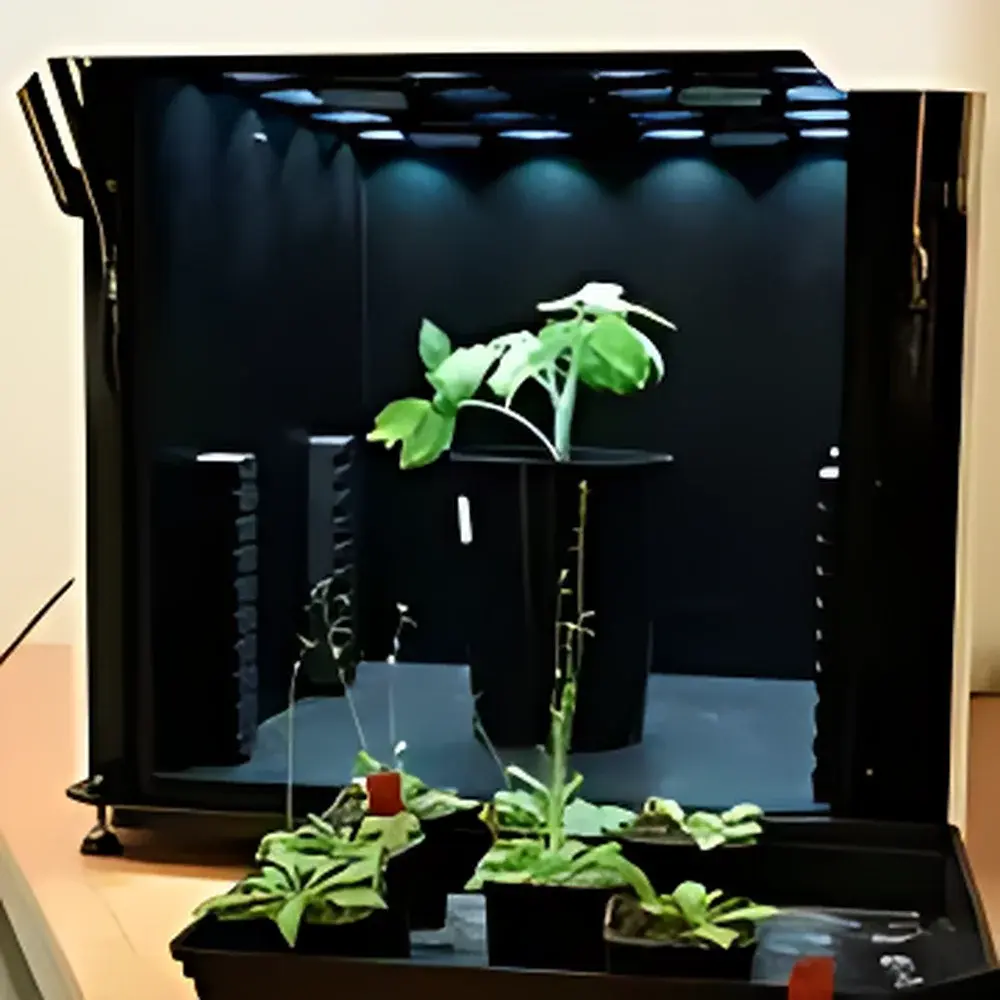
FluorCam-Pro Plant Multispectral Fluorescence Imaging System
| Origin | Czech Republic |
|---|---|
| Manufacturer Type | Authorized Distributor |
| Origin Category | Imported |
| Model | FluorCam-Pro |
| Pricing | Upon Request |
Overview
The FluorCam-Pro Plant Multispectral Fluorescence Imaging System is a high-precision, integrated platform engineered for quantitative, non-invasive, and spatially resolved fluorescence phenotyping of living plant and algal specimens. Built upon the proven FluorCam PAM (Pulse-Amplitude Modulation) chlorophyll fluorescence imaging architecture, the FluorCam-Pro extends functionality through synchronized multispectral excitation and detection across three complementary fluorescence domains: (1) modulated red-light–induced chlorophyll fluorescence for photosynthetic efficiency analysis; (2) UV-induced autofluorescence (F440, F520, F690, F740) for secondary metabolite profiling; and (3) steady-state fluorescence from genetically encoded or exogenously applied fluorophores (e.g., GFP, RFP, YFP, SYBR Green, DAPI). Its core measurement principle relies on time-resolved, wavelength-selective fluorescence capture under controlled illumination regimes—enabling simultaneous acquisition of kinetic, spectral, and spatial fluorescence signatures without mechanical reconfiguration. The system operates within a fully enclosed, light-tight dark-adaptation chamber, ensuring standardized physiological conditions prior to and during measurement—critical for reproducible PSII quantum yield (ΦPSII), NPQ, and quenching parameter derivation per ISO 10211 and ASTM E2912 protocols.
Key Features
- Integrated multispectral excitation: LED-based light sources at 365 nm (UV), 445 nm (cyan), 470 nm (blue), 505 nm (teal), 530 nm (green), 590 nm (amber), 620 nm (red), 735 nm (far-red), and 5700 K white light—fully programmable in intensity, duration, and sequence.
- 7-position motorized filter wheel with factory-calibrated bandpass filters for chlorophyll fluorescence (e.g., >695 nm), UV-excited spectral bands (F440, F520, F690, F740), and fluorophore-specific detection (e.g., GFP: 500–550 nm; RFP: 575–625 nm).
- High-sensitivity CCD camera: 1360 × 1024 pixel resolution, 20 fps maximum frame rate at full resolution, thermoelectrically stabilized sensor for low-noise imaging under low-light conditions.
- Standard imaging area: 20 × 20 cm—optimized for Arabidopsis rosettes, detached leaves, fruit sections, moss mats, microalgal cultures (in wells, droplets, or agar plates), and small whole plants.
- Automated protocol-driven operation: User-defined measurement sequences—including dark adaptation, saturating pulses, actinic light ramps, and multi-wavelength excitation cycles—execute unattended with timestamped data export.
- Comprehensive parameter quantification: >50 chlorophyll fluorescence parameters (Fo, Fm, Fv/Fm, ΦPSII, NPQ_Dn/Ln, qL, ETR, Rfd), UV-induced spectral ratios (Flavonol Index, Anthocyanin Index), and absolute fluorescence intensities (Ft) for each ROI.
Sample Compatibility & Compliance
The FluorCam-Pro accommodates diverse biological samples without fixation or sectioning: intact leaves, floral organs, fruits, seedlings, bryophytes, freshwater/marine microalgae (suspended or surface-grown), macroalgae thalli, and selected animal tissues expressing fluorescent reporters. All measurements are conducted under ambient CO₂ and temperature-controlled conditions, supporting GLP-aligned experimental workflows. Data acquisition and storage comply with FDA 21 CFR Part 11 requirements when deployed with audit-trail-enabled software configurations. Instrument calibration adheres to NIST-traceable photometric standards for irradiance (µmol photons·m⁻²·s⁻¹) and radiance (nW·cm⁻²·sr⁻¹·nm⁻¹), ensuring cross-laboratory comparability per ISO/IEC 17025 guidelines.
Software & Data Management
FluorCam Control & Analysis Software provides a modular, scriptable interface with four primary modules: Live (real-time preview and manual adjustment), Protocols (graphical editor for multistep experiments), Pre-processing (automated or manual ROI segmentation—rectangular, circular, polygonal, or sector-based—with >1000 ROIs supported), and Results (parameter mapping, kinetic curve fitting, statistical comparison, and batch export). Each acquired image series is embedded with EXIF metadata including timestamp, excitation/detection settings, exposure time, and environmental log data. Output formats include TIFF (16-bit), AVI (time-lapse), CSV/Excel (parameter tables), PNG (false-color parameter maps), and PDF reports with embedded histograms and ROI statistics. Raw data files are structured for direct import into MATLAB, Python (via NumPy/Pandas), or R for advanced multivariate modeling.
Applications
- Photosynthetic phenotyping: Quantitative assessment of PSII photochemical efficiency, electron transport rate (ETR), and non-photochemical quenching (NPQ) across genotypes or treatments.
- Abiotic and biotic stress screening: Early detection of drought, heat, heavy metal, or pathogen-induced photoinhibition via kinetic deviations in OJIP transients and NPQ relaxation.
- Secondary metabolism mapping: Spatial quantification of flavonols (F365/F520 ratio) and anthocyanins (F365/F740 ratio) in response to UV-B exposure, nutrient limitation, or developmental cues.
- Transgenic line validation: Co-localized imaging of reporter gene expression (GFP/RFP) and functional photosynthetic status—enabling phenotype–genotype correlation in CRISPR-edited lines.
- Seed vigor and germination monitoring: Time-series fluorescence imaging of embryonic tissue activation, chloroplast development, and metabolic reactivation post-imbibition.
- Algal biotechnology: High-throughput screening of lipid accumulation (via Nile Red co-staining), photosynthetic resilience in photobioreactors, and strain stability under fluctuating light regimes.
FAQ
Does the FluorCam-Pro require hardware modification to switch between chlorophyll fluorescence, UV multispectral, and fluorescent protein imaging modes?
No. All three modalities operate natively within a single optical configuration using software-controlled LED excitation sequencing and motorized filter selection—no manual lens, filter, or light-source replacement is needed.
Can the system quantify absolute concentrations of flavonoids or anthocyanins?
It provides semi-quantitative indices (Flavonol Index, Anthocyanin Index) calibrated against spectrophotometric reference standards. Absolute quantification requires parallel HPLC or LC-MS validation.
Is remote operation and long-term无人值守 monitoring supported?
Yes. Scheduled protocols can run unattended for days or weeks; data are automatically timestamped, archived locally, and optionally synced to network drives or LIMS via configurable export rules.
What compliance documentation is provided for regulated environments?
Factory calibration certificates, IQ/OQ documentation templates, and software validation packages (including 21 CFR Part 11 audit trail configuration guides) are available upon request.
Are custom filter sets or excitation wavelengths available beyond the standard configuration?
Yes. Custom bandpass filters (e.g., for BFP, CFP, mCherry) and narrowband LEDs (±5 nm FWHM) can be integrated under engineering consultation—subject to optical path compatibility verification.




