
Foedisch MCA14-m High-Temperature In Situ Infrared Multicomponent Gas Analyzer
| Brand | Foedisch |
|---|---|
| Origin | Germany |
| Model | MCA14-m |
| Principle | Non-Dispersive Infrared (NDIR) Absorption Spectroscopy |
| Type | Portable |
| Measured Gases | CO, CO₂, NO, NO₂, N₂O, NH₃, SO₂, O₂, CH₄, H₂O, HCl, CH₂O (13 components) |
| Response Time | <10 s |
| Repeatability | ≤1% |
| Operating Temperature | 185–200 °C (sample path & measurement cell) |
| Compliance | CPA Certified |
| Sample Handling | Hot-wet in situ analysis, no drying, dilution or cooling required |
Overview
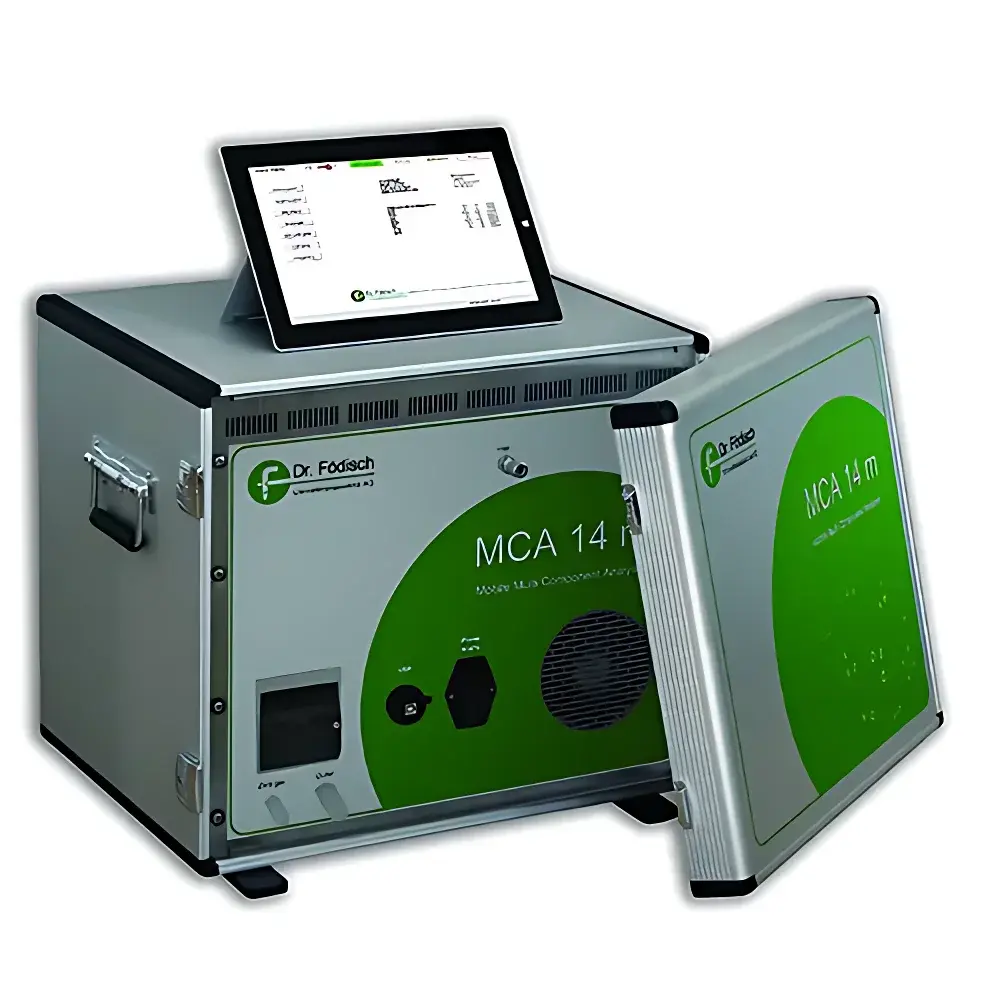
The Foedisch MCA14-m is a high-temperature, in situ infrared multicomponent gas analyzer engineered for regulatory-grade continuous emission monitoring (CEM) and process optimization in demanding industrial and environmental applications. It employs non-dispersive infrared (NDIR) absorption spectroscopy with thermally stabilized optical paths to quantify up to 13 gaseous species—including CO, CO₂, NO, NO₂, N₂O, NH₃, SO₂, O₂, CH₄, H₂O, HCl, and formaldehyde (CH₂O)—in hot, humid, undiluted sample streams. Unlike conventional extractive analyzers requiring gas conditioning (e.g., condensate removal, dilution, or catalytic conversion), the MCA14-m maintains the entire sampling train—including probe, filter, transport line, and measurement cell—at a constant 185–200 °C. This eliminates aqueous-phase dissolution, adsorption losses, and chemical interconversion (e.g., NO₂ ↔ N₂O₄, NH₃ + HCl → NH₄Cl), ensuring quantitative fidelity for reactive and water-soluble analytes such as ammonia, hydrogen chloride, and low-concentration nitrogen oxides post-selective catalytic reduction (SCR).
Key Features
- Full-path high-temperature operation (185–200 °C): prevents condensation, minimizes adsorption on surfaces, and preserves thermodynamic equilibrium of reactive species.
- Multi-range auto-switching per gas component: dynamically selects optimal detection range based on real-time concentration, enhancing signal-to-noise ratio across ppm to % levels.
- Extended optical path (up to 16 m) achieved via gold- and barium fluoride-coated mirrors with ultra-precision polishing—improving detection limits and spectral resolution for trace-level quantification.
- Integrated hot-gas filtration: ceramic filter heated to 185 °C eliminates cold-spot deposition while retaining particulate integrity upstream of the analyzer.
- Real-time cross-interference compensation: proprietary multivariate algorithm corrects for spectral overlap among overlapping IR bands (e.g., NO₂/H₂O, NH₃/CO₂, SO₂/H₂O) without requiring physical scrubbers or secondary sensors.
- Onboard thermal printer and graphical display: supports field-deployable reporting with time-stamped concentration curves, alarm logs, and calibration history.
- CPA (China Metrology Accreditation) certified: meets national metrological verification requirements for legal traceability in Chinese environmental enforcement contexts.
Sample Compatibility & Compliance
The MCA14-m is validated for direct analysis of raw flue gases from coal-fired power plants, waste-to-energy incinerators, cement kilns, ceramic furnaces, and SCR/SNCR-equipped boilers. Its hot-wet methodology complies with ISO 12039, EN 15267-3, and EPA Method 320 for infrared gas analysis, and supports GLP/GMP-aligned data integrity when paired with audit-trail-enabled software configurations. While not inherently compliant with FDA 21 CFR Part 11 out-of-the-box, its firmware architecture permits integration into validated laboratory information management systems (LIMS) supporting electronic signatures and change control protocols. The instrument meets CE marking requirements for electromagnetic compatibility (EMC) and low-voltage directive (LVD), and its stainless-steel wetted materials (316L SS, Inconel) ensure corrosion resistance against acidic condensates and halogen-rich streams.
Software & Data Management
The embedded operating system provides real-time visualization of all measured components with configurable trend plots, statistical summaries (min/max/avg/std dev), and event-triggered data export (CSV, PDF). Internal memory retains ≥30 days of second-by-second measurements at default logging intervals. Optional PC-based software enables remote diagnostics, method validation reports (including linearity, zero/span drift, and interference testing), and automated generation of compliance-ready emissions reports aligned with local regulatory templates (e.g., China’s HJ 75–2017 and HJ 76–2017 standards). All calibration events, parameter changes, and firmware updates are timestamped and logged with user ID attribution—supporting full audit trail functionality for quality assurance frameworks.
Applications
- Regulatory stack testing and continuous emission monitoring (CEMS) for NOₓ, SO₂, NH₃ (ammonia slip), and CO in thermal power, waste incineration, and steel production.
- Post-SCR/SNCR performance verification: accurate low-ppm NO₂ and NH₃ quantification without aqueous loss artifacts.
- Greenhouse gas (GHG) inventory support: simultaneous CH₄, CO₂, N₂O, and H₂O measurement under representative process conditions.
- Combustion efficiency optimization: real-time O₂, CO, and CO₂ feedback for air-fuel ratio tuning in industrial burners and engine test cells.
- R&D process monitoring: kinetic studies of catalytic reactions (e.g., NH₃-SCR, VOC oxidation), photocatalytic degradation, and flue gas desulfurization (FGD) byproduct formation.
- Energy efficiency auditing: boiler and furnace flue gas analysis per ISO 5167 and GB/T 10180 standards.
FAQ
Does the MCA14-m require gas drying or conditioning prior to analysis?
No. It performs true hot-wet in situ analysis—no condensate removal, dilution, or cooling is needed. Water vapor is measured as a component, not removed.
How is cross-sensitivity between overlapping IR absorptions handled?
Through factory-calibrated multivariate spectral deconvolution algorithms, continuously updated during operation using reference spectra libraries.
Can the measurement ranges be customized for specific site requirements?
Yes. Foedisch offers application-specific configuration of upper detection limits and sensitivity tiers per gas channel, subject to optical path and detector constraints.
Is the analyzer suitable for unattended long-term deployment?
Yes. Designed for 24/7 operation with redundant heating control, self-diagnostic routines, and optional uninterruptible power supply (UPS) integration.
What maintenance intervals are recommended for field operation?
Optical window cleaning every 3–6 months depending on particulate load; annual calibration verification with certified span gases; filter element replacement every 12 months under typical industrial conditions.







