
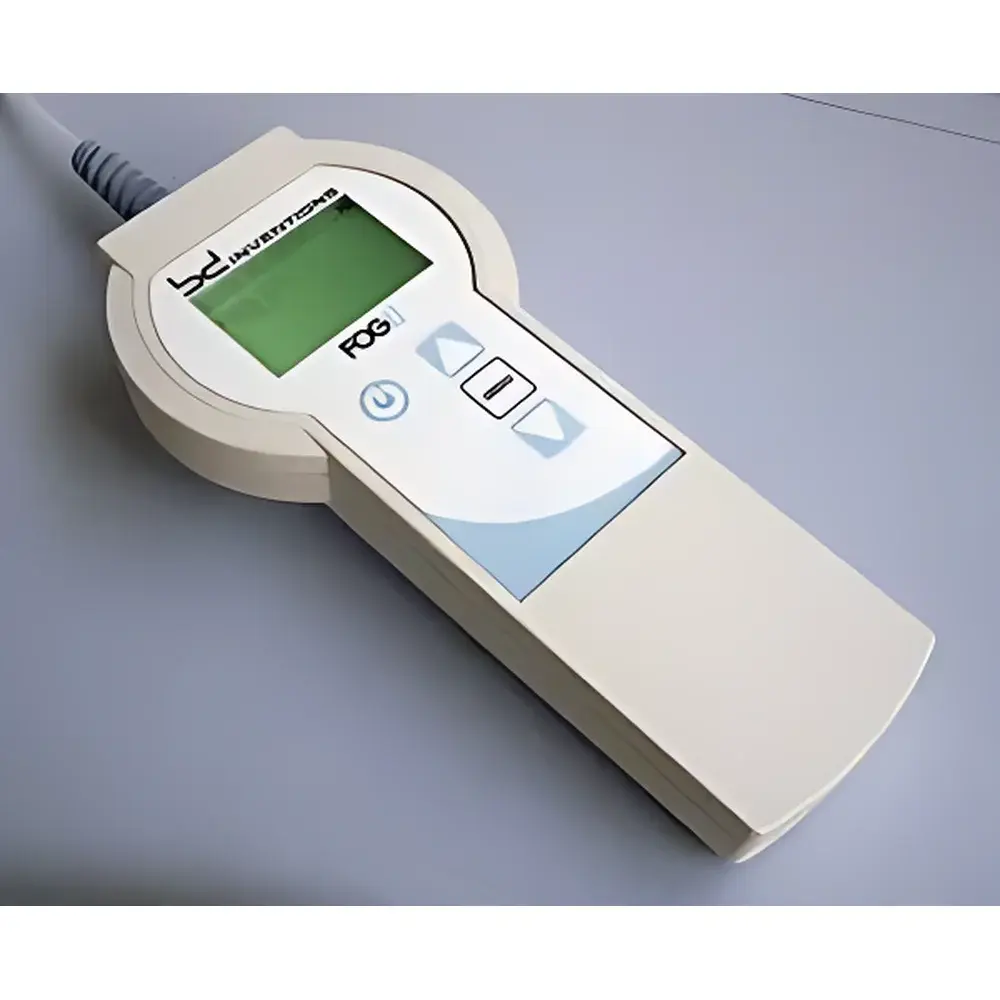
FOGII Digital Soil Calcium Carbonate Analyzer
| Origin | Greece |
|---|---|
| Manufacturer Type | Distributor |
| Origin Category | Imported |
| Model | FOGII |
| Price | USD 5,000 |
| Instrument Type | Contaminant Analyzer |
| Operating Interface | Backlit LCD with Membrane Keypad |
| Power Supply | 3×AA Alkaline or Rechargeable Batteries |
| Measurement Unit | % CaCO₃ |
| Range | 0–100% CaCO₃ |
| Accuracy | ±0.5% CaCO₃ |
| Resolution | 0.1% CaCO₃ |
| Linearity (R²) | 0.999 |
| Temperature Compensation | Built-in Sensor, 5–50°C |
| Reaction Vessel | Borosilicate Glass |
| Sample Mass | 0.5–5 g |
| Analysis Time | ~30 s |
| Data Storage | Last 50 Measurements |
| Ingress Protection | IP65 |
| Dimensions (L×W×H) | 200×94×39 mm |
| Weight | 350 g |
| Housing Material | UL94 HB-rated ABS |
| Keypad Material | PET Polyester Film |
| Display Coating | Scratch-Resistant Resin |
Overview
The FOGII Digital Soil Calcium Carbonate Analyzer is a field-deployable, acid-reaction-based instrument engineered for rapid, quantitative determination of total carbonate content—expressed as calcium carbonate equivalent (% CaCO₃)—in soil samples. It operates on the principle of acid dissolution: a precisely metered volume of hydrochloric acid is reacted with a weighed soil sample inside a sealed borosilicate glass reaction vessel; the evolved CO₂ gas displaces a calibrated liquid column, and the resulting volume change is converted into % CaCO₃ via a pre-calibrated linear algorithm (R² = 0.999). Unlike indirect estimation methods (e.g., pH or electrical conductivity), the FOGII delivers direct, stoichiometric quantification of carbonate minerals—including calcite (CaCO₃), dolomite (CaMg(CO₃)₂), and magnesite (MgCO₃)—critical for assessing soil buffering capacity, cation exchange potential, and long-term fertility management. Its compact, battery-powered architecture enables routine use in agronomic field surveys, ecological monitoring, and land rehabilitation projects without reliance on laboratory infrastructure.
Key Features
- Integrated temperature compensation (5–50°C) using an embedded NTC sensor, ensuring measurement stability across seasonal and geographic field conditions
- Optimized reaction kinetics: complete CO₂ evolution and signal stabilization within ≤30 seconds per analysis
- IP65-rated enclosure with UL94 HB-compliant ABS housing and scratch-resistant resin-coated LCD display—designed for durability in humid, dusty, or rain-exposed environments
- On-device data logging of the most recent 50 measurements with timestamp and sample ID support (via manual entry)
- Non-destructive, single-use glass reaction vessels enabling consistent gas-phase geometry and eliminating cross-contamination risk between samples
- Low-power operation: up to 200 analyses per set of three AA alkaline batteries; compatible with NiMH rechargeables for sustainable deployment
Sample Compatibility & Compliance
The FOGII accepts air-dried, homogenized soil samples ranging from 0.5 g to 5.0 g—covering typical textures from sandy loams to clay-rich vertisols. It is validated for soils containing up to 100% CaCO₃ equivalent, including highly calcareous aridisols and mollisols. The method aligns with ASTM D4373–22 (“Standard Test Method for Carbonate Content of Soils”) and supports ISO 10390:2021 (soil pH and carbonate determinations) workflows. While not a GLP-certified instrument per se, its traceable calibration protocol (using certified CaCO₃ reference standards), linear response (R² ≥ 0.999), and built-in audit trail (stored measurement history) meet baseline requirements for environmental monitoring programs under EPA Region 6 Soil Screening Levels guidance and EU Soil Thematic Strategy reporting frameworks.
Software & Data Management
The FOGII operates as a standalone analyzer with no proprietary software dependency. All measurement data are stored locally in non-volatile memory and can be manually transcribed or exported via optional RS-232 serial interface (available as accessory kit). For integration into farm management information systems (FMIS) or LIMS platforms, ASCII-formatted output supports direct ingestion into Excel, ArcGIS Field Maps, or AgLeader SMS. The device does not implement FDA 21 CFR Part 11 electronic signature functionality, but its immutable measurement log (no edit/delete capability) satisfies basic ALCOA+ principles (Attributable, Legible, Contemporaneous, Original, Accurate) for field-level data integrity in agricultural extension and soil health certification schemes.
Applications
- Agronomic lime requirement assessment prior to precision liming operations
- Monitoring carbonate depletion in acidifying orchard or vineyard soils
- Evaluating pedogenic carbonate accumulation in semi-arid ecosystem restoration
- Quality control of soil amendments in golf course turf management (USGA-spec rootzones)
- Baseline characterization of archaeological or paleosol profiles in environmental archaeology
- Raw material screening in ceramic clay processing—where excess carbonates cause bloating during firing
FAQ
How does the FOGII differentiate between calcium carbonate and magnesium carbonate?
The instrument reports total carbonate content as % CaCO₃ equivalent based on stoichiometric CO₂ yield; it does not speciate CaCO₃ vs. MgCO₃. For mineralogical differentiation, XRD or ICP-OES follow-up is recommended.
Can the FOGII be used on organic-rich or high-sulfide soils?
Organic matter >15% may interfere with acid reaction kinetics; sulfides (e.g., pyrite) generate H₂S gas, which affects displacement accuracy. Pre-treatment (e.g., H₂O₂ oxidation) is advised per ASTM D4373 Annex A2.
Is calibration verification required before each field day?
A daily blank (acid-only run) and one-point check using a 10% CaCO₃ standard are recommended to confirm system integrity; full multi-point calibration is required quarterly or after sensor replacement.
Does the instrument comply with ISO/IEC 17025 for accredited testing labs?
No—the FOGII is intended for field screening and process control, not accredited conformity assessment. Its uncertainty budget (±0.5% CaCO₃) is derived from repeatability studies under controlled conditions, not formal ISO/IEC 17025 validation.
What maintenance is required for long-term reliability?
Annual inspection of the glass reaction vessel seal integrity, cleaning of the CO₂ displacement chamber with ethanol, and verification of keypad membrane conductivity using a multimeter (continuity test at 10 kΩ threshold).







