
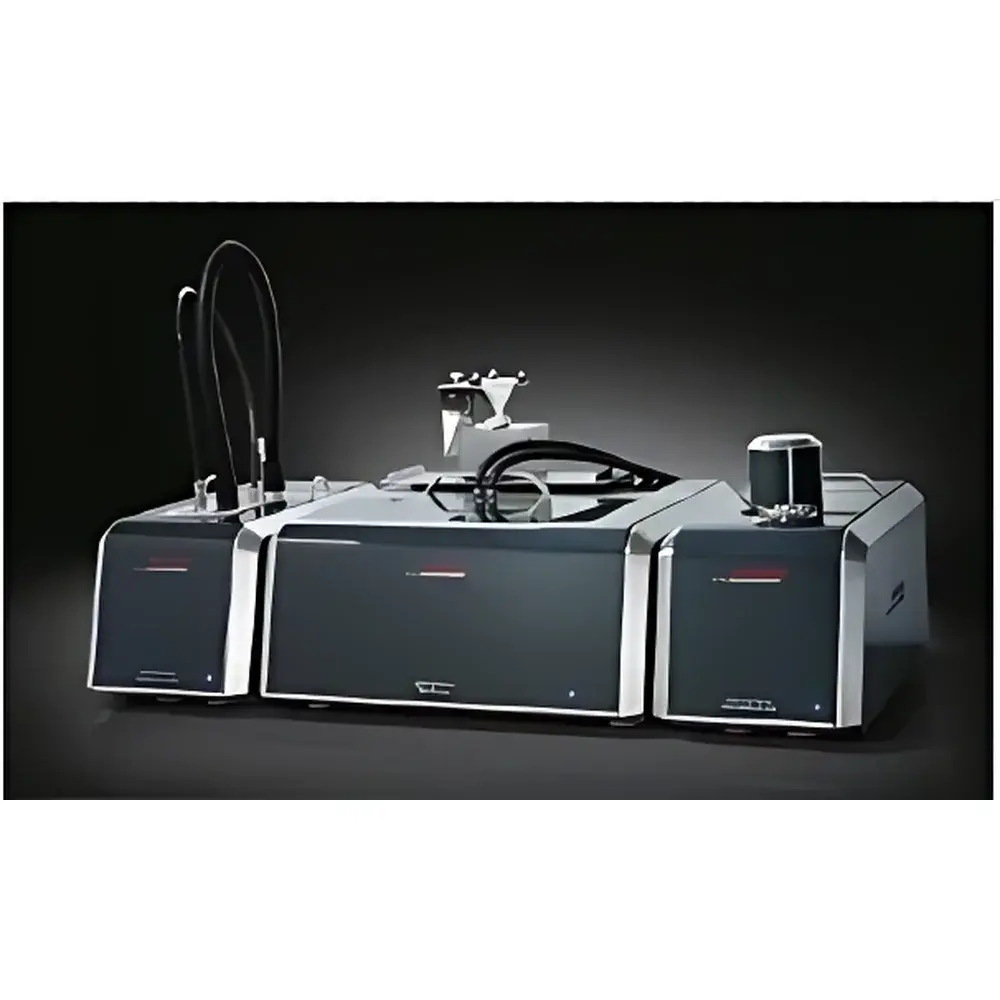
FRITSCH ANALYSETTE 22 Micro Tech/Nano Tech Laser Particle Size Analyzer
| Origin | Germany |
|---|---|
| Manufacturer Type | Authorized Distributor |
| Origin Category | Imported |
| Model | ANALYSETTE 22 Micro Tech / Nano Tech |
| Pricing | Upon Request |
Overview
The FRITSCH ANALYSETTE 22 Micro Tech/Nano Tech Laser Particle Size Analyzer is a high-precision, wet-dispersion laser diffraction instrument engineered for rapid, reproducible particle size distribution (PSD) analysis of suspensions and emulsions across research, development, and quality control environments. Based on the Mie scattering theory and compliant with ISO 13320:2020 (“Particle size analysis — Laser diffraction methods”), the system employs a patented inverse Fourier optical design to maximize detection sensitivity—particularly for submicron and nanoscale particles. Its dual- or triple-laser configuration (532 nm green and 940 nm infrared, with Nano Tech adding a second 532 nm source) enables extended dynamic range and enhanced signal-to-noise ratio across broad size distributions. All lasers meet EN 60825-1:2014 Class 1 safety requirements, ensuring operator safety without requiring interlocks or protective enclosures.
Key Features
- Patented inverse Fourier optical layout with motorized, auto-positioning sample cell—ensures full angular scattering capture and optimal resolution down to 10 nm (Nano Tech variant)
- Compact optical bench utilizing reflective optics (folded beam path), reducing footprint while maintaining optical integrity
- Automated laser beam alignment system—eliminates manual calibration drift and ensures long-term measurement stability
- Dual-axis polarized detection: 57-channel sensor array with orthogonal vertical/horizontal polarization channels for improved refractive index discrimination
- Integrated SOP-driven workflow engine—modular parameter assignment allows independent activation/deactivation of dispersion modules (e.g., ultrasonication, stirring, pump speed) without reconfiguring entire methods
- Self-cleaning fluidic pathway with programmable rinse cycles using deionized water or user-defined solvents—minimizes carryover and supports GLP-compliant operation
- Background subtraction algorithm reduces dependency on ultra-pure water; tap water is acceptable for routine measurements after baseline validation
Sample Compatibility & Compliance
The ANALYSETTE 22 supports liquid-phase analysis of aqueous and organic suspensions, colloids, polymer dispersions, pharmaceutical nanosuspensions, and ceramic slurries. Optional dry dispersion module (ANALYSETTE 22 Dry Tech) provides complementary analysis for free-flowing powders under ISO 13320-compliant conditions. Instrument design meets EU Machinery Directive 2006/42/EC and EMC Directive 2014/30/EU. Software architecture supports audit trail functionality and electronic signature capability per FDA 21 CFR Part 11 when deployed in validated GMP/GLP environments. All critical optical and mechanical components—including lasers, detectors, and fluidic manifolds—are manufactured and assembled at FRITSCH’s facility in Idar-Oberstein, Germany, under DIN EN ISO 9001-certified quality management.
Software & Data Management
The included Fritsch ParticleSizing software (v6.x) provides intuitive method setup, real-time scatter pattern visualization, and customizable reporting templates compatible with PDF, CSV, and XML export. Built-in database management supports hierarchical sample naming, batch tracking, and version-controlled SOP libraries. Measurement data includes full raw intensity spectra, Mie-derived volume-based distributions (D10, D50, D90), span, and relative standard deviation. Software supports multi-user access control, password-protected method editing, and configurable report headers/footers aligned with internal QA documentation standards. Raw data files are stored in open binary format with metadata embedding (instrument ID, timestamp, operator, dispersion parameters), enabling third-party post-processing and regulatory submission readiness.
Applications
- Pharmaceutical formulation development: nanoparticle drug carriers, inhalation aerosols, parenteral suspensions
- Materials science: carbon black, silica fume, quantum dots, metal oxide nanoparticles
- Chemical industry: pigment dispersion stability, catalyst particle sizing, latex emulsion characterization
- Food & beverage R&D: protein aggregates, starch granule distribution, fat globule sizing in dairy emulsions
- Environmental monitoring: suspended particulate matter (SPM) in wastewater effluents and surface waters
- Quality assurance labs: incoming raw material verification, in-process control, final product release testing
FAQ
What is the difference between Micro Tech and Nano Tech configurations?
The Nano Tech variant adds a second 532 nm laser source and optimizes detector sensitivity and background suppression algorithms to extend reliable lower detection limits from 80 nm (Micro Tech) to 10 nm—without compromising upper range (2000 µm).
Can the system operate without ultrasonication?
Yes. SOP modularity permits deactivation of the ultrasonic disperser while retaining all other parameters (stirring speed, flow rate, measurement time), enabling analysis of shear-sensitive or fragile particles.
Is dry dispersion included by default?
No. The dry dispersion unit (ANALYSETTE 22 Dry Tech) is an optional add-on module with dedicated feed mechanism, dispersion air control, and jet mill integration.
How does the system ensure measurement repeatability across operators?
Through SOP locking, automated alignment, self-calibrating background acquisition, and hardware-level traceability via embedded serial-numbered optical components.
Does the software support LIMS integration?
Yes—via configurable ODBC drivers and structured XML output, enabling bidirectional data exchange with major laboratory information management systems under validated configurations.



