
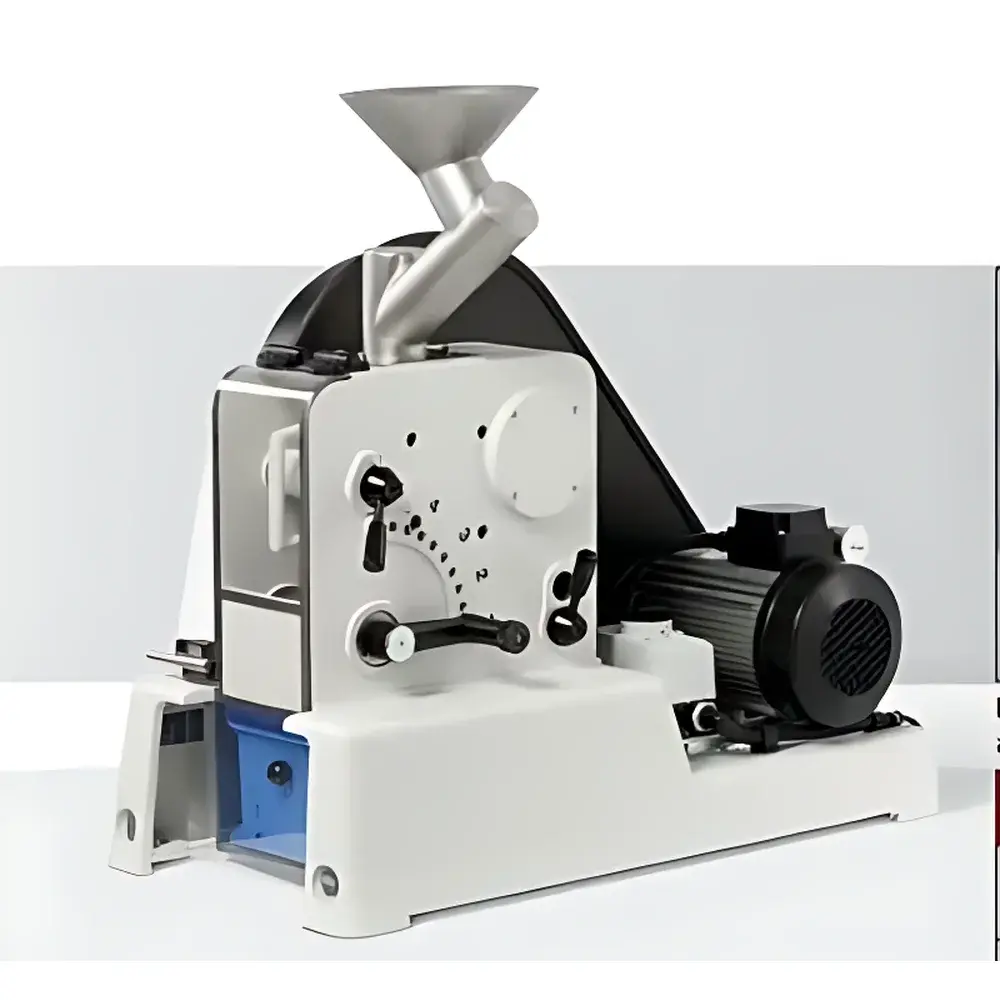
FRITSCH Pulverisette 1 Universal Jaw Crusher, Type II
| Brand | FRITSCH |
|---|---|
| Origin | Germany |
| Model | Pulverisette 1 Type II |
| Final Particle Size | 1–15 mm |
| Max. Feed Size | 95 mm |
| Throughput Capacity | up to 200 kg/h |
| Motor Speed | 1500 rpm |
| Vibration Frequency | 308 min⁻¹ |
| Input Power | 2780 W |
| Voltage/Frequency | 400 V / 3~ / 50–60 Hz |
| Net Weight | 205 kg |
| Gross Weight | 245 kg |
| Dimensions (W×D×H) | 40 × 80 × 80 cm |
| Grinding Chamber Material Options | Manganese Steel, Tungsten Carbide, Zirconium Oxide |
| Dust Extraction Interface | Integrated |
| Safety Certification | CE-compliant |
| Warranty | 12 months |
Overview
The FRITSCH Pulverisette 1 Universal Jaw Crusher, Type II is a heavy-duty, laboratory-scale primary crusher engineered for reproducible pre-crushing of heterogeneous solid materials under controlled mechanical pressure. Based on the classical jaw crushing principle—where material is compressed between two opposing, reciprocating jaws in a confined chamber—the instrument delivers consistent size reduction across a broad spectrum of sample types. Its robust cast-iron frame and precision-machined jaw geometry ensure stable operation at high torque loads, making it suitable for routine use in quality control laboratories, geological survey units, R&D facilities in ceramics and metallurgy, and raw material testing labs compliant with ISO 17025 requirements. Unlike high-energy impact or rotary mills, the Pulverisette 1 operates via quasi-static compression, minimizing thermal degradation and particle amorphization—critical for temperature-sensitive or phase-sensitive samples such as hydrated minerals, pharmaceutical excipients, or polymer blends.
Key Features
- Interchangeable jaw plates in four certified material grades: standard manganese steel (included), stainless steel, tungsten carbide, and zirconium oxide—enabling compatibility with abrasive, corrosive, or contamination-sensitive samples.
- Hermetically sealed grinding chamber with integrated dust extraction port (Ø 100 mm, DIN 24163), fully compliant with OSHA PEL and EU Directive 2004/37/EC for occupational dust exposure control.
- Tool-free jaw plate replacement system: static and moving jaws detach within 90 seconds using standardized hex-key hardware; no alignment recalibration required post-installation.
- Integrated safety interlock circuitry with dual-channel emergency stop, CE-marked per Machinery Directive 2006/42/EC and Low Voltage Directive 2014/35/EU.
- Optimized kinematic profile delivering 308 compressive cycles per minute at constant 1500 rpm motor speed—ensuring uniform stress distribution and minimal overgrinding.
- Modular design supporting seamless integration with downstream equipment, including the FRITSCH Pulverisette 13 Disc Mill for secondary fine grinding or classification workflows.
Sample Compatibility & Compliance
The Pulverisette 1 Type II accepts feed particles up to 95 mm in maximum dimension and accommodates brittle, semi-brittle, medium-hard, and soft materials—including silicates, ores, slag, limestone, clays, glass frits, concrete aggregates, and dried biological matrices. It is explicitly validated for moisture-tolerant operation (up to 8% w/w surface moisture) without clogging, thanks to its self-cleaning jaw geometry and adjustable discharge gap (1–15 mm). All wetted components comply with FDA 21 CFR 177.2400 for indirect food contact where applicable. Instrument documentation supports GLP audit trails, including calibration certificates traceable to PTB (Physikalisch-Technische Bundesanstalt), and meets the mechanical testing prerequisites outlined in ASTM C136/C136M (sieve analysis preparation) and ISO 679 (cement fineness testing).
Software & Data Management
While the Pulverisette 1 Type II operates as a standalone electromechanical unit without embedded firmware or digital interface, its mechanical design incorporates standardized I/O provisions for third-party process monitoring: analog 0–10 V output for real-time load torque feedback, dry-contact status signals for run/stop/fault states, and RS-485 Modbus RTU capability (optional add-on module). These interfaces enable integration into LIMS environments (e.g., LabWare LIMS, Thermo Fisher SampleManager) and support 21 CFR Part 11-compliant electronic batch records when paired with validated SCADA gateways. Maintenance logs, jaw wear metrics, and throughput tracking are documented in accordance with ISO 9001:2015 clause 7.5.3.
Applications
- Preparation of representative subsamples for XRF, XRD, and ICP-OES analysis in geochemical exploration and mine grade control.
- Size reduction of refractory ceramic bodies prior to BET surface area measurement (ISO 9277) or laser diffraction particle sizing (ISO 13320).
- Homogenization of construction materials (e.g., asphalt binders, fly ash, slag cement) for compressive strength testing per EN 196-1.
- Routine crushing of pharmaceutical granules and tablet cores for dissolution method development under USP <711>.
- Feedstock conditioning for thermal analysis (TGA/DSC) where minimal thermal history alteration is essential.
FAQ
What jaw plate materials are supplied as standard with the Pulverisette 1 Type II?
Standard configuration includes manganese steel fixed and movable jaws plus side support plates—all pre-installed and calibrated.
Can the crusher handle wet or sticky samples?
Yes—samples with up to 8% surface moisture can be processed without bridging, provided feed size remains within specification and jaw gap is adjusted accordingly.
Is the instrument compatible with automated sample feeding systems?
It features a top-feed hopper with standardized flange interface (DIN 28178) for integration with vibratory feeders or loss-in-weight dosing modules.
Does FRITSCH provide calibration services traceable to national standards?
Yes—factory calibration reports include PTB-traceable verification of jaw gap accuracy, motor torque linearity, and throughput consistency against reference gravimetric standards.
What maintenance intervals are recommended for continuous operation?
Lubrication of eccentric shaft bearings every 500 operating hours; jaw plate inspection and replacement based on wear depth measurements (threshold: >0.5 mm groove erosion).



