
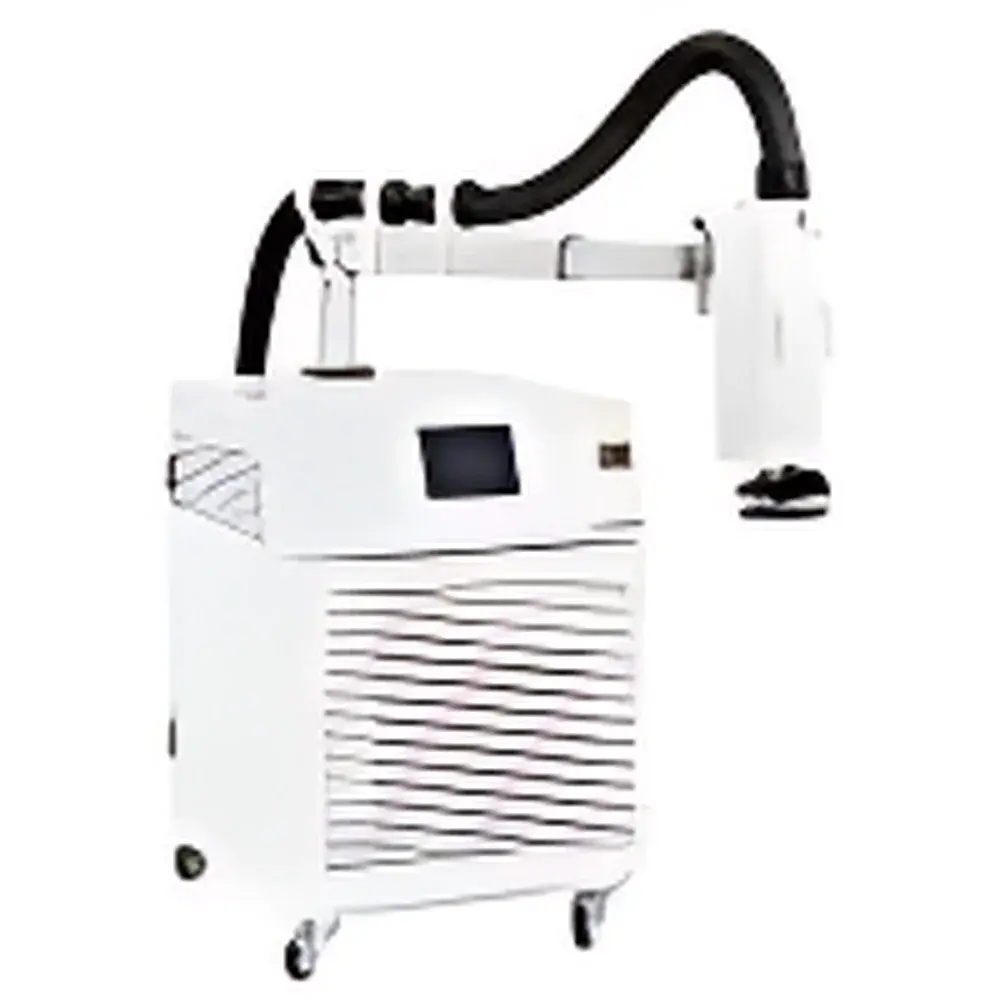
Froilabo Dragon Rapid Thermal Cycling System
| Brand | Froilabo |
|---|---|
| Model | Dragon |
| Origin | Guangdong, China (Distributed by Hongzhan Technology Co., Ltd.) |
| Temperature Range | −80 °C to +250 °C |
| Ramp Rates | −55 °C → +125 °C in 7 s |
| Temperature Accuracy | ±0.1 °C |
| Airflow Control | 2.2–8.4 L/s |
| Operating Modes | Manual / Automatic / Programmable |
| Program Storage | 45 profiles, up to 20 steps per profile |
| Standards Compliance | JEDEC JESD22-A104, MIL-STD-883 Method 1010, MIL-STD-750 Method 1037 |
Overview
The Froilabo Dragon Rapid Thermal Cycling System is a high-performance, air-based thermal shock test instrument engineered for precise, repeatable, and accelerated temperature transition testing of electronic components, materials, and assemblies. Based on forced-convection thermal transfer using conditioned dry air, the system delivers rapid, controlled thermal transients without mechanical contact or liquid media—ensuring clean, non-contaminating exposure essential for semiconductor packaging, PCB reliability validation, and qualification-grade environmental stress screening (ESS). Designed and refined over Froilabo’s century-long heritage in precision temperature control since its founding in Lyon, France (1918), the Dragon platform integrates robust thermal architecture with deterministic airflow management to achieve sub-second thermal inertia and exceptional thermal uniformity across test zones.
Key Features
- Wide operational temperature range from −80 °C to +250 °C, enabling comprehensive stress profiling for both cryogenic and high-temperature applications.
- Exceptional ramp performance: transitions between −55 °C and +125 °C completed in just 7 seconds (cold-to-hot) and 14 seconds (hot-to-cold), meeting stringent requirements for accelerated life testing and failure mode acceleration.
- High-resolution temperature regulation with ±0.1 °C accuracy across the full span, verified via traceable platinum resistance thermometers (PRTs) and dual-sensor redundancy.
- Adjustable volumetric airflow control (2.2–8.4 L/s) ensures consistent convective heat transfer coefficients—critical for reproducible thermal loading on low-mass devices such as bare die, BGA packages, and thin-film sensors.
- Three operational modes—Manual (real-time setpoint adjustment), Automatic (predefined sequence execution), and Programmable (user-defined multi-step profiles)—support flexibility from R&D debugging to production-line qualification.
- Intuitive 7-inch capacitive touchscreen interface with multilingual support (English, Chinese, French), real-time trend plotting, and contextual help overlays for operator guidance.
- Onboard storage for up to 45 independent test programs, each configurable with up to 20 discrete temperature/time steps—including dwell durations, ramp rates, and conditional branching logic.
Sample Compatibility & Compliance
The Dragon system accommodates a broad spectrum of test specimens—from individual ICs and SMT components to populated PCBAs, automotive ECUs, and small-scale polymer or ceramic samples—without requiring custom fixtures. Its chamber-free design eliminates thermal mass limitations associated with conventional chamber-based thermal shock testers, enabling direct, unobstructed airflow impingement on device surfaces. The system is fully aligned with industry-standard thermal cycling protocols including JEDEC JESD22-A104 (Temperature Cycling), MIL-STD-883 Method 1010.12 (Steady-State Temperature Cycling), and MIL-STD-750 Method 1037 (Thermal Shock). All firmware and data logging functions comply with GLP/GMP documentation requirements, supporting audit-ready operation with timestamped event logs, user access controls, and optional electronic signature integration for 21 CFR Part 11 readiness.
Software & Data Management
Equipped with Froilabo’s proprietary DragonControl™ software suite (Windows-compatible), the system supports remote configuration, real-time monitoring, and post-test analysis via USB or Ethernet. Data export is available in CSV and XML formats, preserving metadata such as ambient conditions, sensor calibration IDs, and operator credentials. The software includes built-in statistical process control (SPC) tools for Cp/Cpk calculation on cycle-to-cycle deviation, automated pass/fail flagging against user-defined limits, and graphical overlay of multiple test runs for comparative thermal response analysis. Audit trails record all parameter changes, program executions, and calibration events with immutable timestamps—ensuring full traceability for ISO/IEC 17025-accredited laboratories.
Applications
- Qualification testing of semiconductor packages (QFN, BGA, WLCSP) per AEC-Q200 and JEDEC standards.
- Failure analysis root cause identification through accelerated thermal fatigue induction in solder joints and underfill interfaces.
- Reliability screening of automotive electronics subjected to extreme ambient cycling in engine compartments or battery management systems.
- Material characterization of thermal expansion mismatch in multi-layer substrates and MEMS devices.
- Process validation for conformal coating adhesion, potting compound curing integrity, and adhesive bond strength under cyclic thermal load.
- Research-level investigation of time-dependent dielectric breakdown (TDDB) and electromigration kinetics under thermal modulation.
FAQ
What is the minimum sample size the Dragon system can effectively test?
The system is optimized for specimens with active surface areas ≥10 mm² and mass ≤5 g. Smaller devices (e.g., 0201 passives or bare die) require optional micro-nozzle adapters to maintain localized airflow velocity and thermal coupling fidelity.
Does the Dragon system support nitrogen purging for moisture-sensitive tests?
Yes—integrated N₂ purge ports are available as a factory-configurable option, enabling oxygen- and humidity-controlled environments during thermal cycling to prevent oxidation or condensation-related artifacts.
Can test data be exported directly into LIMS or MES platforms?
Yes—DragonControl™ supports OPC UA and Modbus TCP protocols, allowing seamless integration with laboratory information management systems (LIMS) and manufacturing execution systems (MES) for automated result ingestion and workflow synchronization.
Is calibration certification included with shipment?
Each unit ships with a NIST-traceable calibration certificate covering temperature uniformity, ramp rate verification, and sensor linearity across the full operating range, valid for 12 months from date of commissioning.
How is thermal uniformity validated within the test zone?
Uniformity is characterized per IEC 60068-3-5 using a 9-point thermocouple array mounted on a standardized aluminum test plate, with maximum spatial deviation maintained at ≤±1.2 °C across the central 75% of the nominal test envelope.



