FRYKA KBT Series Mini Benchtop Ultra-Low Temperature Freezers
| Brand | FRYKA |
|---|---|
| Origin | Germany |
| Model Variants | KBT 02-51, KBT 04-51, KBT 08-51 |
| Temperature Range | −50 °C to −30 °C |
| Control Accuracy | ±1 °C |
| Internal Volume | 2 L / 4 L / 8 L |
| Internal Dimensions (mm) | Ø130×170 / Ø170×185 / 150×300×200 |
| External Dimensions (mm) | 270×400×480 / 340×400×500 / 360×490×570 |
| Power Supply | 230 V / 50 Hz |
| Weight | 22 kg / 22 kg / 36 kg |
| Ambient Operating Temperature | +12 °C to +30 °C |
| Cooling System | Sealed, Fan-Cooled |
| Display | LED with Microprocessor Control |
| Alarm System | Audible/Visual Alarm with 72-h Backup Battery |
| Interfaces | Remote Alarm Output, RS485, 100 mV/K Temperature Recorder Port |
| Optional Upgrade | ST100 Supervisory Control System (KBT 08-51 only) |
Overview
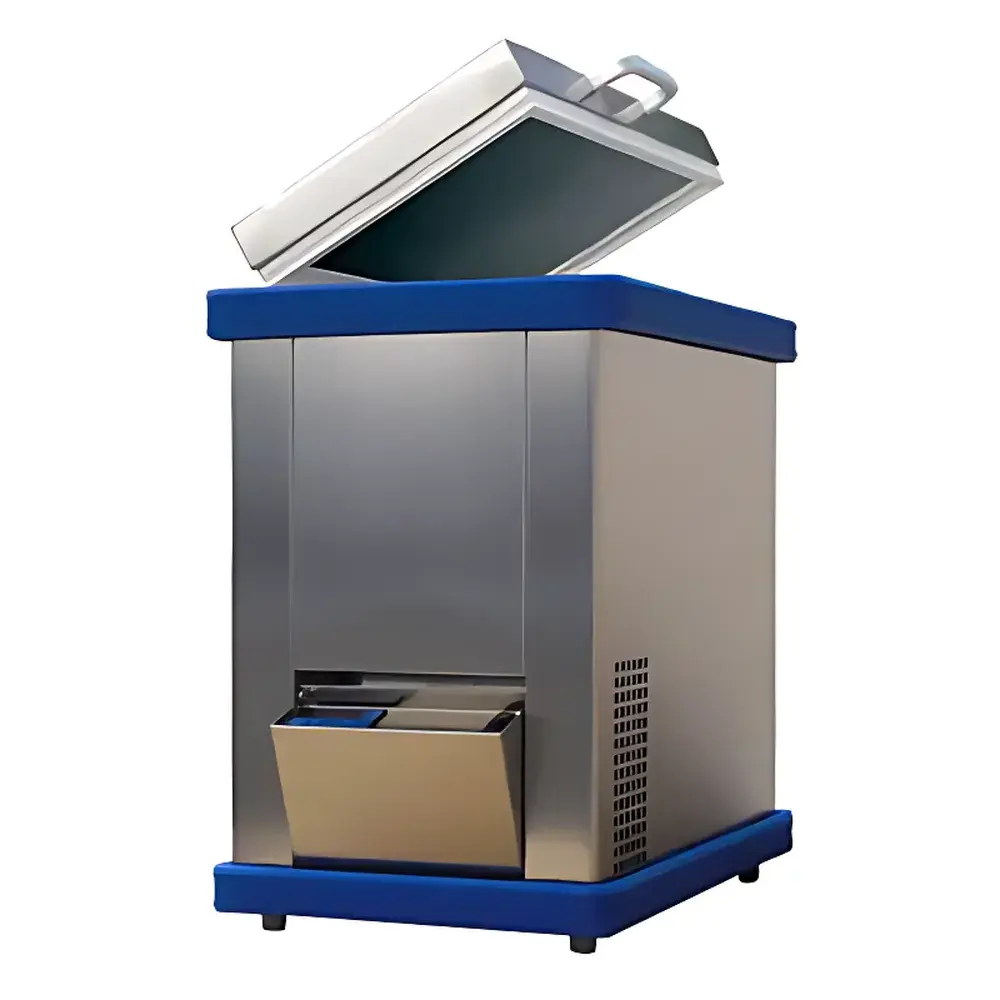
The FRYKA KBT Series comprises compact, benchtop ultra-low temperature (ULT) freezers engineered for precise, stable cold storage of biological samples, reagents, and sensitive diagnostics in constrained laboratory environments. Designed and manufactured in Germany, each unit operates within a tightly controlled temperature range of −50 °C to −30 °C—optimized for applications requiring cryogenic preservation without the infrastructure demands of −80 °C systems. Unlike cascade compressor-based ULT freezers, the KBT series employs a sealed, fan-assisted air-cooling architecture that eliminates refrigerant leakage risks and significantly reduces maintenance frequency. Its thermally insulated stainless-steel cabinet—reinforced with impact-absorbing bumpers on top and base—ensures mechanical resilience in high-traffic labs while maintaining thermal stability under ambient conditions from +12 °C to +30 °C. The series is classified as a low-energy ULT freezer (<−40 °C), compliant with IEC 61000-6-3 (EMC) and IEC 61010-1 (safety), and meets essential requirements for GLP-aligned sample integrity workflows.
Key Features
- Microprocessor-controlled temperature regulation with ±1 °C accuracy across all operating points, verified per DIN EN 60068-3-5
- Sealed, brushless DC fan-cooled system—no condenser cleaning, no oil circulation, minimal vibration transmission
- LED display with intuitive membrane keypad interface; real-time setpoint, actual temperature, and status indicators
- Triple-layer insulation: polyurethane foam core (≥45 mm) with vacuum-enhanced perimeter sealing for reduced thermal bridging
- Redundant alarm architecture: audible/visual alert triggered by temperature deviation, door open >30 s, or power failure—backed by 72-hour internal Ni-MH battery
- Standard communication interfaces: isolated RS485 (Modbus RTU protocol), dry-contact remote alarm output, and analog 100 mV/K output for external data loggers
- Model-specific chamber geometry: cylindrical interior (KBT 02-51 & KBT 04-51) minimizes dead volume and improves air uniformity; rectangular cavity (KBT 08-51) supports standard 2 mL tube racks and microplate storage
Sample Compatibility & Compliance
The KBT series is validated for long-term storage of primary human cells, plasma aliquots, RNA extracts, monoclonal antibodies, and lyophilized standards at temperatures sufficient to suppress enzymatic degradation and ice recrystallization kinetics. Chamber materials comply with ISO 10993-5 (cytotoxicity) and EU Regulation (EC) No 1935/2004 for food-contact-equivalent stainless steel (AISI 304). Units are CE-marked and conform to the EU Medical Device Regulation (MDR 2017/745) Annex I essential requirements when used in IVD sample handling contexts. All models support audit-ready operation: event logs (door openings, alarms, temperature excursions) are timestamped and retained for ≥30 days; optional ST100 integration enables FDA 21 CFR Part 11–compliant electronic signatures and role-based access control.
Software & Data Management
While the base unit operates autonomously via embedded firmware, the KBT 08-51 supports upgrade to the ST100 Supervisory Terminal—a dedicated hardware controller with Ethernet connectivity, web-based UI, and local SD-card logging (10,000+ events). ST100 enables configurable alarm thresholds, scheduled temperature profiling, and CSV export of continuous 1-minute interval data. Third-party SCADA and LIMS integration is achieved through native Modbus TCP mapping or OPC UA gateway compatibility. All temperature recorder outputs (100 mV/K) meet ASTM E74-22 traceability requirements when paired with NIST-traceable calibrators.
Applications
- Short-to-medium term storage of clinical biospecimens prior to nucleic acid extraction or biobanking transfer
- Stabilization of thermolabile enzymes (e.g., restriction endonucleases, reverse transcriptases) between experimental sessions
- Pre-chilling of HPLC autosampler trays and GC injection ports to minimize thermal carryover
- On-bench backup storage during −80 °C freezer maintenance or validation downtimes
- Field-deployable cold chain nodes in mobile diagnostic units or point-of-care testing laboratories
FAQ
What is the minimum ambient temperature required for stable operation?
The KBT series requires an ambient environment between +12 °C and +30 °C. Operation below +12 °C may cause evaporator icing; above +30 °C compromises cooling capacity and increases compressor duty cycle.
Can the KBT 08-51 be integrated into a central lab monitoring network?
Yes—via its RS485 port using Modbus RTU, or optionally through the ST100 terminal’s Ethernet interface supporting SNMP v3 and HTTPS-based API calls.
Is calibration certificate included with shipment?
A factory-issued calibration report (per ISO/IEC 17025) is provided, documenting temperature uniformity (±0.8 °C max deviation across 9-point mapping) and stability (±0.3 °C over 24 h) at −40 °C.
Does the unit support external temperature probe input?
No—the internal Pt1000 sensor is fixed and non-removable; however, the 100 mV/K analog output allows connection to external calibrated recorders for independent verification.
What safety certifications apply to the KBT series?
Units comply with IEC 61010-1:2010 (electrical safety), IEC 61326-1:2013 (EMC for lab equipment), and carry the CE mark under the Low Voltage Directive 2014/35/EU and EMC Directive 2014/30/EU.