
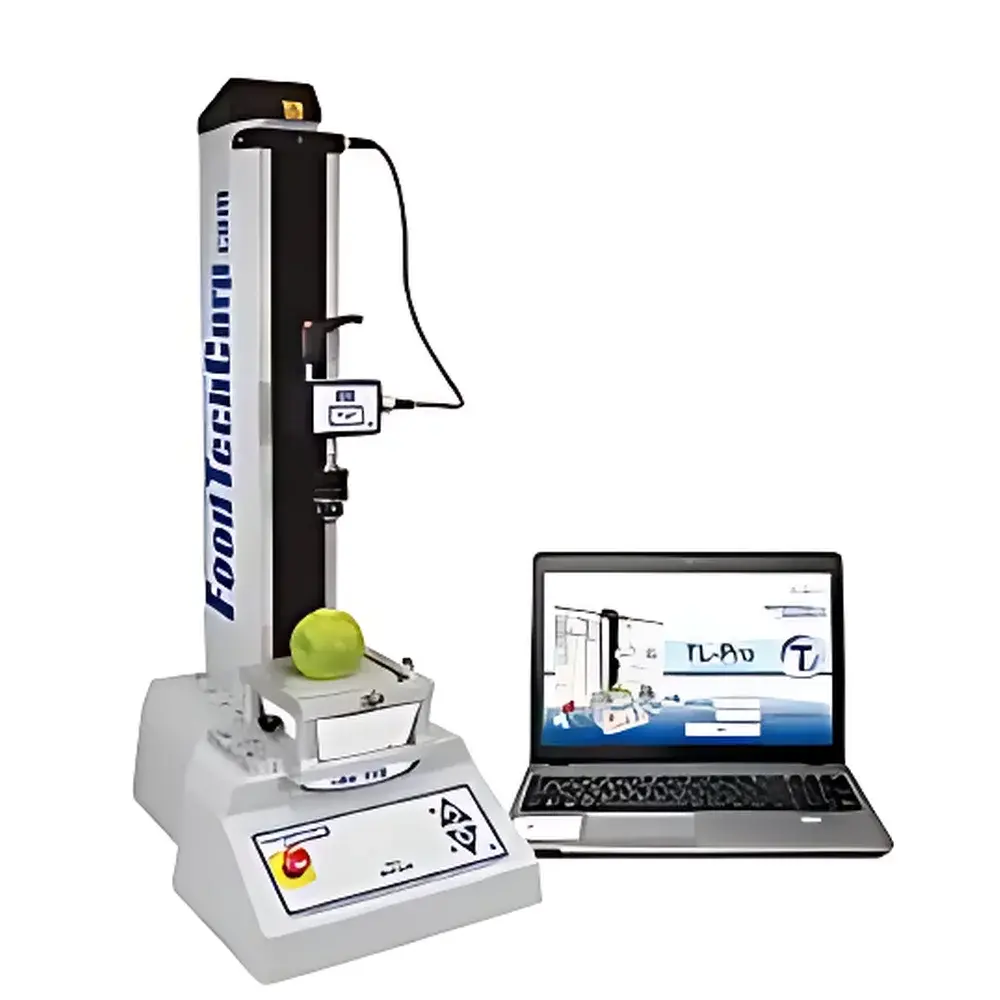
FTC TMS-PRO Texture Analyzer
| Brand | FTC |
|---|---|
| Origin | USA |
| Model | TMS-PRO |
| Maximum Force Capacity | 2500 N |
| Force Resolution | Adjustable via interchangeable load cells (10, 25, 50, 100, 250, 500, 1000, 2500 N) |
| Force Accuracy | ±0.015% of full scale |
| Travel Distance | 300 mm (extendable per custom configuration) |
| Vertical Positioning Resolution | 2.5 µm over 320 mm stroke |
| Speed Range | 0.1–500 mm/min (adjustable in 0.01 mm/min increments) |
| Speed Accuracy | ±0.1% of set value |
| Data Acquisition Rate | >2000 points/sec |
| Probe Compatibility | ISO/ASTM-compliant standardized probes with NIST-traceable calibration certificates |
| Dimensions (W×D×H) | 290 × 430 × 750 mm |
| Weight | 18.2 kg |
Overview
The FTC TMS-PRO Texture Analyzer is a high-precision, computer-controlled universal testing system engineered for objective mechanical property characterization of food materials. Based on the fundamental principles of uniaxial compression, tension, penetration, extrusion, and shear deformation—governed by Hooke’s law and empirical viscoelastic models—the instrument quantifies textural parameters including hardness, fracturability, cohesiveness, springiness, chewiness, adhesiveness, and resilience. Designed specifically for food science laboratories, it adheres to standardized test protocols defined in ASTM STP 1356, ISO 11357-3, and USP , enabling reproducible, instrument-based replacement of subjective sensory evaluation. Its modular architecture supports both routine QC testing and advanced research applications across academic, industrial, and regulatory environments.
Key Features
- Interchangeable load cell system offering eight calibrated force ranges (10–2500 N), each optimized for resolution and linearity within its span—ensuring optimal signal-to-noise ratio across diverse sample types from soft gels to dense meat analogs.
- Sub-micron vertical positioning capability (2.5 µm resolution over 320 mm travel), achieved via precision-ground ball screw actuation and closed-loop servo control, guaranteeing repeatable probe displacement under dynamic loading conditions.
- High-fidelity real-time data acquisition at >2000 Hz, synchronized with motor position and environmental metadata (e.g., ambient temperature), supporting transient event capture such as brittle fracture onset or viscoelastic relaxation.
- Rigid aluminum frame with vibration-damped base minimizes external interference; all mechanical components conform to ISO 2768-mK general tolerances for dimensional stability over extended operation cycles.
- Compliance-ready hardware interface: USB 2.0 and RS-232 ports support integration into validated laboratory networks; optional Ethernet module enables remote monitoring and audit trail synchronization.
Sample Compatibility & Compliance
The TMS-PRO accommodates heterogeneous food matrices—including raw and cooked meats, cereal-based doughs, hydrocolloid gels, fresh produce, confectionery systems, and dairy analogs—using application-specific probes (e.g., TA-43 spherical probe for fruit firmness, TA-10 cylindrical plunger for pasta tensile strength). All probes are manufactured to ISO 9001-certified processes and supplied with individual calibration certificates traceable to NIST standards. The system meets requirements for GLP-compliant documentation under FDA 21 CFR Part 11 when operated with validated software configurations, including electronic signatures, audit trails, and user access controls. Test methods align with AOAC Official Method 985.29 (cheese texture), AACC Method 74-09 (bread compression), and ISO 11357-3 (thermal-mechanical analysis of thermoplastics used in food packaging).
Software & Data Management
Control and analysis are executed via FTC’s proprietary TexturePro CT v3.2 software—a Windows-based platform compliant with ICH GCP and 21 CFR Part 11 Annex 11 guidelines. It provides preconfigured method templates for standard assays (e.g., “TPA – Two-Pulse Compression”, “Shear Press”, “Peel Test”), customizable parameter scripting, automated pass/fail logic based on user-defined specification limits, and export to CSV, Excel, or PDF formats with embedded metadata. Raw data files include timestamped headers, instrument serial number, operator ID, and environmental logs. Software validation packages—including IQ/OQ/PQ documentation, risk assessments, and change control records—are available upon request for regulated facilities.
Applications
- Quantification of tenderness in marinated vs. non-marinated beef strips using Warner-Bratzler shear protocol (ASTM F2714).
- Dynamic modulus profiling of starch-based edible films during hydration-induced swelling (ISO 11357-4).
- Texture mapping of layered snack products (e.g., chips with cheese coating) via multi-cycle cyclic compression to assess interfacial adhesion loss.
- Validation of enzymatic tenderization efficacy in plant-based meat alternatives through time-resolved hardness decay curves.
- Correlation of instrumental texture metrics (e.g., fracture force, work of shear) with trained sensory panel scores using partial least squares regression (PLSR) modeling.
FAQ
What force ranges are supported, and how does load cell selection affect measurement resolution?
The TMS-PRO accepts eight NIST-calibrated load cells (10–2500 N). Resolution scales inversely with full-scale capacity; for example, the 10 N cell delivers 0.00015 N resolution, while the 2500 N cell provides 0.375 N resolution—enabling optimal digitization across soft gels and rigid baked goods.
Is the system compatible with third-party probes or custom fixtures?
Yes—standardized ¼”-20 UNC threaded mounting and ISO 80601-2-61 mechanical interface allow integration of OEM or lab-fabricated fixtures, provided static and dynamic load ratings are verified against the selected load cell’s safe operating envelope.
Does the software support statistical process control (SPC) charting?
TexturePro CT includes built-in SPC tools: X-bar/R charts, capability indices (Cp/Cpk), and trend analysis with alarm thresholds—configurable per product line or batch ID.
Can test methods be locked to prevent unauthorized modification in production environments?
Method templates may be password-protected and digitally signed; revision history is logged automatically, satisfying FDA 21 CFR Part 11 §11.10(a) requirements for electronic record integrity.
What environmental conditions are recommended for optimal performance?
Operate within 15–30 °C ambient temperature, ≤70% RH non-condensing; avoid direct sunlight or HVAC drafts near the instrument to minimize thermal drift in force transduction.
Related Products







