
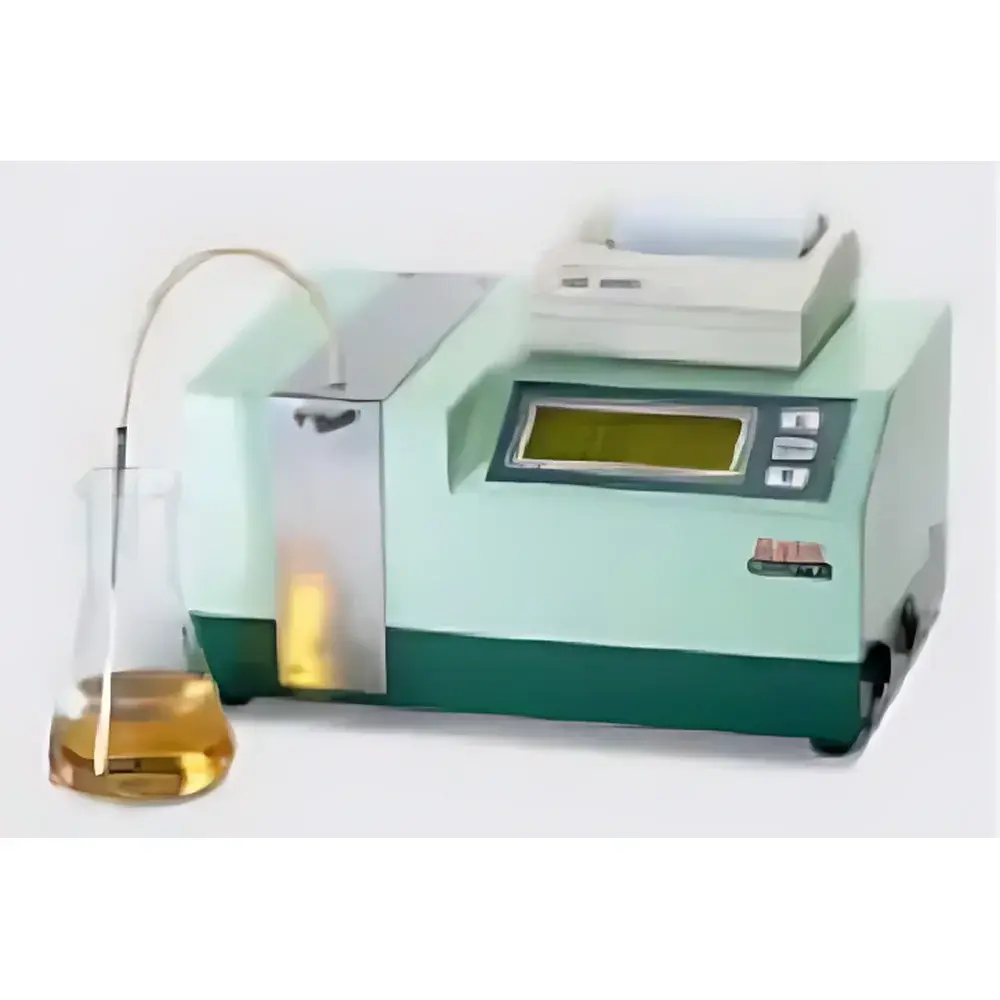
Funke FermentoStar Beer Analyzer
| Brand | Funke |
|---|---|
| Origin | Germany |
| Manufacturer Type | Authorized Distributor |
| Origin Category | Imported |
| Model | FermentoStar |
| Price | Upon Request |
| Alcohol Content Range | 0–15% (v/v) |
| Real Extract Range | 0–10% (w/w) |
| Original Wort Extract Range | 0–20% (w/w) |
| Apparent Extract Range | 0–10% (w/w) |
| Repeatability | ±0.01% for all extract and alcohol parameters |
| Sample Volume | 18 mL |
| Analysis Time | ≤120 s per sample |
| Throughput | Up to 30 samples/hour |
| Power Supply | 220 V / 50 Hz, 180 W |
| Dimensions | 25 × 19 × 35 cm |
| Weight | 8.5 kg |
| Interfaces | RS-232, USB, Parallel Printer Port |
| Calibration | Internal database of 20 preloaded beer types (e.g., Pilsner, Malt Beer, Strong Ale) |
Overview
The Funke FermentoStar Beer Analyzer is a dedicated, benchtop thermal analysis instrument engineered for rapid, precise quantification of key compositional parameters in fermented alcoholic beverages—primarily beer. Unlike traditional density-based (oscillating U-tube) or refractometric methods, the FermentoStar employs differential thermal analysis (DTA) coupled with controlled heating kinetics to resolve ethanol, real extract, apparent extract, and original wort extract concentrations simultaneously. The system operates on the principle that ethanol, sugars, dextrins, and other soluble solids exhibit distinct thermal response profiles during programmed heating—particularly in their evaporation onset temperatures, latent heat absorption characteristics, and vapor-phase composition shifts. Prior to analysis, degassed beer samples (18 mL) are automatically aspirated via integrated peristaltic pumping; filtration through standard qualitative filter paper ensures removal of CO₂ microbubbles and suspended yeast or haze particles, minimizing thermal interference and improving measurement reproducibility. All results—including alcohol by volume (ABV), real extract (RE), apparent extract (AE), and calculated original extract (OE)—are computed in under two minutes and displayed digitally with 0.01% resolution.
Key Features
- Thermal analysis platform delivering ABV, RE, AE, and OE in ≤120 seconds per sample without reagents or consumables beyond standard filter paper
- Integrated degassing and filtration workflow: automated sample aspiration after manual pre-filtration eliminates operator-dependent CO₂ handling errors
- Three-button intuitive interface with hierarchical menu navigation—designed for routine use in production QC labs with minimal training
- Built-in calibration library containing 20 validated beer-type profiles (e.g., Pilsner, Weizen, Stout, Bock), each with thermally optimized parameter sets
- User-initiated calibration mode: enter certified reference values (e.g., from distillation + hydrometry or HPLC) to auto-adjust thermal curve fitting coefficients
- Robust mechanical architecture: stainless-steel sample path components, PID-controlled heating block, and sealed thermal sensor array ensure long-term stability
- Compliance-ready data handling: timestamped results with operator ID fields, optional audit trail logging when connected to compliant LIMS environments
Sample Compatibility & Compliance
The FermentoStar is validated for use with filtered, non-carbonated or fully degassed beer samples across all major styles—including lagers, ales, sour beers, and high-gravity brews—with alcohol content up to 15% v/v and original wort extract up to 20°P. It accommodates turbid or hazy samples provided they are pre-filtered to ≤5 µm particle retention. While not an ISO 15212-1 or AOAC 988.10 primary method, the instrument demonstrates strong correlation (r² ≥ 0.997) with reference methods (e.g., distillation + pycnometry for ABV; enzymatic hydrolysis + HPLC for fermentable sugars) across inter-laboratory validation studies conducted per ISO/IEC 17025 guidelines. Its operational design supports GLP-compliant workflows when paired with external electronic lab notebooks (ELNs) or 21 CFR Part 11–enabled data systems via RS-232 or USB serial emulation.
Software & Data Management
The FermentoStar operates autonomously without PC dependency; however, its RS-232 and USB interfaces support bidirectional ASCII protocol communication for integration into existing QA/QC informatics infrastructure. Exported data includes sample ID, date/time stamp, operator code, measured ABV, RE, AE, OE, temperature ramp profile checksum, and calibration status flag. Optional firmware updates—distributed via encrypted USB stick—include enhanced outlier detection algorithms and expanded extract calculation models aligned with MEBAK (Mitteleuropäische Brautechnische Analysen-Kommission) 2023 revision tables. Raw thermal scan logs (CSV format) are accessible for retrospective method verification and root-cause analysis of atypical readings.
Applications
- Routine fermentation monitoring: tracking ABV and real extract decline during active fermentation to determine terminal gravity and yeast viability
- Final product release testing: verifying compliance with label claims for ABV and original extract per EU Regulation No. 1169/2011 and TTB 27 CFR Part 7
- Brewery R&D: evaluating mash efficiency, adjunct substitution impact, and attenuation limits across experimental batches
- Contract brewing & co-packing QA: rapid batch acceptance testing with documented traceability for third-party audits
- Teaching laboratories: demonstrating thermal property relationships in complex aqueous carbohydrate-ethanol matrices
FAQ
Does the FermentoStar require daily recalibration?
No—under stable ambient conditions (±2°C), recalibration is recommended only after maintenance, firmware updates, or when analyzing atypical beer matrices (e.g., high-dextrin kettle sours). A full verification using a control sample is advised at start-of-shift.
Can it analyze unfiltered craft beers with live yeast?
Not directly. Samples must be filtered to remove suspended solids and fully degassed. Standard qualitative filter paper (e.g., Whatman Grade 1) is sufficient; centrifugation is not required.
Is the 0.01% repeatability value certified per ISO 5725?
Yes—the stated repeatability reflects within-lab precision (r) determined per ISO 5725-2:2019 across five operators, three days, and ten replicates of six reference beers spanning 3–12% ABV.
What regulatory standards does the instrument support?
It aligns with analytical principles referenced in MEBAK Chapter 4.1 (Alcohol Determination), ASBC Methods of Analysis Beer-12 (Alcohol), and supports data integrity requirements for breweries operating under FSSC 22000 v5.1 and BRCGS Packaging Materials Issue 6 Annex 4.
Is service and spare parts support available outside Germany?
Yes—Funke authorizes regional service partners in North America, UK/Ireland, Benelux, and APAC regions; critical spares (heating block, thermal sensor module, pump head) are stocked globally with <72-hour dispatch SLA.





