
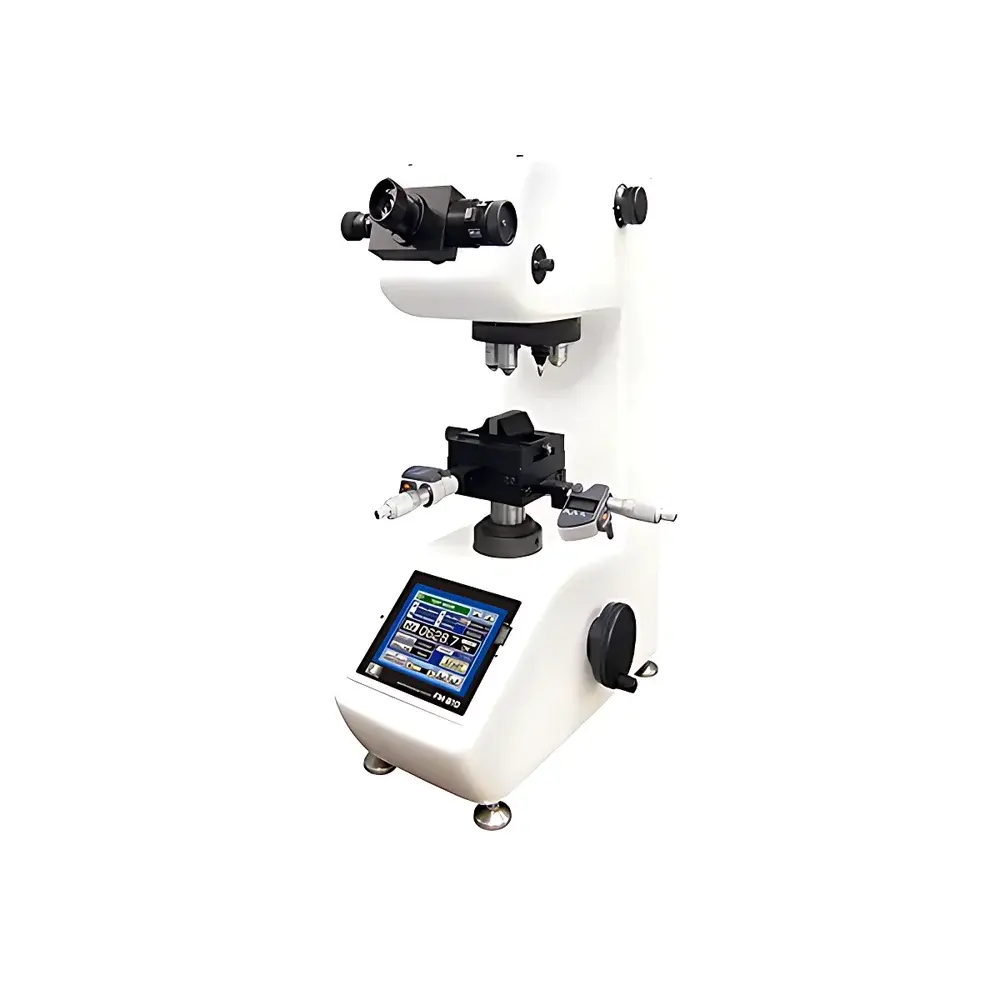
Future-Tech FM-300 Micro-Vickers Hardness Tester
| Brand | Future-Tech |
|---|---|
| Origin | Japan |
| Model | FM-300 |
| Hardness Scale Range | 1–5000 HV |
| Test Load | 1000 gf (9.807 N) |
| Maximum Specimen Height | 95 mm |
| Maximum Specimen Depth | 115 mm |
| Optical System | Dual Standard Objectives (10× & 50×), Expandable to Four Objectives |
| Indentation Measurement | Manual or Optional Digital XY Stage with 0.01 µm Resolution at 500× Magnification |
| Compliance | JIS B 7725, JIS B 7734, JIS B 7735, ASTM E-384, ISO 6507-2, ISO 8507-2 |
| Control Interface | FM-810 Smart Touch Panel (7″ Full-Color LCD), Supporting HV/HK/HBW/HBS/KC Toughness Testing, SAE-J417b & ASTM E140 Hardness Conversion, Cylindrical/Spherical Surface Correction, Data Logging, and GLP-Compliant Audit Trail |
Overview
The Future-Tech FM-300 is a precision-engineered micro-Vickers hardness tester designed for metrologically rigorous applications in metallurgical R&D, quality control laboratories, and advanced materials characterization. Based on the fundamental principle of Vickers indentation—where a diamond pyramid indenter (136° apex angle) is applied under controlled static load to produce a geometrically reproducible impression—the FM-300 delivers traceable, high-repeatability hardness values across the full scale range of 1–5000 HV. Its optical-mechanical architecture integrates Japanese manufacturing discipline with ISO 6507-2–compliant test force application, dwell time control (5–99 s), and load-unload kinetics (60 µm/sec). The instrument meets the dimensional stability requirements defined in JIS B 7725 and supports dual-scale evaluation (HV and HK) as well as specialized modes including Knoop microhardness, Brinell (HBW/HBS), and fracture toughness (KC) calculation per ASTM E384 Annex A4.
Key Features
- High-rigidity monolithic frame with vibration-damped base and proprietary anti-corrosion coating ensures long-term mechanical stability and optical alignment integrity.
- FM-810 intelligent touch interface (7″ full-color LCD) enables intuitive operation: real-time load display, D1/D2 diagonal measurement, dwell time adjustment, hardness curve plotting, and self-diagnostic reporting.
- Four-objective turret support (5×, 10×, 20×, 40×, 50×, 100×) with parfocal design allows seamless magnification switching without refocusing; standard configuration includes 10× and 50× objectives.
- Cylindrical and spherical surface correction algorithms compensate for curvature-induced diagonal measurement error—critical for testing wires, bearings, and coated spherical components.
- Optional digital XY stage with integrated micrometer readout (0.01 µm resolution at 500×) enables coordinate-based indentation mapping and automated multi-point hardness profiling.
- LED illumination system features adaptive dimming during indentation to minimize operator eye fatigue while maintaining optimal contrast for precise diagonal delineation.
Sample Compatibility & Compliance
The FM-300 accommodates specimens up to 95 mm in height and 115 mm in depth, supporting diverse geometries—from thin foils and cross-sectioned coatings to bulk castings and heat-treated tool steels. Its modular test head design permits interchangeable indenters (Vickers, Knoop, Brinell) and optional HK or HB attachments. Regulatory conformance includes full alignment with JIS B 7734 (microhardness testing methods), JIS B 7735 (calibration of hardness testers), ASTM E-384 (standard test method for microindentation hardness of materials), and ISO 6507-2 (verification of Vickers hardness testers). All calibration certificates are issued with traceability to NMIJ (National Metrology Institute of Japan) and include uncertainty budgets compliant with ISO/IEC 17025.
Software & Data Management
The FT-ZERO hardness measurement software suite provides GLP-compliant data acquisition, storage, and export functionality. It supports USB and RS232C interfaces for bidirectional communication with the FM-810 panel. Features include: user-defined test templates, batch report generation (PDF/CSV), statistical analysis (mean, SD, Cp/Cpk), hardness-depth profile visualization, and audit trail logging per FDA 21 CFR Part 11 requirements when paired with password-protected user roles and electronic signature modules. Calibration history, maintenance logs, and environmental condition metadata (temperature/humidity timestamps) are embedded within each test record.
Applications
The FM-300 serves critical roles in failure analysis labs evaluating case-hardened gear surfaces, semiconductor packaging substrates, biomedical implant coatings (e.g., TiN, DLC), and additive-manufactured metal lattices. Its ability to resolve sub-micron indentations at low loads (e.g., 10 gf) makes it suitable for thin-film hardness assessment per ISO 20502. In aerospace QA, it verifies diffusion bond integrity in turbine blade alloys. In academic research, it supports nanostructure–property correlation studies where localized hardness gradients reflect phase distribution, grain boundary segregation, or irradiation damage profiles.
FAQ
Does the FM-300 comply with ISO/IEC 17025-accredited calibration requirements?
Yes—when calibrated using NMIJ-traceable reference blocks and documented per ISO 6507-2 Annex B, the FM-300 satisfies metrological prerequisites for accredited laboratory use.
Can the FM-300 perform automatic indentation measurement without human intervention?
Not natively—but integration with the optional AR-based Vickers Auto-Read System (1.3 MP CMOS camera + FT-ZERO AI algorithm) enables fully automated diagonal detection, area calculation, and hardness conversion with <±0.8% repeatability (k=2) per ASTM E384 Section 8.4.
Is the FM-300 compatible with third-party LIMS or MES platforms?
Yes—via configurable ASCII protocol over RS232C or USB-serial emulation, enabling direct ingestion into LabWare LIMS, Thermo Fisher SampleManager, or Siemens Opcenter Quality.
What is the minimum resolvable indentation size at 500× magnification?
At 500× optical magnification with the 50× objective and 10× eyepiece, the system resolves features down to 0.17 µm (measured via calibrated graticule), meeting the 0.2 µm minimum diagonal requirement specified in ISO 6507-1 Clause 6.2.
How does the cylindrical surface correction function operate?
The FM-810 firmware applies a geometric compensation factor derived from specimen radius input and measured diagonal length, correcting for apparent shortening due to curvature—validated against NIST SRM 2840 reference spheres.



