
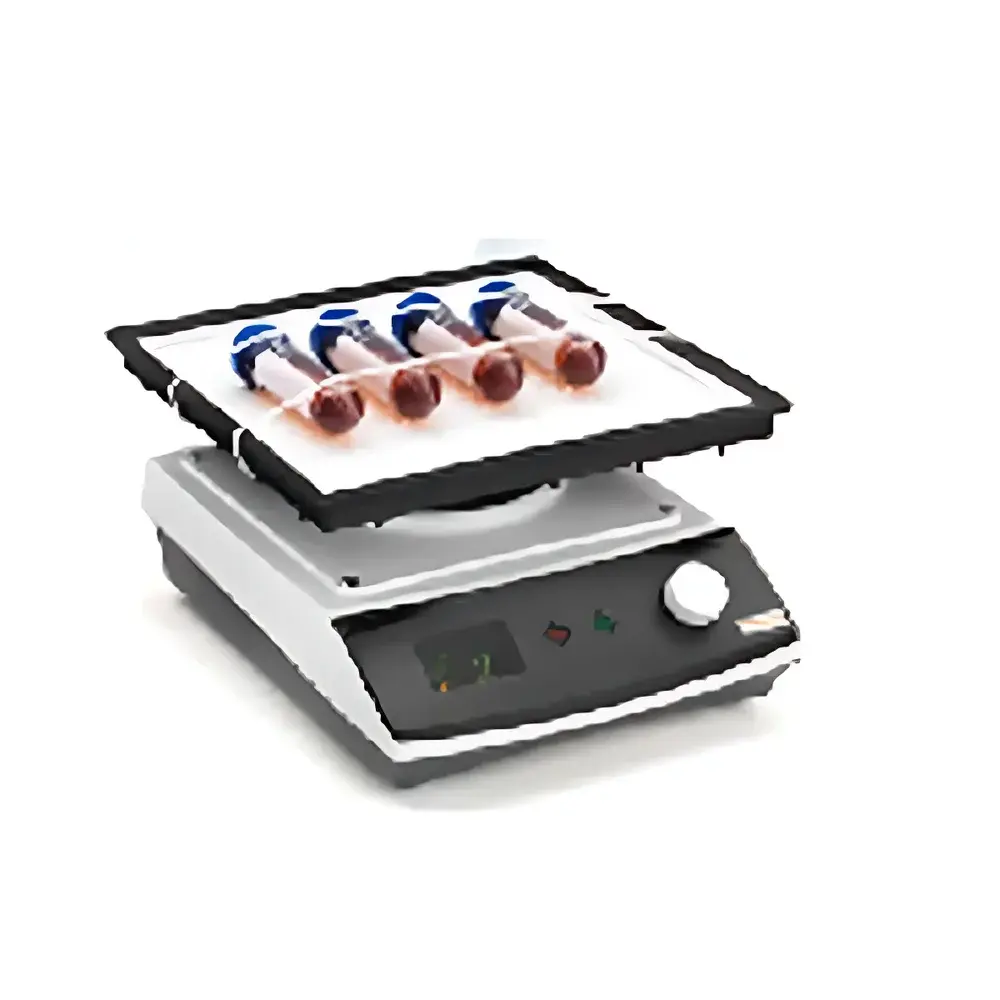
Thermo Fisher Scientific Orbital Shaker with Photoelectric Speed Control
| Brand | Thermo Fisher Scientific |
|---|---|
| Origin | USA |
| Model | Photoelectric-Controlled Rocking Shaker |
| Speed Range | 5–100 rpm |
| Adjustable Tilt Angle | 7°–13° |
| Distribution Type | Imported Instrument (Distributed by Authorized General Distributor) |
| Pricing | Available Upon Request |
Overview
The Thermo Fisher Scientific Photoelectric-Controlled Rocking Shaker is an engineered platform for gentle, reproducible mixing of low-viscosity liquid samples in tubes, bottles, flasks, and microplates. Unlike orbital or vortex shakers, this device employs a controlled rocking motion—oscillating around a fixed pivot axis—to induce laminar fluid displacement without splashing or foaming. The photoelectric speed control system utilizes an optical encoder integrated into the drive mechanism, enabling precise, non-contact rotational feedback for stable speed maintenance across the full 5–100 rpm range. This architecture ensures minimal mechanical drift over extended operation cycles and eliminates wear-related calibration drift common in potentiometer-based controllers. Designed for routine use in molecular biology labs, clinical diagnostics workflows, and cell culture support environments, the shaker delivers consistent mixing performance under ambient laboratory conditions (15–30 °C, <80% RH).
Key Features
- Photoelectric speed sensing and closed-loop motor control for ±1 rpm stability across the 5–100 rpm operating range
- Adjustable tilt angle from 7° to 13°, optimized for balancing mixing efficiency and sample containment in open vessels
- Low-noise DC brushless motor with thermal overload protection and automatic shutdown at >45 °C internal temperature
- Stainless-steel platform with non-slip silicone mat (removable and autoclavable at 121 °C for 20 min)
- Dual-mode operation: continuous run or timer-controlled (0.1–99.9 hr, programmable in 0.1-hr increments)
- CE-compliant electromagnetic compatibility (EN 61326-1) and safety certification (EN 61010-1)
Sample Compatibility & Compliance
This rocking shaker accommodates standard labware including 50 mL conical tubes, 125–1000 mL Erlenmeyer flasks, multi-well plates (6–96-well), and glass or polypropylene bottles up to 2 L capacity. Platform dimensions (300 × 250 mm) allow simultaneous processing of heterogeneous vessel types. The device complies with ISO 13485:2016 requirements for medical device-associated equipment when used in IVD reagent preparation. For GLP- and GMP-regulated environments, optional audit trail logging (via RS-232/USB interface) supports 21 CFR Part 11–compliant electronic records when paired with validated third-party data acquisition software. It meets ASTM D4084-22 criteria for mixing uniformity assessment in suspension stability studies.
Software & Data Management
While the base unit operates via front-panel keypad and LCD display, optional connectivity modules enable integration into centralized lab management systems. An RS-232 serial port supports SCPI command sets for remote parameter setting (speed, tilt, duration) and real-time status polling (motor temperature, actual rpm, elapsed time). USB-C firmware update capability ensures long-term compatibility with evolving compliance requirements. When connected to Thermo Fisher’s LabTrack™ ecosystem (v3.2+), the shaker contributes timestamped operational metadata—including start/stop events, speed deviations >±2 rpm, and thermal fault logs—to centralized audit repositories. All configuration changes are logged with user ID, timestamp, and pre-/post-values for traceability.
Applications
- Hybridization and washing steps in Southern/Northern blotting protocols
- Gentle resuspension of pelleted cells or precipitated nucleic acids prior to downstream analysis
- Antibody incubation on membrane blots and ELISA plate coating steps
- Stabilization of immunoassay reagents during storage at 4 °C (when mounted in cold room-compatible enclosures)
- Preparation of homogeneous suspensions for particle size distribution analysis (e.g., prior to laser diffraction measurement)
- Supporting ASTM E2912-20-compliant dissolution testing of oral solid dosage forms using rocking agitation as an alternative hydrodynamic condition
FAQ
Is the tilt angle calibrated at the factory and field-adjustable?
Yes—each unit undergoes angular verification using digital inclinometry during final QA. The tilt adjustment mechanism features dual-locking screws and a vernier scale etched onto the hinge housing for repeatable positioning within ±0.3° tolerance.
Can this shaker be operated inside a CO₂ incubator?
No—the electronics are not rated for humidified, 5% CO₂ environments. However, it is compatible with refrigerated cabinets (4–10 °C) when equipped with optional condensation-resistant housing (Part No. SHK-RK-COLD).
Does the photoelectric control system require periodic recalibration?
No—optical encoders are drift-free and do not require scheduled recalibration. Annual verification against a NIST-traceable tachometer is recommended for GLP audits.
What is the maximum load capacity per cycle?
The platform supports up to 5 kg evenly distributed mass. Exceeding this limit may compromise tilt-angle repeatability and accelerate bearing wear.
Is the silicone mat resistant to common solvents such as ethanol, isopropanol, and 10% sodium hypochlorite?
Yes—the food-grade silicone formulation shows no swelling or degradation after 72-hour immersion in these agents at room temperature, per ASTM D471 testing.
Related Products



