
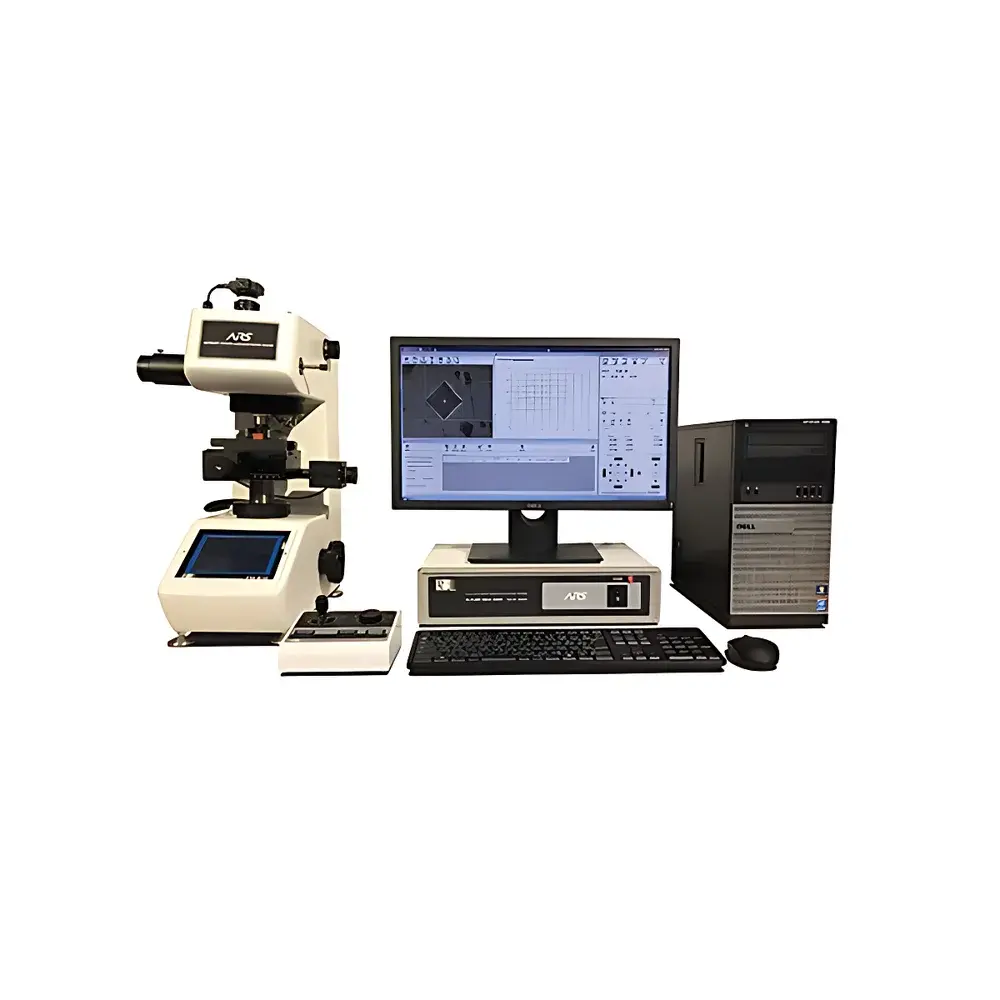
Future-Tech FM-ARS9000 Fully Automated Vickers Hardness Tester
| Brand | Future-Tech |
|---|---|
| Origin | Japan |
| Model | FM-ARS9000 |
| Indentation Measurement Principle | Digital Image Analysis with Shadow-Based Edge Detection |
| Total Test Load | 1000 gf (9.807 N) |
| Measurement Range | HV 1–5000 |
| Maximum Specimen Height | 95 mm |
| Maximum Specimen Depth | 115 mm |
| Minimum Indentation Size | 16 µm (diagonal) |
| XY Stage Travel (FM/FV Series) | 50 mm × 50 mm |
| XY Stage Travel (FLV Series) | 180 mm × 110 mm |
| Minimum Stage Resolution | 1 µm |
| Optical Resolution | 0.1 µm |
| Hardness Scales | HV, HK |
| Repeatability | ±0.5% at HV500 (500 gf load) |
| Camera | 1.3 MP CMOS sensor |
| Software | FT-ZERO v3.x (with ASTM E384, ISO 6507, JIS Z2244 compliance support) |
Overview
The Future-Tech FM-ARS9000 is a fully automated Vickers microhardness testing system engineered for high-precision, unattended hardness evaluation in R&D laboratories, quality control environments, and metallurgical service centers. It operates on the principle of optical indentation measurement using advanced shadow-based digital image analysis — a robust method that minimizes interference from surface artifacts such as grain boundaries, machining marks, or oxidation layers. Unlike conventional manual or semi-automated systems, the FM-ARS9000 integrates motorized Z-axis auto-focusing, programmable XY stage navigation, and real-time image processing to execute complete test sequences — including indenter loading, dwell, unloading, focus optimization, indentation capture, and geometric analysis — without operator intervention. Designed to meet stringent international standards, it supports traceable hardness assessment per ASTM E384 (Microindentation Hardness of Materials), ISO 6507 (Metallic Materials — Vickers Hardness Test), and JIS Z2244 (Vickers Hardness Test Method), making it suitable for GLP/GMP-regulated workflows where auditability and data integrity are mandatory.
Key Features
- Fully automated indentation measurement via proprietary shadow-edge detection algorithm — insensitive to metallic microstructure, scratches, or surface contamination
- Integrated 1.3 MP CMOS camera with sub-micron optical resolution (0.1 µm measurement increment) and real-time contrast enhancement
- Motorized XYZ stage with programmable travel limits and safety interlocks to prevent lens or indenter collision
- Auto-focus functionality synchronized with load application, reducing focusing time by up to 60% compared to manual systems
- Multi-pattern measurement modes: linear arrays, circular arcs, contour-following paths, random matrix grids, and teach-mode user-defined trajectories
- Inclined surface tracking (ARS-F configuration only): automatic Z-axis compensation based on preset tilt angle for accurate positioning on non-planar specimens
- On-screen distance and angular measurement tools — single-click point selection for rapid geometric analysis of indentation arrays
- Image programming interface enabling multi-origin alignment within a single field-of-view — eliminates repeated stage repositioning during large-area mapping
Sample Compatibility & Compliance
The FM-ARS9000 accommodates specimens up to 95 mm in height and 115 mm in depth, supporting standard metallographic mounts, heat-treated components, thin films, coatings, and case-hardened parts. Its modular stage design allows compatibility with Future-Tech’s FM, FV, and FLV series hardness testers, including legacy models (FM-110, FV-310, FLV-50, etc.). All measurement data comply with ISO/IEC 17025 requirements for calibration traceability when used with certified reference blocks (e.g., NIST SRM 2874, BCR-367). The system logs full metadata — including load value, dwell time, ambient temperature, operator ID, and timestamp — in accordance with FDA 21 CFR Part 11 electronic record and signature requirements when configured with FT-ZERO software audit trail and user access controls.
Software & Data Management
FT-ZERO v3.x serves as the unified control and analysis platform, providing intuitive workflow orchestration and comprehensive statistical reporting. Raw indentation images are stored losslessly with embedded EXIF metadata, enabling retrospective reanalysis without physical sample remeasurement. Statistical outputs include mean, standard deviation, min/max values, coefficient of variation, case depth calculation (e.g., effective case depth per ASTM E1036), and pass/fail evaluation against user-defined specification limits. Hardness distribution maps are rendered in full-color gradient overlays, exportable as PNG, TIFF, or vector PDF. All numerical results synchronize directly to Microsoft Excel via OLE automation — eliminating manual transcription errors. Batch report generation supports customizable templates compliant with internal QA documentation standards or external customer deliverables.
Applications
- Case depth profiling of carburized, nitrided, or induction-hardened steels
- Thin-film and PVD/CVD coating hardness verification (e.g., TiN, DLC, Al₂O₃)
- Weld zone microhardness mapping across HAZ, fusion line, and base metal
- Quality assurance of aerospace turbine blades, medical implants, and precision gears
- Research-grade material homogeneity studies requiring >100-point hardness arrays
- Failure analysis labs performing cross-sectional hardness gradients on fractured components
FAQ
Does the FM-ARS9000 support both Vickers (HV) and Knoop (HK) hardness scales?
Yes — the system automatically calculates and displays both HV and HK values based on measured diagonal lengths and applied load, with selectable scale conversion per ASTM E384 Annex A2.
Can I import custom specimen outlines for contour-following measurements?
Yes — FT-ZERO accepts DXF files for defining complex specimen perimeters, enabling adaptive path planning along irregular edges.
Is remote operation supported for integration into automated lab environments?
The system provides TCP/IP and RS-232 interfaces for OEM-level integration with MES, LIMS, or robotic sample handling systems.
What calibration protocols are recommended for routine maintenance?
Annual verification using certified hardness reference blocks traceable to national metrology institutes (e.g., NIST, PTB, NMIJ) is advised; daily verification with a control block is required under ISO/IEC 17025 accreditation.
How does the shadow-edge detection improve repeatability over traditional threshold-based algorithms?
By modeling light refraction at indentation edges rather than relying on pixel intensity thresholds, the algorithm achieves consistent centroid localization even on oxidized or etched surfaces — reducing inter-operator variability by >40% in comparative studies.



