
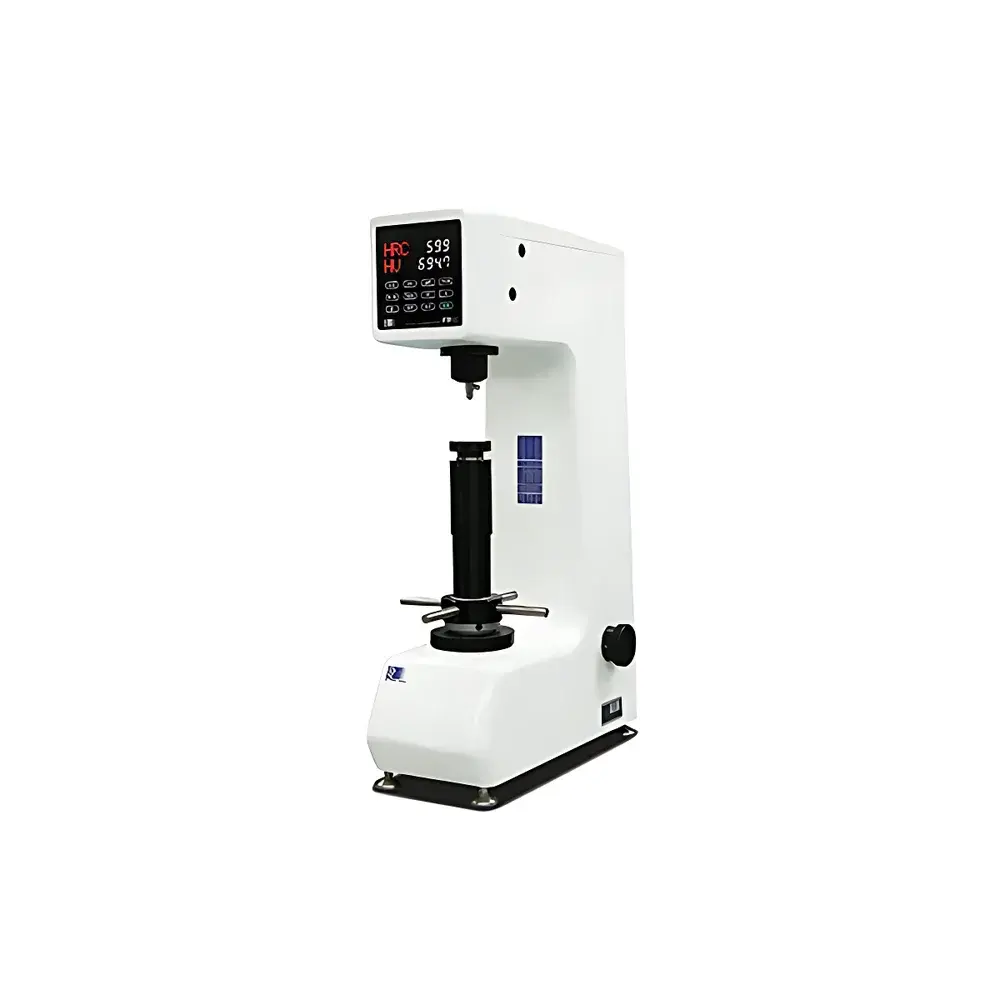
Future-Tech FR-3E Rockwell Hardness Tester
| Brand | Future-Tech |
|---|---|
| Origin | Japan |
| Model | FR-3E |
| Rockwell Scale Range | 20–88 HRC/HRB equivalent |
| Total Test Force | 150 kgf |
| Maximum Specimen Height | 255 mm |
| Vertical Travel | 255 mm |
| Load Axis Stability | High-sensitivity vertical load column with lateral displacement suppression |
| Calibration | Multi-point reference correction (low/mid/high) per JIS Z 2245, ISO 6508-1, ASTM E18 |
| Geometry Correction | Spherical/cylindrical specimen diameter input for curvature compensation |
| Indentation Depth Display | Max. indenter penetration depth shown simultaneously with hardness value |
| Data Output | RS-232C + USB adapter supported |
| Power Supply | AC 100/115/220 V, 50/60 Hz |
| Net Weight | 82 kg |
| Dimensions (W×D×H) | 196 × 487 × 820 mm |
Overview
The Future-Tech FR-3E Rockwell Hardness Tester is an engineered precision instrument designed for high-reproducibility Rockwell hardness measurement in industrial quality control, metallurgical laboratories, and R&D environments. Based on the standardized Rockwell principle—measuring permanent indentation depth under major and minor loads—the FR-3E employs a robust mechanical architecture to minimize deflection and thermal drift during testing. Its vertically aligned, high-sensitivity load column incorporates precision-ground guide rods that actively suppress lateral movement, ensuring consistent force application regardless of specimen geometry or surface contour. This design directly supports compliance with international standards including ISO 6508-1:2016, ASTM E18-23, and JIS Z 2245, making it suitable for auditable production environments operating under ISO 9001, IATF 16949, or AS9100 frameworks.
Key Features
- Stabilized Load Axis Architecture: Dual-column vertical guidance system with hardened steel guide rods ensures axial alignment stability during 150 kgf major load application, reducing measurement uncertainty from frame deformation.
- Extended Testing Space: 255 mm maximum specimen height accommodates large forgings, castings, and long shafts; compatible with optional flat anvil, ball anvil, and V-block fixtures per ASTM E18 Annex A3.
- Geometry Compensation Function: Operator-input specimen diameter (for spherical or cylindrical parts) enables automatic curvature correction per ISO 6508-1 Clause 7.4, delivering traceable results without manual interpolation.
- Multi-Point Reference Calibration: Low-, mid-, and high-range reference point adjustment using certified Rockwell test blocks (e.g., NIST-traceable SRM 2821 series), supporting daily verification and GLP-compliant calibration records.
- Real-Time Indentation Depth Monitoring: Simultaneous display of maximum indenter penetration depth (in µm) alongside hardness value enables post-test evaluation of material elastic recovery and approximate modulus estimation via empirical correlations.
- Pass/Fail Decision Logic: Programmable upper/lower tolerance limits (HL/OK/LO indicators) with statistical averaging across user-defined test points—critical for incoming inspection workflows requiring automated go/no-go output.
- Enhanced Operator Interface: Backlit dual-line LCD panel with illumination-guided preload positioning, audible confirmation tone, and intuitive menu navigation reduces operator dependency and minimizes setup error.
Sample Compatibility & Compliance
The FR-3E accommodates flat, convex, concave, and cylindrical specimens up to 255 mm in height and 165 mm in depth. Standard test forces (60, 100, and 150 kgf) and indenters (120° diamond cone for HRC, 1.588 mm steel ball for HRB) conform to ISO 6508-1 Annex B specifications. Curvature correction algorithms are validated for diameters ≥10 mm. All hardness values are reported in conventional Rockwell units (e.g., HRC, HRB, HRA) with resolution of 0.1 HR. The instrument meets electromagnetic compatibility requirements per IEC 61326-1 and safety standards per IEC 61010-1. Factory calibration includes full-load verification at 150 kgf using deadweight standards traceable to NMIJ (National Metrology Institute of Japan).
Software & Data Management
Data export is supported via RS-232C serial interface, with optional USB-to-RS232 adapter enabling direct connection to Windows-based laboratory information systems (LIMS) or statistical process control (SPC) platforms. Raw measurement logs include timestamp, operator ID (manual entry), test sequence number, load duration, indentation depth, and final hardness value. Audit trail functionality complies with FDA 21 CFR Part 11 requirements when integrated with validated third-party software—supporting electronic signatures, change history, and secure data archiving. Export formats include CSV and TXT for seamless import into Excel, Minitab, or JMP for capability analysis (Cp/Cpk) and trend reporting.
Applications
- Heat treatment verification of alloy steels, tool steels, and case-hardened components
- In-process hardness monitoring during automotive crankshaft, gear, and bearing manufacturing
- Quality assurance of aerospace fasteners and landing gear materials per AMS 2242
- Research-grade correlation studies between Rockwell hardness and tensile strength (per ASTM E140)
- Calibration laboratory use as a secondary standard tester for inter-laboratory comparison programs
- Education and training in metallurgy and materials science curricula requiring ISO/ASTM-aligned instrumentation
FAQ
What Rockwell scales does the FR-3E support?
The FR-3E performs tests across standard Rockwell scales including HRA, HRB, HRC, HRD, HRF, and HRG, configured via mechanical scale selection and compliant with ISO 6508-1 Table 1.
Is curvature correction applicable to all Rockwell scales?
Curvature compensation is available for HRC, HRB, and HR30T scales when spherical or cylindrical geometry is selected and valid diameter input is provided per ISO 6508-1 Clause 7.4.
Can the FR-3E generate GLP-compliant calibration records?
Yes—when used with validated external software, the instrument supports audit trails, electronic signatures, and calibration event logging required under Good Laboratory Practice guidelines.
What is the recommended maintenance interval?
Annual verification by an accredited metrology service provider is recommended; daily verification using certified reference blocks is required prior to first use per ISO/IEC 17025 Clause 7.7.
Does the FR-3E meet FDA 21 CFR Part 11 requirements out-of-the-box?
The hardware supports Part 11 compliance when integrated with validated software solutions that provide role-based access control, electronic signatures, and immutable audit logs.



