
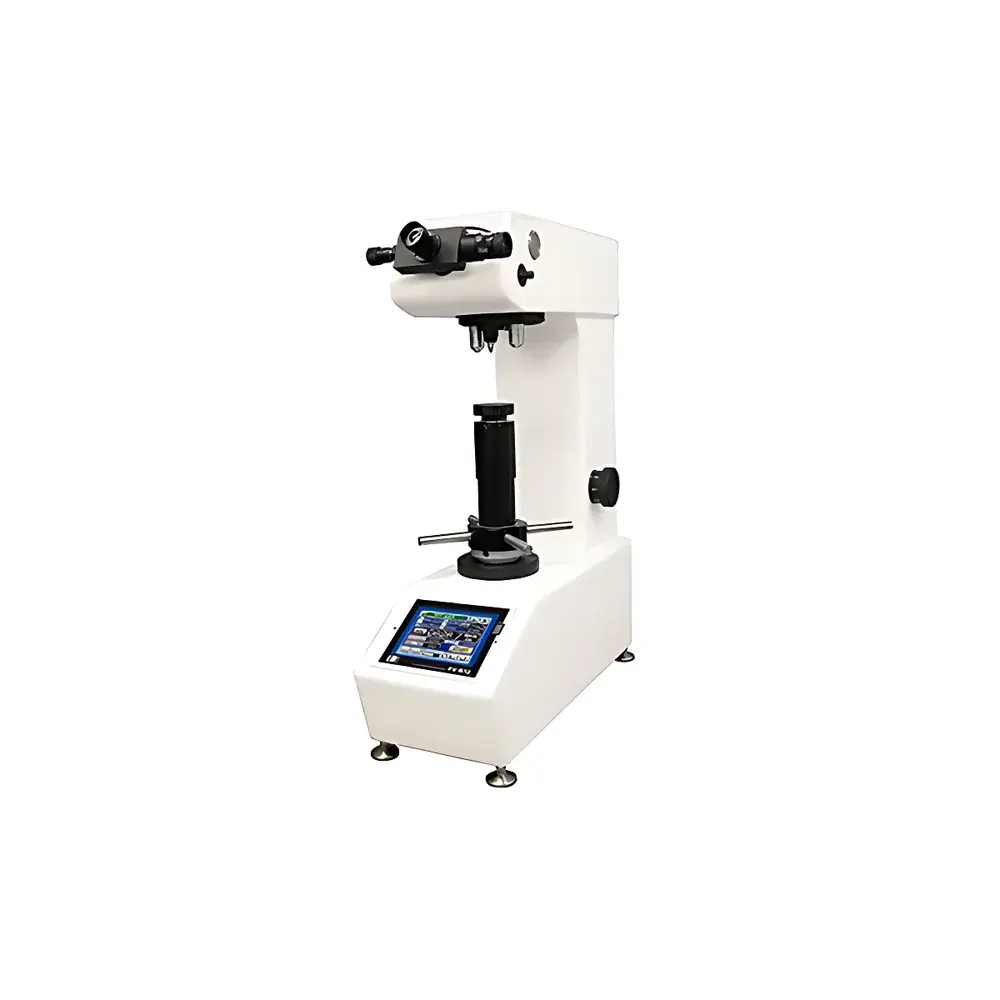
Future-Tech FV-810 Vickers Hardness Tester
| Brand | Future-Tech |
|---|---|
| Origin | Japan |
| Manufacturer Status | Authorized Distributor |
| Product Origin | Imported |
| Model | FV-810 |
| Price Range | USD 14,000 – 28,000 |
| Instrument Type | Vickers Hardness Tester |
| Measurement Range | 0–3000 HV |
| Total Test Force | 50 kgf |
| Maximum Specimen Height | 210 mm |
| Specimen Depth Capacity | 165 mm |
| Loading Mechanism | Fully Automatic (Load-Hold-Unload) |
| Turret Operation | Motorized Automatic |
| Standard Indenter | Single Diamond Vickers (HV) |
| Optional Dual Indenter Mount | Simultaneous HV + Knoop (HK) |
| Max. Objective Lenses | 4 (including standard pair) |
| Display | Full-color LCD Touchscreen with On-screen Data Overlay |
| Compliance | JIS R 1607 (Fracture Toughness Kc Calculation), ISO 6507, ASTM E384, ASTM E92 (Brinell Conversion) |
| Power Supply | AC 100–240 V, 50/60 Hz (Auto-ranging) |
Overview
The Future-Tech FV-810 is a fully automated, high-precision Vickers hardness tester engineered for metrologically rigorous applications in R&D laboratories, quality control environments, and advanced materials research facilities. It operates on the fundamental principle of indentation hardness measurement: a precisely ground diamond pyramid indenter (136° apex angle) is applied to the specimen surface under controlled static load, and the resulting diagonal lengths of the permanent impression are optically measured to calculate the Vickers Hardness Number (HV) according to ISO 6507-1 and ASTM E384. Unlike conventional analog or semi-automatic systems, the FV-810 integrates closed-loop force actuation, motorized turret positioning, and real-time image-based indentation analysis—enabling repeatable, operator-independent results across a broad hardness range (0–3000 HV) and test force spectrum (up to 50 kgf). Its mechanical architecture is optimized for minimal thermal drift and vibration isolation, ensuring long-term stability during extended testing sequences required for statistical process control (SPC) and inter-laboratory comparison studies.
Key Features
- Fully automatic loading, dwell time control (0.1–99.9 s adjustable), and unloading cycle with digital force feedback—eliminating manual intervention and reducing measurement variability.
- Motorized six-position turret supporting simultaneous installation of up to four objective lenses (e.g., 10×, 20×, 40×, 100×) and dual indenters (HV + HK), enabling rapid switching between microhardness and macrohardness protocols without recalibration.
- High-resolution full-color touchscreen interface with intuitive icon-driven navigation; displays real-time test parameters, live optical feed, indentation geometry overlay, and pass/fail status per ISO/ASTM acceptance criteria.
- Integrated Brinell hardness calculation module compliant with ASTM E10, allowing direct conversion from Vickers measurements for comparative material evaluation—especially valuable for cast alloys and heat-treated steels.
- Dedicated fracture toughness (Kc) computation engine aligned with JIS R 1607 Annex B (IF method), supporting quantitative evaluation of brittle ceramics, CVD coatings, and sintered carbides using crack-length-to-indent-diagonal ratios.
- Optical system enhancements include interchangeable aperture and field diaphragms, selectable color filters (for enhanced contrast on reflective or anodized surfaces), and parfocal lens design ensuring consistent focus depth across magnifications.
Sample Compatibility & Compliance
The FV-810 accommodates specimens up to 210 mm in height and 165 mm in depth, making it suitable for large forgings, turbine blades, and layered composite coupons. Its rigid C-frame construction minimizes deflection under maximum load, preserving geometric fidelity during high-force indentation. All hardness values are traceable to national standards via NIST-traceable calibration certificates (available upon request). The instrument meets ISO/IEC 17025 requirements for hardness testing laboratories and supports audit-ready documentation for GLP/GMP-regulated environments. Software-generated reports include full metadata: timestamp, operator ID, environmental conditions (optional sensor integration), raw pixel measurements, uncertainty estimation per GUM (Guide to the Expression of Uncertainty in Measurement), and compliance flags for ASTM E384 section 7.3 (diagonal measurement tolerance) and ISO 6507-2 section 6.2 (indenter verification).
Software & Data Management
Embedded firmware provides native support for USB export of CSV and PDF reports—including annotated images with scale bars and measurement vectors. Optional PC-based software (FV-Link Pro) enables advanced data management: multi-sample batch processing, SPC charting (X̄-R, Cpk), trend analysis over time, and database synchronization with LIMS platforms. Audit trail functionality complies with FDA 21 CFR Part 11 requirements, recording all user actions, parameter modifications, and result approvals with electronic signatures and immutable timestamps. Data encryption (AES-256) and role-based access control (RBAC) ensure regulatory readiness for pharmaceutical excipient characterization or aerospace component certification workflows.
Applications
The FV-810 serves critical roles in metallurgical failure analysis (e.g., weld HAZ hardness mapping), thin-film adhesion assessment (via cross-sectional microhardness profiling), ceramic matrix composite development (Kc validation per JIS R 1607), and additive manufacturing post-process qualification (density–hardness correlation studies). Its dual-indenter capability facilitates comparative HV/HK testing on gradient materials such as case-hardened gears or PVD-coated cutting tools—where Knoop indentation minimizes cracking in brittle interfacial layers. Academic users leverage its programmable test sequences for creep-hardness coupling experiments and temperature-dependent indentation studies (when integrated with environmental chambers).
FAQ
Does the FV-810 support automatic indentation measurement without manual calibration?
Yes—the system performs auto-focus, edge detection, and diagonal length quantification using sub-pixel interpolation algorithms validated against certified reference blocks (e.g., NIST SRM 2820).
Can the instrument be integrated into an existing factory MES or QMS platform?
Yes—via Ethernet TCP/IP or RS-232 serial interface, supporting Modbus RTU and custom API protocols for bidirectional data exchange.
Is JIS R 1607 Kc calculation limited to specific materials?
No—the algorithm applies universally to any brittle material exhibiting radial/median cracks post-indentation, provided crack lengths exceed 2.5× the indentation diagonal (per IF method validity criteria).
What maintenance intervals are recommended for long-term accuracy?
Annual verification of indenter geometry (using SEM or interferometric profilometry) and biannual force calibration with dead-weight standards are advised per ISO 6507-3.



