
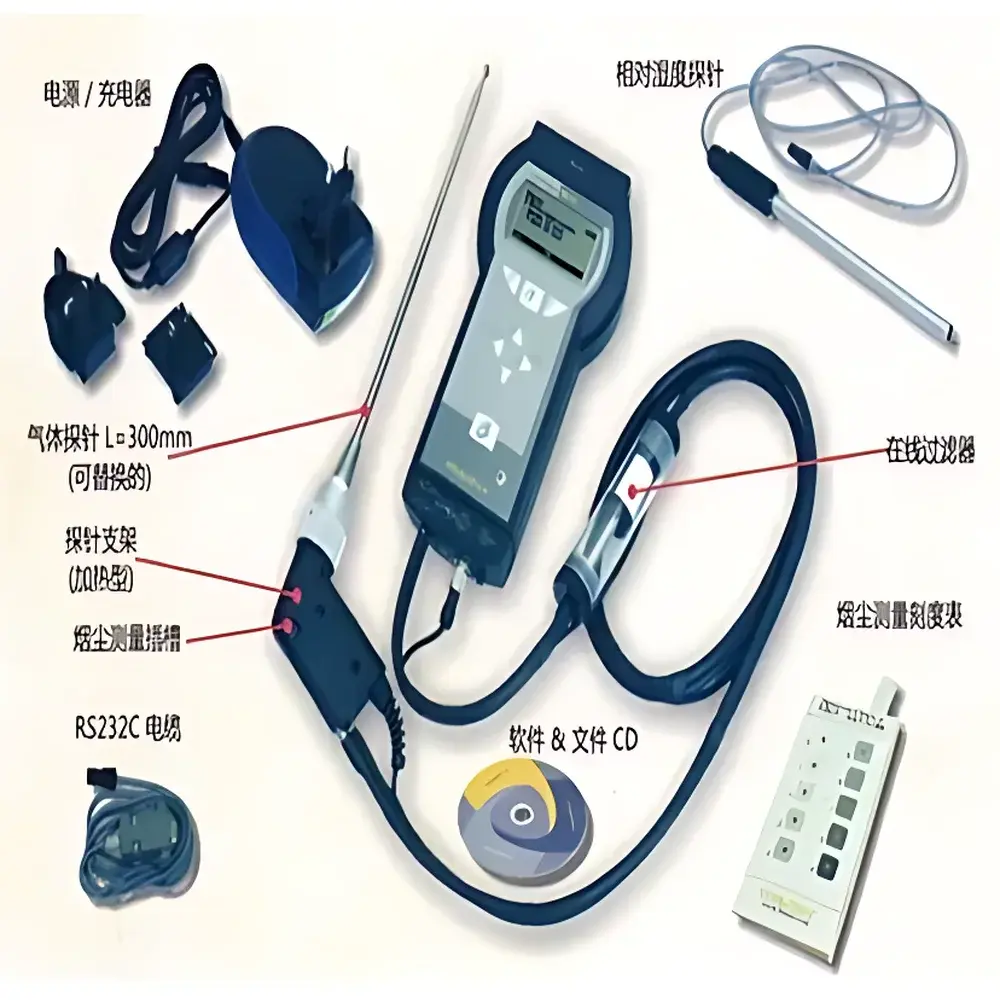
GA-12plus Handheld Flue Gas Analyzer by Testo (Austrian Origin)
| Key | Origin=Austria |
|---|---|
| All gas sensors | LOD=5 ppm |
Overview
The GA-12plus Handheld Flue Gas Analyzer is a compact, field-deployable instrument engineered for precise, real-time combustion efficiency and emissions assessment in small- to medium-scale thermal systems. Designed and manufactured under strict Austrian quality control, it complies fully with EN 50379-1 and EN 50379-2 (2012), the European standard governing portable flue gas analyzers used for regulatory-compliant boiler commissioning, maintenance, and periodic emission verification. Its core measurement architecture employs calibrated electrochemical gas sensors for O₂, CO, NO, NO₂, and SO₂ — each optimized for long-term baseline stability and low cross-sensitivity. Temperature measurements utilize a Class 2 thermocouple (K-type) for flue gas and a Pt100 RTD for ambient conditions; static pressure and differential pressure are acquired via temperature-compensated silicon piezoresistive (DMS) bridges; flow velocity is derived from Pitot tube differential pressure with integrated temperature compensation; and smoke blackness is assessed per standardized visual comparison (Bacharach scale). The unit’s robust IP54-rated housing ensures operational reliability in industrial environments, including boiler rooms, heating plant basements, and outdoor stack access points.
Key Features
- True multi-parameter combustion analysis: Simultaneous acquisition of five regulated gases (O₂, CO, NO, NO₂, SO₂), flue gas temperature (Tgas), ambient temperature (Tamb), static pressure, ambient barometric pressure, volumetric flow velocity, and smoke blackness.
- High-precision electrochemical sensor array with factory calibration traceable to national metrology institutes; individual sensor zero and span verification supported via built-in calibration mode.
- Integrated calculation engine delivering real-time derived parameters: excess air ratio (λ), combustion efficiency (η), heat loss (qA), CO/CO₂ ratio, and dew point estimation (via optional humidity module).
- Ruggedized magnesium alloy enclosure rated IP54 for dust and water ingress resistance; ergonomic grip design and backlit high-contrast LCD enable one-handed operation in low-light conditions.
- Battery-powered operation (rechargeable Li-ion, >6 h typical runtime); USB-C interface for data export and firmware updates; no external PC required for basic measurements or report generation.
- Pre-configured test templates aligned with EN 12952, EN 12953, and VDI 2066 for quick-start compliance checks during on-site boiler inspections.
Sample Compatibility & Compliance
The GA-12plus is validated for use across residential, commercial, and light industrial combustion sources, including oil- and gas-fired condensing boilers, biomass stoves, packaged steam generators (<1 MW thermal input), and small-scale waste heat recovery units. It is not intended for continuous emissions monitoring (CEMS) or high-temperature duct applications exceeding 1600 °C. All gas sensors meet EN 50379-2 requirements for selectivity, response linearity, and interference rejection (e.g., CO sensor immunity to H₂ up to 1000 ppm). The instrument supports audit-ready documentation: each measurement record includes timestamp, GPS coordinates (when paired with Bluetooth GNSS module), operator ID, probe serial number, and full sensor status logs. Data files comply with EN 14181 QA/QC reporting formats and may be exported in CSV or PDF for integration into ISO 17025-accredited laboratory workflows.
Software & Data Management
Data acquisition and post-processing are managed through the bundled GA-Connect desktop software (Windows/macOS), which supports automated report generation per DIN SPEC 91340 and EU Directive 2010/75/EU Annex VI requirements. The software provides GLP-compliant audit trails: every calibration event, parameter change, or data export is timestamped and user-authenticated. Raw sensor outputs are stored with full metadata (temperature compensation coefficients, pressure correction factors, sensor age counters). Export options include CSV (for LIMS ingestion), PDF (with digital signature support), and XML (compatible with EPA Method 203A reporting frameworks). Firmware updates preserve all user-defined configurations and historical calibration records, ensuring continuity across device lifecycle management.
Applications
- Routine combustion tuning and optimization of gas/oil-fired heating systems to minimize CO formation and maximize η.
- Regulatory pre-commissioning checks for new installations subject to local air quality ordinances (e.g., TA Luft, BImSchV Annex 15).
- Annual maintenance verification of emission limits per EN 303-2, EN 303-4, or regional equivalents (e.g., US EPA Subpart OOOO).
- Troubleshooting incomplete combustion events using real-time λ and CO/CO₂ trends correlated with Tgas and draft pressure profiles.
- Educational use in vocational training programs for HVAC technicians and energy auditors — includes pedagogical overlays and guided measurement workflows.
- Baseline emissions profiling prior to retrofitting with low-NOx burners or flue gas recirculation systems.
FAQ
What standards does the GA-12plus comply with for legal metrology?
It conforms to EN 50379-1 and EN 50379-2 (2012), covering type examination, performance testing, and documentation requirements for portable flue gas analyzers used in official inspections.
Can the instrument measure NOx as a sum parameter?
Yes — when NO and NO₂ sensors are both installed, the analyzer computes total NOx (NO + NO₂) automatically and displays it alongside individual concentrations.
Is field calibration possible without sending the unit to a service center?
Zero calibration for all electrochemical sensors can be performed on-site using certified zero air; span calibration requires certified span gases and is recommended annually or after exposure to extreme contamination.
Does the GA-12plus support data encryption or 21 CFR Part 11 compliance?
While not FDA-certified, its desktop software implements electronic signatures, role-based access control, and immutable audit logs — enabling alignment with internal GLP/GMP data integrity policies.
What is the expected service life of the electrochemical sensors?
Typical operational lifetime is 24–36 months under normal field conditions; sensor health is continuously monitored and reported via diagnostic codes in the status menu.
Related Products







