
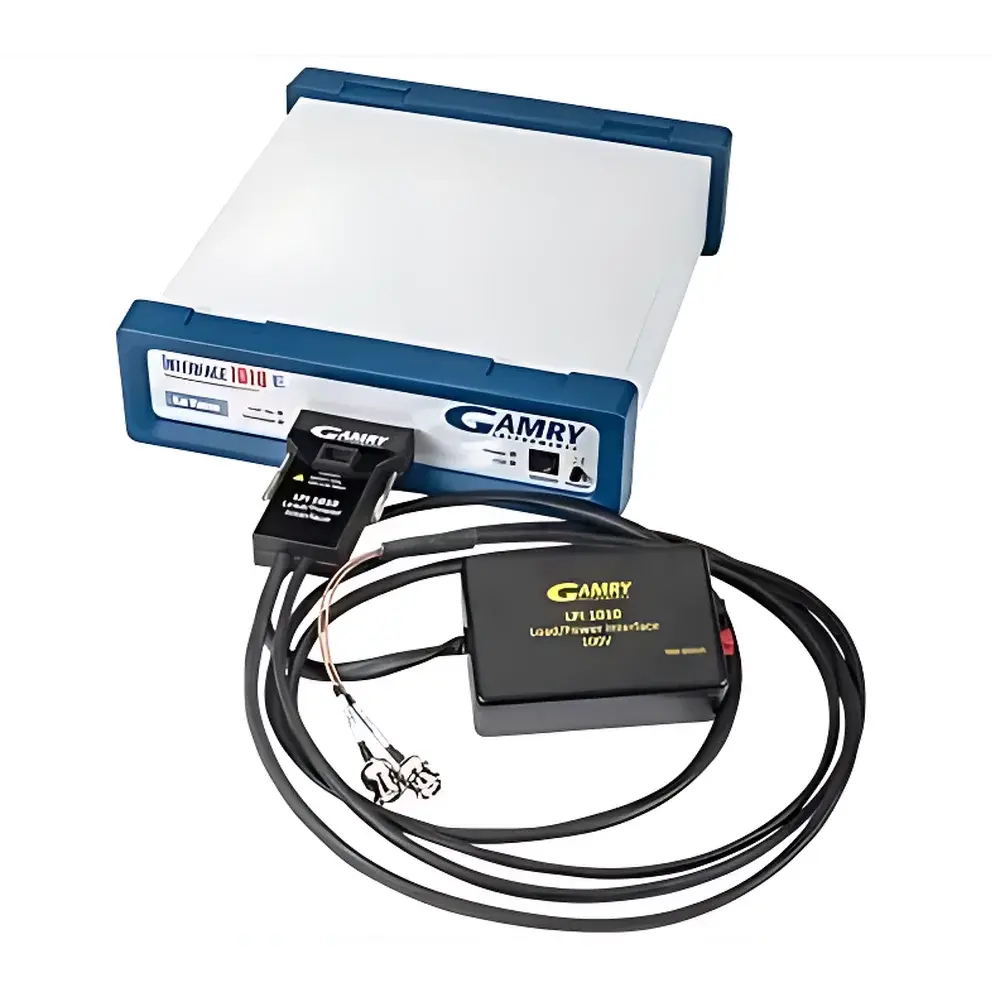
Gamry LPI1010 Load/Power Supply Interface for High-Voltage, High-Current EIS Testing
| Brand | Gamry |
|---|---|
| Origin | USA |
| Model | LPI1010 |
| Instrument Type | Portable Electrochemical Workstation Interface |
| Current Range | ±10 mA |
| Current Accuracy | ±0.2% of reading |
| Potentiostatic Range | ±10 V (configurable up to ±100 V or ±1000 V with optional variants) |
| Voltage Control Modes | 10 V / 100 V / 1000 V |
| AC Impedance Frequency Range | 10 µHz – 1 MHz (measurement bandwidth limited by external power supply or electronic load) |
| Weight | 1 kg |
| Electrode Cable Length | 1 m |
| Signal Output/Input Interface | BNC, ±10 V full-scale |
| Operating Modes | Galvanostatic EIS, Hybrid EIS |
Overview
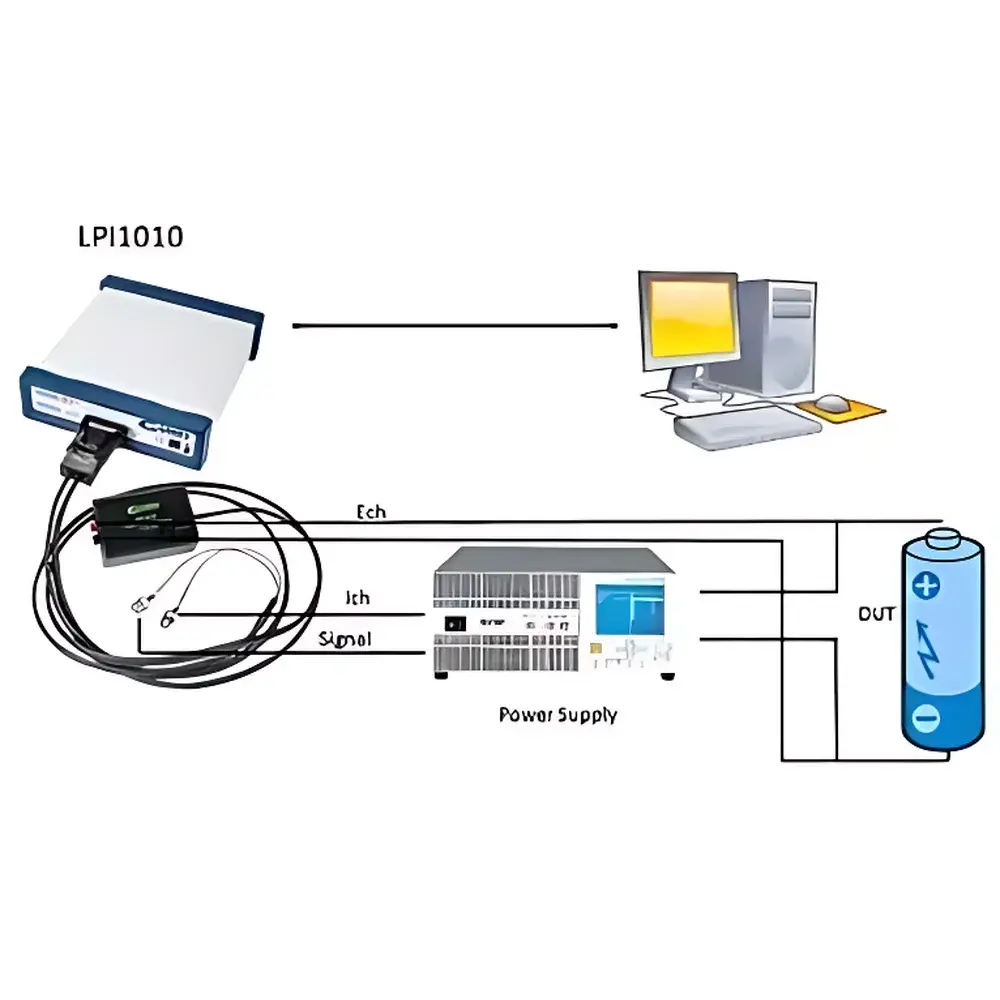
The Gamry LPI1010 Load/Power Supply Interface is a precision-engineered hardware module designed to extend the voltage and current capabilities of Gamry’s Interface 1010E potentiostat for electrochemical impedance spectroscopy (EIS) measurements on high-power electrochemical systems. Unlike conventional laboratory-grade potentiostats—typically limited to ±10 V and sub-amp current ranges—the LPI1010 enables EIS characterization of low-impedance, high-energy devices such as lithium-ion battery packs, fuel cell stacks, and flow batteries operating at system-level voltages up to ±1000 V. It functions not as a standalone potentiostat, but as an intelligent signal conditioning and interface unit that bridges the Interface 1010E with external bipolar power supplies or programmable electronic loads. By injecting calibrated sinusoidal current perturbations (via the external source) and synchronously measuring voltage response across the device under test (DUT), the LPI1010 facilitates accurate, phase-resolved impedance acquisition in galvanostatic or Gamry’s proprietary hybrid EIS mode. Its architecture is grounded in controlled-current excitation and high-fidelity voltage sensing—principles essential for minimizing measurement artifacts in systems where series resistance and distributed capacitance dominate the impedance signature.
Key Features
- Three configurable voltage interface variants: LPI1010-10V (±10 V), LPI1010-100V (±100 V), and LPI1010-1000V (±1000 V), each optimized for specific stack-level testing requirements
- Galvanostatic EIS capability with ±10 mA current range and ±0.2% current accuracy, enabling precise perturbation control even at sub-milliohm impedances
- Extended low-frequency resolution down to 10 µHz—critical for modeling slow interfacial processes including solid-electrolyte interphase (SEI) evolution and catalyst degradation kinetics
- BNC-based analog I/O (±10 V full-scale) for seamless integration with industry-standard bipolar power supplies and electronic loads
- Hybrid EIS mode: dynamically combines potentiostatic and galvanostatic control within a single frequency sweep to maintain stability during transient polarization states
- Robust electromagnetic shielding and differential voltage sensing minimize noise in high-current, high-voltage environments typical of EV battery pack validation and PEM fuel cell stack diagnostics
Sample Compatibility & Compliance
The LPI1010 is engineered for direct compatibility with multi-cell battery modules (e.g., 48 V–800 V traction packs), proton exchange membrane (PEM) and solid oxide fuel cell (SOFC) stacks, redox flow cells, and large-format supercapacitor banks. Its design adheres to fundamental safety and metrological principles aligned with IEC 62619 (secondary lithium cells for industrial applications) and ISO 12405 (electric vehicle battery testing). When integrated into a full Gamry system—including the Interface 1010E and validated external power electronics—the configuration supports audit-ready data acquisition compliant with GLP and GMP frameworks. Full traceability is maintained through timestamped raw impedance spectra, instrument calibration logs, and metadata-tagged experimental parameters—all preserved in Gamry’s Echem Analyst™ software in accordance with FDA 21 CFR Part 11 requirements for electronic records and signatures.
Software & Data Management
Data acquisition and analysis are fully managed via Gamry’s Echem Analyst™ v9.x software suite, which provides native support for LPI1010-specific acquisition protocols, automatic gain scaling, and real-time FFT-based signal validation. The software implements advanced Kramers–Kronig consistency checks and supports custom equivalent circuit modeling (ECM) using distributed element networks (e.g., transmission line models) required for accurate interpretation of porous electrode and membrane responses. All impedance datasets are stored in the standardized .DTA binary format, ensuring interoperability with third-party tools such as MATLAB®, Python (via gamrytools library), and Thermo Scientific™ OMNIC™ for cross-platform spectral correlation. Audit trails include operator ID, instrument firmware revision, environmental temperature/humidity tags (when interfaced with optional sensors), and full chain-of-custody metadata exportable as CSV or PDF reports.
Applications
- State-of-health (SoH) assessment of EV battery packs via low-frequency EIS (<1 Hz) to quantify aging-induced increases in ohmic resistance and charge-transfer impedance
- Diagnostics of PEM fuel cell stack performance loss—differentiating cathode oxygen transport limitations from membrane hydration deficits using distribution-of-relaxation-times (DRT) analysis
- Accelerated stress testing (AST) of next-generation anode materials (e.g., silicon composites) under realistic cycling conditions with simultaneous EIS monitoring
- Validation of thermal management system efficacy by correlating in-situ EIS phase angle shifts with localized temperature gradients across battery modules
- Electrolyte formulation screening for sodium-ion and solid-state batteries using high-precision mid-frequency impedance mapping (100 Hz–10 kHz)
FAQ
Is the LPI1010 a standalone potentiostat?
No. The LPI1010 is a dedicated interface module and requires pairing with a Gamry Interface 1010E (or newer compatible potentiostat) and an externally sourced bipolar power supply or electronic load.
Can the LPI1010 perform potentiostatic EIS?
Not independently. It enables galvanostatic and hybrid-mode EIS only. Potentiostatic control is executed by the host Interface 1010E, while the LPI1010 manages current modulation and synchronized voltage acquisition.
What is the maximum measurable impedance at 10 µHz with the 1000 V variant?
The theoretical upper limit is governed by system signal-to-noise ratio and integration time—not by the LPI1010 itself. In practice, impedances exceeding 100 kΩ at sub-millihertz frequencies require >60 s per point and active shielding to mitigate drift and environmental coupling.
Does Gamry provide certified calibration for LPI1010 systems?
Yes. NIST-traceable calibration certificates are available for complete LPI1010 + Interface 1010E + power supply configurations, covering gain, offset, phase delay, and frequency response across the full 10 µHz–1 MHz operational envelope.
Is firmware upgrade required for existing Interface 1010E units?
Yes. Interface 1010E instruments manufactured prior to 2021 require factory firmware update and hardware verification before LPI1010 compatibility is enabled.





