
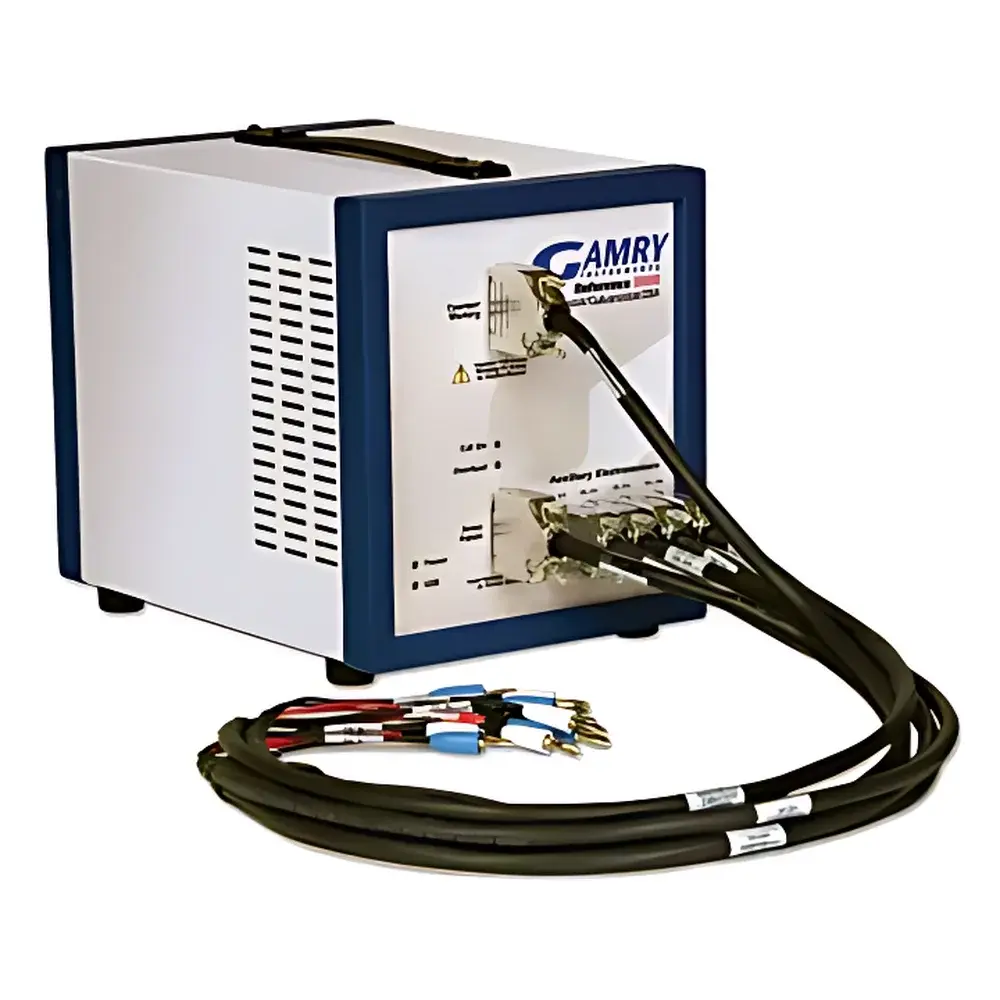
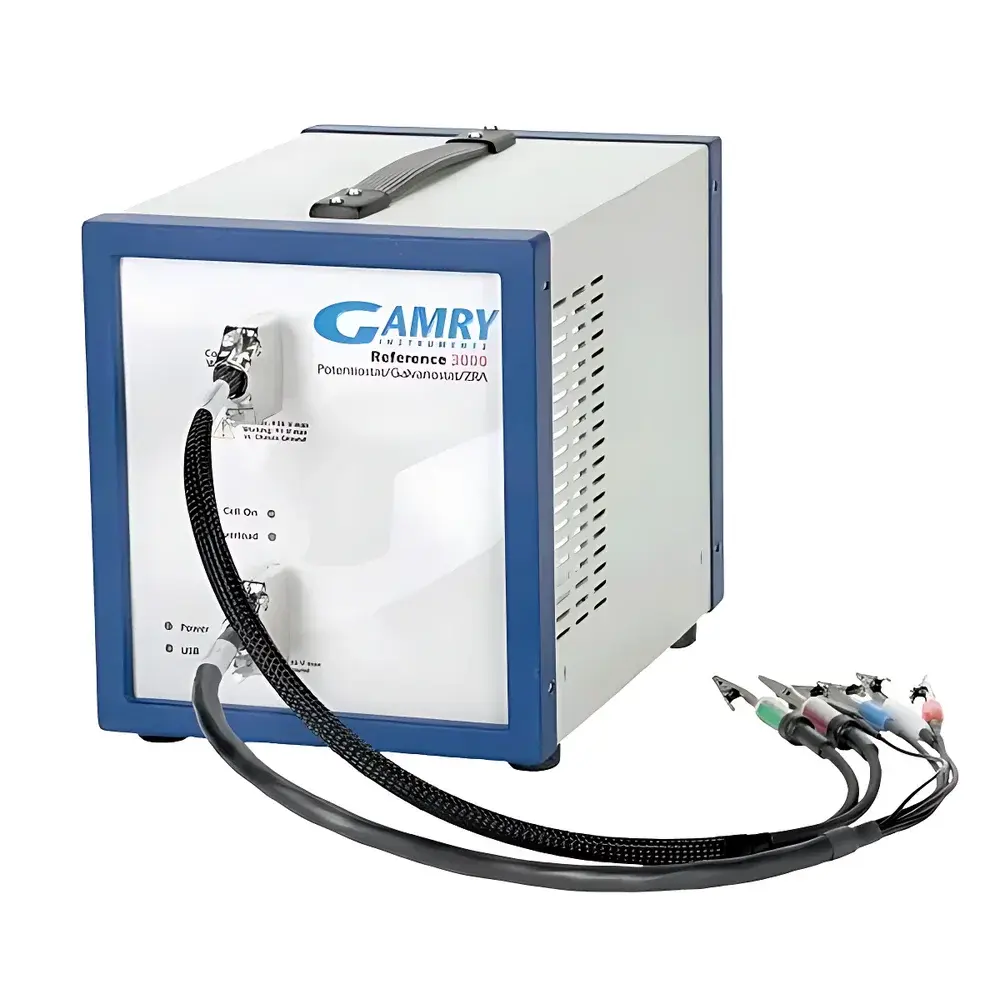
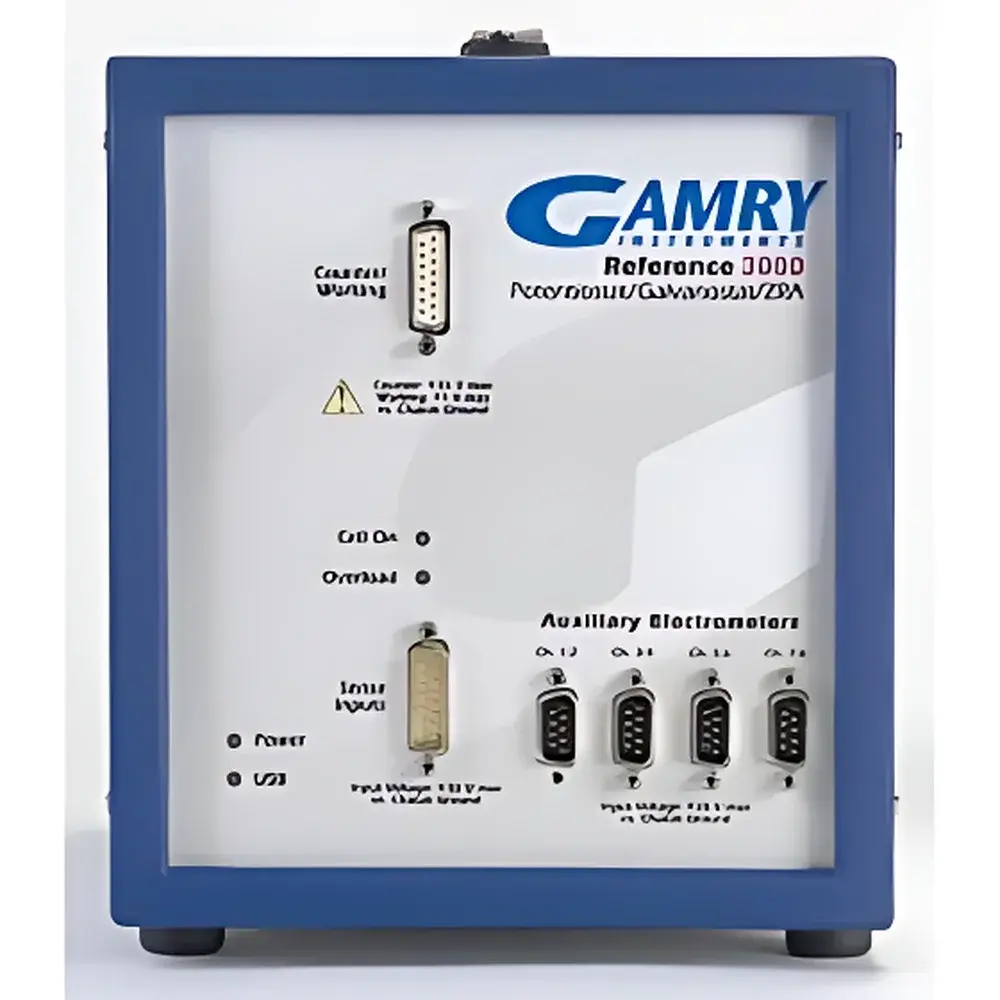
Gamry Reference 3000AE Electrochemical Workstation
| Brand | Gamry |
|---|---|
| Origin | USA |
| Model | Reference 3000AE |
| Current Range | 3 pA – 3 A |
| Current Accuracy | ±0.2% of reading or ±10 pA (whichever is greater) |
| Potential Accuracy | ±0.2% of setting range or ±1 mV |
| Potentiostatic Range | ±32 V |
| EIS Frequency Range | 10 µHz – 1 MHz |
| Input Impedance | >10¹⁴ Ω |
| Potential Resolution | 1 µV (high-resolution mode) |
| Sampling Rate | 300,000 points/sec |
| IR Compensation | Current Interruption & Positive Feedback |
| Auxiliary Voltage Inputs | Up to 8-channel serial potentiometry option available |
Overview
The Gamry Reference 3000AE Electrochemical Workstation is a high-performance, floating-ground potentiostat/galvanostat/zero-resistance ammeter (ZRA) engineered for precision electrochemical characterization across demanding research and industrial applications. Built upon Gamry’s proprietary digital signal processing (DSP) architecture, it delivers exceptional noise immunity, sub-picoampere current resolution, and microvolt-level potential control—enabling rigorous investigation of low-current processes such as corrosion initiation, interfacial electron transfer kinetics, and ultra-low-capacitance systems. Its dual-range voltage capability (±32 V at ±1.5 A or ±15 V at ±3.0 A), combined with seamless auto-ranging across 13 current decades—from 3 pA to 3 A (extendable to 30 A via external amplifier)—makes it uniquely suited for energy storage and conversion studies, including single-cell and multi-cell stack testing under realistic operating conditions. The instrument complies with IEEE Std 1139-2008 for signal integrity and meets electromagnetic compatibility requirements per IEC 61326-1 for laboratory-grade instrumentation.
Key Features
- Floating-ground design enabling safe, noise-immune operation in high-impedance environments (e.g., high-pressure autoclaves, soil corrosion cells, or TEM-electrochemical coupling)
- Ultra-low current detection limit: 3 pA full-scale with 92 aA resolution; input bias current <6 pA ensures fidelity in high-impedance reference electrode measurements
- True 1 MHz electrochemical impedance spectroscopy (EIS) with direct digital synthesis (DDS) excitation and Kramers–Kronig validated data integrity
- Dual-mode EIS acquisition: potentiostatic, galvanostatic, or hybrid current-controlled AC voltage output for enhanced stability in battery impedance profiling
- Integrated auxiliary 8-channel serial potentiometer option for simultaneous voltage monitoring across up to eight series-connected electrochemical units (e.g., battery stacks, fuel cell membranes, or supercapacitor modules)
- Real-time iR compensation using both current-interruption and positive-feedback algorithms, with linear regression-based correction for accurate overpotential quantification
- High-speed data acquisition at 300 kS/s with configurable analog/digital filtering, oversampling, and programmable time bases down to 3.333 µs
- Full compliance with FDA 21 CFR Part 11 when used with Gamry Framework software configured for audit-trail-enabled operation
Sample Compatibility & Compliance
The Reference 3000AE supports standard two-, three-, four-, five-, and 21-electrode configurations, accommodating conventional electrochemical cells as well as specialized setups such as rotating disk electrodes (RDE), scanning electrochemical microscopy (SECM) interfaces, and in situ/operando cells. Its >10¹⁴ Ω input impedance allows stable connection to miniature Luggin capillaries, high-resistance reference electrodes (e.g., Ag/AgCl in non-aqueous electrolytes), and MEMS-based microelectrodes. For regulatory environments, the system supports GLP/GMP-aligned workflows through traceable calibration logs, electronic signatures, and version-controlled method templates in Framework software. It is routinely employed in ASTM G59 (DC polarization resistance), G102 (electrochemical impedance), and ISO 16773-2 (corrosion protection coatings) compliant test protocols.
Software & Data Management
Controlled exclusively via Gamry’s Framework software platform, the Reference 3000AE provides a unified interface for experiment design, real-time visualization, post-acquisition analysis, and report generation. Framework includes application-specific packages—including PWR800 for battery cycling, EchemAC for advanced EIS/EFM, and CorrWare for corrosion analysis—with built-in equivalent circuit modeling (ECM), distribution of relaxation times (DRT), and statistical noise analysis tools. All raw datasets are stored in open-format .DTA files with embedded metadata (timestamp, instrument ID, calibration history), supporting third-party integration via Python API or MATLAB interface. Audit trails record user actions, parameter changes, and file exports in accordance with 21 CFR Part 11 requirements when enabled.
Applications
- Battery R&D: Galvanostatic charge/discharge, differential capacity analysis (dQ/dV), state-of-charge estimation, and aging mechanism studies on Li-ion, solid-state, flow, and Na-ion chemistries
- Fuel cell & electrolyzer characterization: High-frequency resistance (HFR), membrane hydration dynamics, catalyst layer degradation, and stack-level voltage mapping
- Corrosion science: Linear polarization resistance (LPR), electrochemical noise (EN), electrochemical frequency modulation (EFM), and critical pitting temperature (CPT) determination per ASTM G150
- Electrocatalysis & sensor development: Cyclic voltammetry, chronoamperometry, square-wave voltammetry, and anodic stripping voltammetry under controlled mass transport
- Coating & surface protection: EIS-based barrier property evaluation, delamination onset detection, and cathodic disbondment monitoring
- Physical electrochemistry: Electron transfer kinetics, double-layer capacitance, and interfacial charge distribution studies on nanomaterial-modified electrodes
FAQ
Is the Reference 3000AE compatible with high-temperature or high-pressure electrochemical cells?
Yes—the floating-ground architecture and isolated auxiliary I/O channels enable safe integration with autoclaves, furnace cells, and mechanical stress rigs without ground-loop interference.
Can it perform simultaneous EIS on multiple electrodes?
Not natively; however, the 8-channel serial potentiometer option permits synchronized voltage monitoring across stacked units while maintaining single-channel EIS on the primary working electrode.
What is the minimum measurable impedance value?
With the optional low-impedance cabling kit, the system achieves reliable measurement down to ~100 mΩ, validated by short-circuit calibration and phase error correction.
Does it support automated compliance testing per ISO/IEC 17025?
Yes—when operated with calibrated reference standards and documented SOPs, its performance verification procedures align with ISO/IEC 17025 clause 5.5.2 for electrochemical instrumentation.
How is data security ensured during long-term experiments?
Framework implements automatic incremental backup, write-protected project directories, and SHA-256 checksum validation for all exported datasets.




