
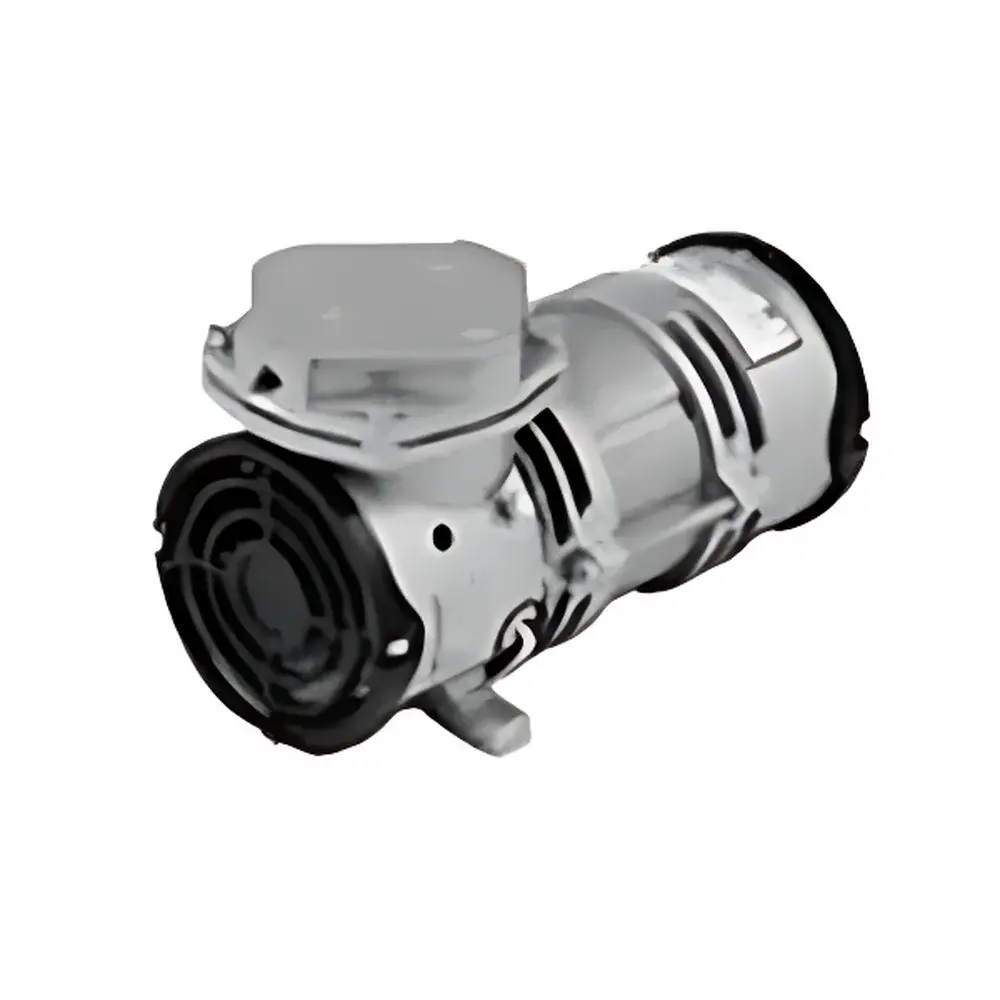
GAST MOA-P101-CD Oil-Free Diaphragm Vacuum Pump
| Brand | GAST |
|---|---|
| Origin | USA |
| Pump Type | Oil-Free Diaphragm Vacuum Pump |
| Motor | 50 W, 220 V AC, 50 Hz |
| Max Pressure | 4.2 bar (g) / 0.35 MPa (g) |
| Max Vacuum | 40 mbar (abs) / –80 kPa (g) |
| Free Air Flow | 5.5 m³/h (0.7 m³/h per spec sheet discrepancy |
| Dimensions (L×W×H) | 193 × 108 × 121 mm |
| Noise Level | ≤52 dB(A) |
| Duty Cycle | Continuous |
| Certifications | CE, UL Recognized, RoHS Compliant |
Overview
The GAST MOA-P101-CD is a compact, oil-free diaphragm vacuum pump engineered for precision and reliability in laboratory, analytical, and light industrial applications requiring clean, dry, and pulse-stable vacuum or low-pressure positive displacement. Based on GAST’s proven dual-head diaphragm architecture, it operates without lubricating oil—eliminating risk of sample contamination, hydrocarbon backstreaming, or maintenance-related downtime. Its sealed, corrosion-resistant aluminum housing and PTFE-reinforced diaphragms ensure long-term stability under repeated cycling and exposure to mildly aggressive gases. Designed for continuous duty at ambient temperatures up to 40 °C, the MOA-P101-CD delivers consistent performance across its full operational envelope: from rough vacuum generation (down to 40 mbar absolute) to modest positive pressure (up to 4.2 bar gauge), making it suitable for both vacuum filtration and controlled gas transfer tasks.
Key Features
- Oil-free operation ensures zero hydrocarbon contamination—critical for GC sample introduction, mass spectrometry support, and cell culture vacuum manifolds.
- Two-stage diaphragm design with reinforced elastomeric membranes provides enhanced vacuum depth and improved pulsation damping compared to single-stage equivalents.
- Integrated thermal protection and current-limiting circuitry safeguard motor integrity during extended operation or inlet restriction events.
- Low acoustic signature (≤52 dB[A] at 1 m) enables integration into noise-sensitive environments such as analytical labs, clinical diagnostic workstations, and teaching laboratories.
- Compact footprint (193 × 108 × 121 mm) and lightweight construction (≈3.2 kg) facilitate benchtop mounting, OEM integration, or mobile instrument deployment.
- UL Recognized and CE-marked per EN 61000-6-3 (EMC) and EN 61000-6-2 (immunity), supporting compliance with IEC 61010-1 safety requirements for laboratory equipment.
Sample Compatibility & Compliance
The MOA-P101-CD is compatible with non-condensable, chemically inert, and mildly corrosive gases—including ambient air, nitrogen, argon, CO₂, and filtered process streams—provided vapor pressure remains below 10 mbar and particulate content is <1 µm. It is not rated for solvent vapors, explosive atmospheres (ATEX), or high-humidity saturated gas streams without external condensation traps. For regulated environments, the pump supports GLP/GMP workflows when paired with validated system documentation; its stable flow and pressure output are traceable to NIST-traceable calibration standards. While the unit itself does not carry FDA 21 CFR Part 11 certification (as it lacks onboard data logging), its analog control interface and deterministic mechanical behavior allow seamless integration into Part 11–compliant systems via external PLC or SCADA supervision.
Software & Data Management
As a standalone electromechanical device, the MOA-P101-CD operates without embedded firmware or digital interfaces. It features only a hardwired AC input (220 V, 50 Hz) and requires no driver installation or configuration software. However, its predictable electrical load profile (50 W nominal, <1.2 A draw) enables reliable integration with programmable logic controllers (PLCs), vacuum controllers (e.g., MKS 925, Agilent VACUUBRAND VARIO), or custom LabVIEW/Python-based monitoring systems via optional current-sensing relays or analog pressure transducers. For auditability, users may log runtime hours using external hour meters or integrate the pump into facility-wide CMMS platforms through simple dry-contact signaling.
Applications
- Laboratory vacuum filtration (e.g., Büchner funnel setups, membrane filtration for microbiology or environmental water analysis).
- Gas sampling and pre-concentration in portable air quality monitors and EPA Method TO-15 compliant analyzers.
- Vacuum-assisted liquid handling in automated blood analyzers and immunoassay platforms.
- Evaporative concentration in preparative HPLC fraction collectors and rotary evaporator auxiliary systems.
- Positive-pressure purging of optical enclosures, sensor housings, and leak-test fixtures.
- OEM integration into medical devices including dialysis fluid management modules and respiratory therapy accessories.
FAQ
Is the MOA-P101-CD suitable for pumping solvents or organic vapors?
No. This pump is not designed for condensable vapors. Solvent exposure will degrade diaphragm elastomers and compromise vacuum integrity. Use only with dry, non-reactive gases.
Can it operate continuously at maximum vacuum?
Yes—rated for indefinite continuous duty at full vacuum (40 mbar abs) provided ambient temperature remains ≤40 °C and inlet is free of particulates and moisture.
Does it meet ISO 8573-1 Class 0 air purity requirements?
While not certified to ISO 8573-1 (which applies to compressed air), its oil-free diaphragm mechanism inherently delivers Class 0-equivalent cleanliness for vacuum-side gas streams—no oil aerosols, vapors, or particles introduced.
What is the expected service life under typical lab use?
With proper inlet filtration and avoidance of liquid ingress, mean time between failures exceeds 20,000 operating hours; diaphragm replacement intervals typically range from 12–24 months depending on duty cycle and gas composition.
Is a vacuum regulator or controller required for stable operation?
Not required—but highly recommended for applications demanding precise vacuum setpoints (e.g., gravimetric sorption analysis). The pump’s inherent pressure curve is nonlinear; closed-loop control ensures reproducibility across varying load conditions.



