
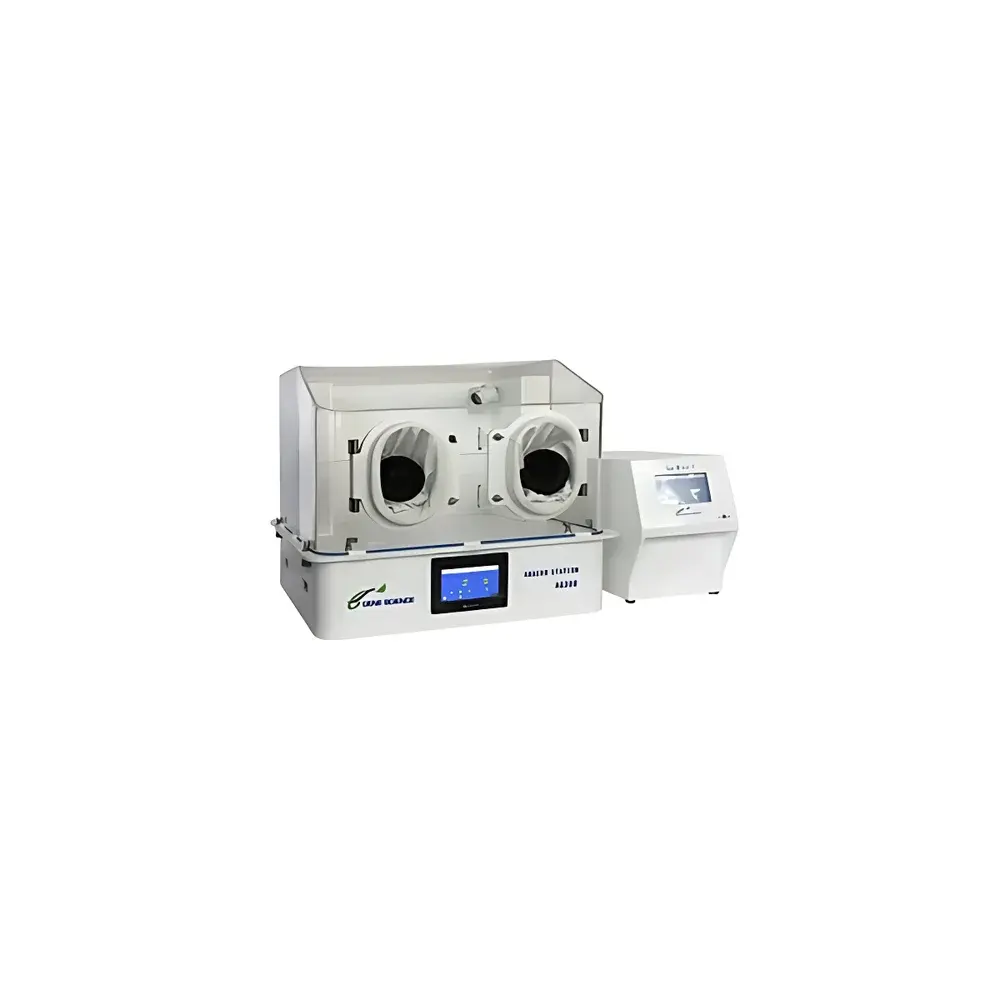
GeneScience AG300 Plus Anaerobic Workstation
| Brand | GeneScience |
|---|---|
| Origin | USA |
| Model | AG300 Plus |
| Incubation Temperature Range | +3°C to 52°C |
| Temperature Uniformity | ±0.3°C |
| Humidity Range | Ambient to 85% RH |
| O₂ Control Range | 0.0–20.9% (±0.1% accuracy) |
| CO₂ Control Range | 0.0–30.0% (±0.1% accuracy) |
| Operating Chamber Dimensions | 750 × 620 × 500 mm (L×W×H) |
| Transfer Lock Capacity | 20 × 90 mm Petri dishes |
| Maximum Culture Capacity | 400 × 90 mm Petri dishes or 70 × 250 mL Erlenmeyer flasks |
| Gas Supply | N₂, CO₂, compressed air, and pre-mixed anaerobic gas (e.g., 85% N₂ / 10% H₂ / 5% CO₂) |
Overview
The GeneScience AG300 Plus Anaerobic Workstation is a fully integrated, touch-screen controlled environmental chamber engineered for precise, long-term cultivation of oxygen-sensitive microorganisms under strictly defined atmospheric conditions. Unlike conventional anaerobic jars or glove boxes with passive gas replacement, the AG300 Plus employs active, real-time gas mixing and feedback-controlled regulation based on electrochemical O₂ and IR-based CO₂ sensing—enabling dynamic maintenance of user-defined hypoxic, microaerophilic, or strict anaerobic atmospheres without cylinder switching or manual recalibration. Its monolithic acrylic construction (10 mm thick) provides optical clarity, chemical resistance, and thermal insulation while supporting dual-function operation: simultaneous sample manipulation and incubation within a single, unified chamber. Designed for compliance with ISO 13485-aligned manufacturing practices and validated for GLP/GMP-relevant workflows, the system supports uninterrupted 24/7 operation under ambient laboratory conditions (220 V, 50/60 Hz), making it suitable for clinical microbiology labs, pharmaceutical QC units, and academic research facilities requiring reproducible anaerobic culture integrity.
Key Features
- Integrated dual-chamber architecture: Combines operator access zone and incubation volume in one sealed, space-efficient unit—eliminating cross-contamination risks associated with transfer between separate workstations and incubators.
- True hands-on operation via nitrogen-purged sleeve system: Vacuum-nitrogen cycling removes >99.99% of ambient O₂ from operator limbs prior to entry; no gloves required, ensuring tactile sensitivity and ergonomic workflow continuity.
- Intelligent gas mixing controller with capacitive touchscreen interface: Enables independent, simultaneous setpoint programming of O₂ (0.0–20.9%, ±0.1% resolution) and CO₂ (0.0–30.0%, ±0.1% resolution); automatic proportional valve actuation maintains target composition without gas cylinder swaps.
- PID-driven temperature regulation: Achieves ±0.1°C setpoint accuracy and ±0.3°C spatial uniformity across the full chamber volume (750 × 620 × 500 mm), supported by redundant thermal sensors and adaptive heating algorithms.
- Active humidity management: Maintains relative humidity from ambient up to 85% RH using a closed-loop evaporative system with condensate trap and cold-trap protection for O₂ sensor stability.
- Lift-off acrylic lid design: Allows complete top removal for installation of large instruments (e.g., colony pickers, microscopes) or deep-cleaning protocols compliant with ISO 14644-1 Class 5 cleanroom maintenance standards.
Sample Compatibility & Compliance
The AG300 Plus accommodates standard microbiological consumables—including 90 mm Petri dishes (up to 400 per run), 250 mL Erlenmeyer flasks (70 units), and multi-well plates—within its high-capacity working volume. Transfer lock functionality supports rapid, contamination-free loading of up to 20 plates per cycle using a dual-gas-exchange protocol (N₂ purge → atmosphere equilibration). All internal surfaces are autoclavable or compatible with sporicidal disinfectants (e.g., hydrogen peroxide vapor, 2% glutaraldehyde). The system meets essential safety requirements per IEC 61010-1 (Electrical Safety for Laboratory Equipment) and incorporates fail-safe mechanisms including low-pressure interlocks, overtemperature cutoffs, and audible/visual alarms triggered by O₂ excursion (>0.1% deviation), CO₂ drift (>0.5%), or humidity loss (>5% RH drop over 30 min). Data logging complies with FDA 21 CFR Part 11 principles via encrypted USB export (Excel-compatible .csv format) with time-stamped audit trails covering all parameter changes, alarm events, and calibration actions.
Software & Data Management
The embedded controller firmware stores up to 14 days of continuous environmental data (O₂, CO₂, temperature, humidity, pressure) at 1-minute intervals. Historical logs are retrievable via USB 2.0 port and exportable as timestamped CSV files for integration into LIMS or statistical process control platforms (e.g., JMP, Minitab). Built-in one-touch O₂ sensor calibration eliminates need for physical probe removal; integrated condensate trap prevents moisture-induced signal drift during high-humidity runs. Firmware supports firmware updates via secure USB media and includes password-protected administrator mode for parameter lockdown in regulated environments. Optional RS-485 or Ethernet modules (sold separately) enable remote monitoring and centralized fleet management across multi-unit installations.
Applications
- Clinical isolation and identification of obligate anaerobes (e.g., Clostridioides difficile, Bacteroides fragilis, Fusobacterium nucleatum) per CLSI M100 and EUCAST guidelines.
- Microaerophilic culture of Helicobacter pylori and Campylobacter jejuni at precisely controlled O₂ (5–10%) and CO₂ (5–10%) levels.
- Long-term maintenance of anaerobic bioreactors, gut microbiota models, and fecal microbiota transplant (FMT) preparation workflows.
- Antibiotic susceptibility testing (AST) under physiologically relevant oxygen tensions to assess metabolic state-dependent resistance phenotypes.
- Preparation of anaerobic culture media, reduction of thioglycollate broth, and activation of catalyst systems (e.g., palladium-based O₂ scavengers).
FAQ
Does the AG300 Plus require external vacuum pumps for routine operation?
No—the integrated vacuum pump is only used during initial chamber evacuation and sleeve purging cycles; continuous operation relies solely on gas mixing and pressure-regulated flow control.
Can the system maintain both anaerobic and microaerophilic conditions without hardware modification?
Yes—gas composition is software-defined; users can switch between 0.0% O₂ (strict anaerobiosis) and 15.0% O₂ (microaerophilic) within seconds via the touchscreen interface.
Is the humidity control system capable of preventing condensation on Petri dish lids?
Yes—the closed-loop humidification system combined with chamber wall temperature zoning minimizes thermal gradients that cause dew formation, preserving colony morphology and reducing edge-effect artifacts.
What regulatory documentation is provided for validation purposes?
Factory-issued IQ/OQ documentation, sensor calibration certificates (NIST-traceable), and a complete electrical safety test report are included; PQ protocols are customizable per client SOP requirements.
How often must the palladium catalyst be replaced?
Under typical usage (8 hrs/day, 5 days/week), the 400 g catalyst cartridge maintains efficacy for ≥12 months; replacement interval is logged automatically and triggers a maintenance alert at 11 months.





