
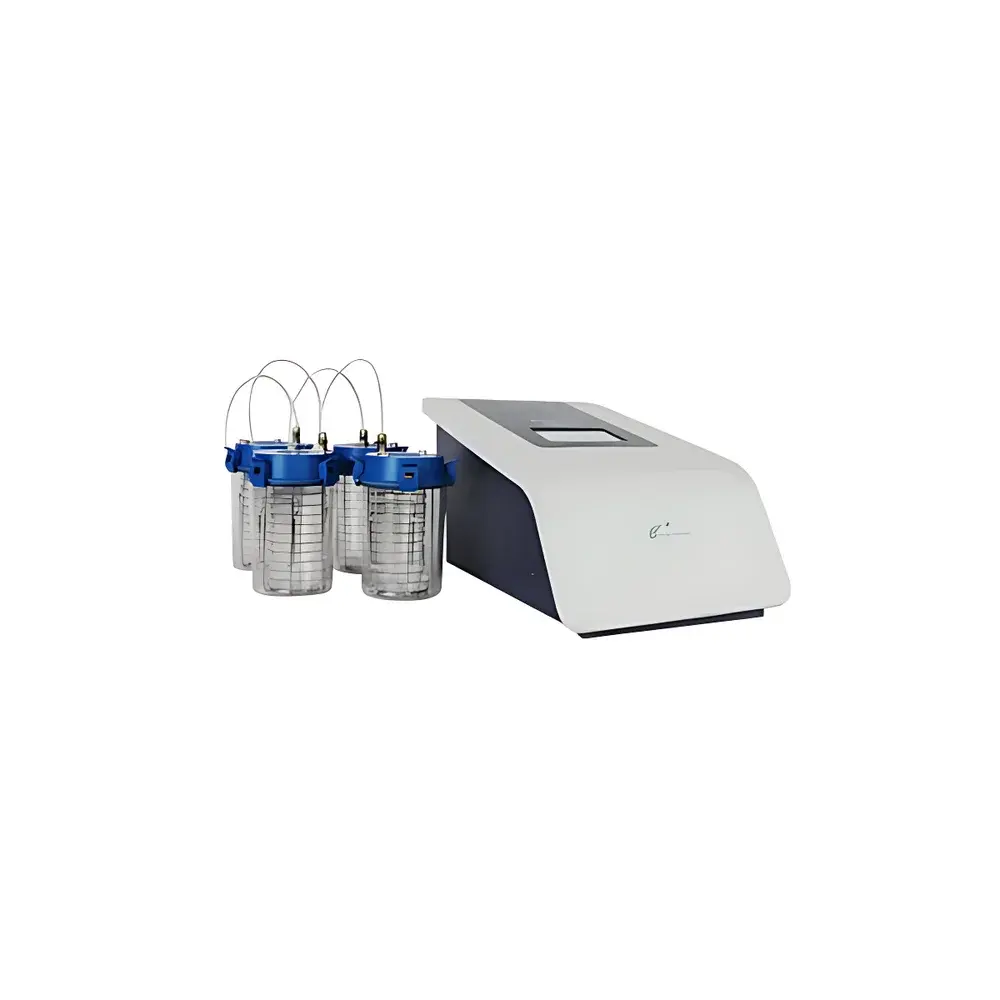
GeneScience Anaero Mark Advanced Anaerobic & Microaerophilic Multi-Gas Incubation System
| Brand | GeneScience |
|---|---|
| Origin | USA |
| Model | Anaero Mark |
| Temperature Range | Up to 100°C |
| Temperature Uniformity & Stability | ±0.3°C at 37°C (typical), validated across full operating range |
| Humidity Control | Ambient humidity-dependent, optimized for operation at 18–28°C ambient |
| Gas Interface | 8 total ports (3 gas cylinder inputs, 4 incubation chamber outputs, 1 spare) |
| Chamber Volumes | 3.5 L / 7 L / 10 L / 20 L (user-selectable, modular) |
| Gas Exchange Speed | <2 min for microaerophilic |
| Catalyst | Palladium-coated hydrogen catalyst, regenerable in situ |
| Compliance | Designed to support GLP/GMP workflows with optional audit-trail-capable data logging and 21 CFR Part 11–compliant software modules |
Overview
The GeneScience Anaero Mark is a benchtop, fully automated multi-gas incubation system engineered for precise, reproducible control of oxygen, carbon dioxide, hydrogen, and nitrogen partial pressures in microbiological culture environments. Utilizing vacuum-assisted gas substitution (VAGS) — a validated alternative to palladium-catalyzed hydrogen replacement alone — the system achieves rapid, quantitative atmospheric conditioning via sequential evacuation and precision gas blending. Unlike passive or catalytic-only systems, the Anaero Mark integrates real-time leak integrity verification, catalyst activity monitoring, and programmable gas ratio synthesis to support strict regulatory requirements for anaerobic, microaerophilic, capnophilic, and facultative culture protocols. Its architecture complies with ISO 13485 design principles for in vitro diagnostic equipment and supports traceability frameworks aligned with FDA 21 CFR Part 11 when configured with optional data export and thermal-printed audit logs.
Key Features
- Modular chamber design: Interchangeable transparent polypropylene incubation vessels (3.5 L, 7 L, 10 L, 20 L) rated for continuous operation up to 100°C — enabling sterilization-in-place (SIP) and high-temperature decontamination cycles without structural compromise.
- Eight-port gas distribution hub: Three dedicated cylinder inlets (left/right-threaded regulators included), four independent chamber outputs, and one configurable spare port — permitting concurrent operation of multiple gas blends (e.g., 5% O₂/10% CO₂/85% N₂ for Campylobacter; 0% O₂/10% H₂/10% CO₂/80% N₂ for strict anaerobes).
- Integrated quality assurance suite: Five-tier validation protocol including gas input pressure verification, chamber leak detection (down to 0.5 mbar/min decay), five-stage seal integrity testing, and real-time palladium catalyst activity assessment — all reported on-screen with actionable status flags.
- Touchscreen-native control interface: 7-inch color LCD with intuitive graphical workflow navigation, multilingual firmware (English default), and embedded microcomputer enabling standalone operation without external PC dependency.
- No consumables or scheduled maintenance: Solid-state solenoid valves, sealed rotary vane vacuum pump, and regenerable Pd/H₂ catalyst eliminate routine part replacement — supporting true 7×24 operational readiness with <60-second warm-up-to-use time.
Sample Compatibility & Compliance
The Anaero Mark accommodates standard microbiological formats including 90 mm and 100 mm Petri dishes (up to 12 per 7 L chamber), agar slants, broth tubes, and membrane filtration assemblies. Its chamber geometry and thermal mass distribution ensure uniform temperature distribution (±0.3°C at 37°C, per ASTM E2874-22) and minimal thermal lag during gas transitions. All materials contacting the incubation environment comply with USP Class VI biocompatibility standards. The system meets ISO 11133:2014 requirements for performance qualification of microbiological incubators and supports validation documentation packages required for CLIA, CAP, and ISO/IEC 17025-accredited laboratories.
Software & Data Management
Preloaded firmware includes programmable method storage (≥50 user-defined profiles), stepwise vacuum/gas sequence scripting, and dynamic parameter interpolation between setpoints. Optional data export module enables CSV-formatted output of timestamped O₂%, CO₂%, vacuum level, chamber temperature, and catalyst status to USB storage or network share. When paired with the certified thermal printer accessory, the system generates tamper-evident hardcopy records compliant with ALCOA+ principles (Attributable, Legible, Contemporaneous, Original, Accurate), satisfying audit requirements under 21 CFR Part 11 Subpart B when deployed with appropriate electronic signature controls.
Applications
- Clinical microbiology: Isolation and subculture of obligate anaerobes (e.g., Clostridioides difficile, Bacteroides fragilis), fastidious microaerophiles (Helicobacter pylori, Campylobacter jejuni), and CO₂-enhanced pathogens (Neisseria gonorrhoeae, Streptococcus pneumoniae).
- Pharmaceutical QC: Anaerobic stability testing of sterile products, antimicrobial susceptibility profiling under physiologically relevant O₂ tensions, and bioburden recovery validation per USP & Ph. Eur. guidelines.
- Research applications: Host-microbe interaction studies requiring dynamic O₂ modulation (e.g., gut microbiota modeling), biofilm development under controlled redox gradients, and metabolic phenotyping of facultative strains across defined atmospheric niches.
- Industrial fermentation support: Pre-culture conditioning for anaerobic bioprocess inocula, strain preservation under low-O₂ cryo-stabilization protocols, and environmental simulation for probiotic viability assessment.
FAQ
What gas mixtures can the Anaero Mark generate?
It supports fully customizable blends of O₂, CO₂, H₂, N₂, and Ar — with programmable setpoints from 0.1% to 21% O₂, 0% to 20% CO₂, 0% to 10% H₂, and balance N₂ or Ar. Vacuum depth is adjustable from 0 to −95 kPa.
How is catalyst activity verified?
The system performs automatic catalytic efficiency checks using calibrated O₂ sensor feedback during H₂-mediated reduction cycles. If residual O₂ exceeds 0.16% after catalyst activation, an alert appears with recommended regeneration or replacement guidance.
Can multiple chambers operate under different gas conditions simultaneously?
Yes — each of the four active chamber ports accepts independent gas blend assignments, allowing concurrent anaerobic, microaerophilic, and capnophilic runs without cross-contamination risk.
Is the system compatible with ISO/IEC 17025 accreditation?
Yes — with optional data export and thermal print modules, it provides full parameter traceability, electronic signature capability, and calibration certificate linkage required for accredited testing laboratories.
What maintenance is required beyond catalyst replacement?
None. The vacuum pump uses oil-free rotary vane technology; all solenoids and sensors are solid-state. Catalyst replacement is only needed after ≥5,000 cycles or confirmed activity loss — typically >2 years under normal use.




