
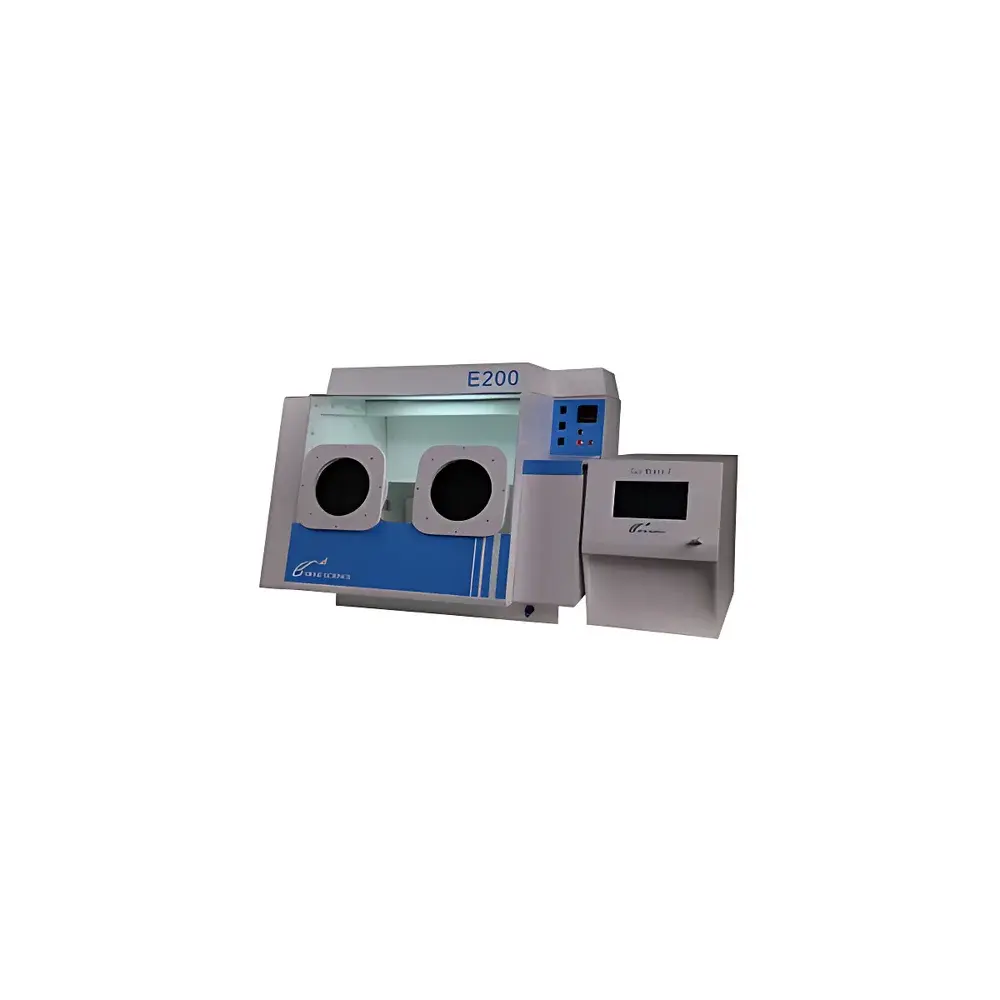
GeneScience E200plus Anaerobic / Hypoxic (CO₂) Workstation
| Brand | GeneScience |
|---|---|
| Origin | USA |
| Model | E200plus |
| Temperature Range | Ambient +3°C to 52°C |
| Temperature Uniformity | ±0.3°C |
| Temperature Accuracy | ±0.1°C |
| Humidity Range | Ambient RH to 85% RH |
| O₂ Control Range | <5 ppm (anaerobic) or 0–25% (hypoxic), resolution 0.1% |
| CO₂ Control Range | 0–20%, resolution 0.1% |
| Transfer Lock Cycle Time | ≤15 s |
| Internal Volume | ≥130 L |
| Culture Capacity | Up to 400 × 90 mm Petri dishes |
| Gas Mixing System | Integrated touchscreen-controlled tri-gas (N₂/CO₂/Air) mixer with 6-stage programmable cycling |
| Data Logging | USB-exportable, 30-day continuous recording of O₂, CO₂, temperature, humidity, and gas inlet events |
| Catalyst Lifespan | ≥4 years (palladium-based, non-regenerative) |
Overview
The GeneScience E200plus Anaerobic / Hypoxic (CO₂) Workstation is an engineered environmental control platform designed for precise, reproducible cultivation of oxygen-sensitive and oxygen-gradient-dependent microorganisms—including strict anaerobes, facultative anaerobes, microaerophiles, and hypoxia-responsive eukaryotic cells. It operates on a closed-chamber, positive-pressure gas replacement principle using high-purity nitrogen, carbon dioxide, and compressed air—eliminating vacuum-based deoxygenation to ensure structural integrity and operator safety. Unlike conventional anaerobic jars or glove boxes reliant on chemical scavengers, the E200plus employs real-time electrochemical O₂ and infrared CO₂ sensing coupled with closed-loop feedback control to maintain stable, user-defined gas compositions across extended incubation periods. Its architecture supports both static and dynamic gas environments—enabling longitudinal studies of physiological adaptation to fluctuating O₂/CO₂ gradients under ISO 13408-1 (sterile processing) and CLSI M47-A (anaerobe susceptibility testing) compliant conditions.
Key Features
- Transparent acrylic chamber (≥130 L internal volume) with optical clarity, electrical insulation, and chemical resistance—facilitating visual monitoring without compromising sterility.
- Integrated transfer lock (2 L capacity, 200 × 120 × 120 mm) achieving <5 ppm O₂ in ≤15 seconds via N₂ purge; accommodates up to 10 × 90 mm Petri dishes per cycle without occupying main workspace.
- Touchscreen gas mixing controller enabling independent, simultaneous setpoint adjustment of O₂ (0–25%, ±0.1% resolution) and CO₂ (0–20%, ±0.1% resolution); no cylinder swapping required for concentration changes.
- Six-segment programmable gas cycling—supports time-resolved hypoxia modeling (e.g., intermittent hypoxia, cyclic reoxygenation, stepwise O₂ ramping) with timestamped parameter logging.
- Bare-hand operation system: sealed linear access ports eliminate gloves/sleeves while maintaining positive pressure integrity—reducing ergonomic fatigue and cross-contamination risk during frequent handling.
- Automated humidity regulation via semiconductor-based dehumidification; maintains RH from ambient to 85% without condensation on sensors or optics.
- Palladium catalyst cartridge (200 g) with >4-year service life under continuous operation; integrated cold trap upstream of O₂ sensor prevents humidity-induced calibration drift.
Sample Compatibility & Compliance
The E200plus accommodates standard microbiological formats—including 90 mm Petri dishes (up to 400 per run), multi-well plates, slant tubes, broth cultures, and tissue culture flasks. Its chamber geometry permits placement of ancillary equipment (e.g., colony pickers, microscopes) via removable side panels. The system complies with IEC 61010-1 (safety of laboratory equipment), meets UL/CSA Class II requirements for electrical isolation, and supports GLP-compliant workflows through audit-trail-capable data logging (O₂, CO₂, T, RH, gas event timestamps). While not FDA 21 CFR Part 11–validated out-of-the-box, its USB-exported CSV logs are compatible with validated LIMS and ELN platforms for regulated environments. All gas sensors are factory-calibrated and traceable to NIST standards; temperature uniformity (±0.3°C) and stability (±0.1°C) are verified per ASTM E145–22 Annex A4 for forced-convection incubators.
Software & Data Management
The embedded controller features a 7-inch capacitive touchscreen interface with intuitive icon-driven navigation. Real-time graphs display O₂, CO₂, temperature, and humidity trends; historical data (30 days at 1-minute intervals) are exportable via USB 2.0 to standard CSV format—compatible with MATLAB, Python pandas, and commercial statistical packages. Alarm events (e.g., low gas pressure, humidity excursion, temperature deviation, leak detection) trigger audible/visual alerts and auto-log entries with severity tagging. The system includes configurable notification thresholds and automatic gas shutoff after 5 minutes of unattended inflow—a fail-safe aligned with ISO 15195:2018 (medical laboratory quality requirements). No proprietary software installation is required for data retrieval or configuration.
Applications
- Cultivation of obligate anaerobes (e.g., Clostridium difficile, Bacteroides fragilis) for clinical diagnostics and antimicrobial susceptibility testing (AST) per CLSI M11-A9.
- Hypoxia research in cancer biology: modeling tumor microenvironments via programmable O₂ gradients (e.g., 0.1–5% O₂) combined with 5–10% CO₂ for pH stabilization.
- Gut microbiota studies requiring sequential O₂ transitions—e.g., simulating colonic oxygen tension shifts during inflammation or dietary intervention.
- Development and validation of anaerobic culture media formulations, including reduction potential (Eh) correlation studies.
- Long-term maintenance of fastidious strains (e.g., Helicobacter pylori, Actinobacillus actinomycetemcomitans) under microaerophilic conditions (5–10% O₂, 5–10% CO₂).
- Quality control of probiotic manufacturing processes where oxygen exposure must be quantified and controlled per ISO 20128:2018.
FAQ
Does the E200plus require vacuum evacuation during initial setup?
No. It uses a quantitative nitrogen flush followed by automated gas composition tuning—avoiding mechanical stress from vacuum cycles and eliminating risk of chamber implosion.
Can the system operate unattended for extended periods?
Yes. Continuous operation is supported with integrated safety interlocks, including automatic gas cutoff, leak detection, and thermal over-limit shutdown—validated for 72-hour uninterrupted runs.
Is calibration of gas sensors performed in situ?
Yes. The O₂ sensor includes one-touch zero-point calibration without disassembly; CO₂ sensor calibration is performed using certified span gas via dedicated port—both procedures documented in the onboard log.
What maintenance is required for the palladium catalyst?
None beyond periodic visual inspection. The catalyst is pre-activated and designed for four years of continuous use under recommended gas purity specifications (N₂ ≥99.999%, CO₂ ≥99.99%).
How is sterility maintained during sample transfer?
The transfer lock uses laminar N₂ flow to displace ambient air; internal UV-C (254 nm) irradiation (30-min cycle) sterilizes surfaces between transfers—validated per ISO 15714 for surface microbial reduction.




