
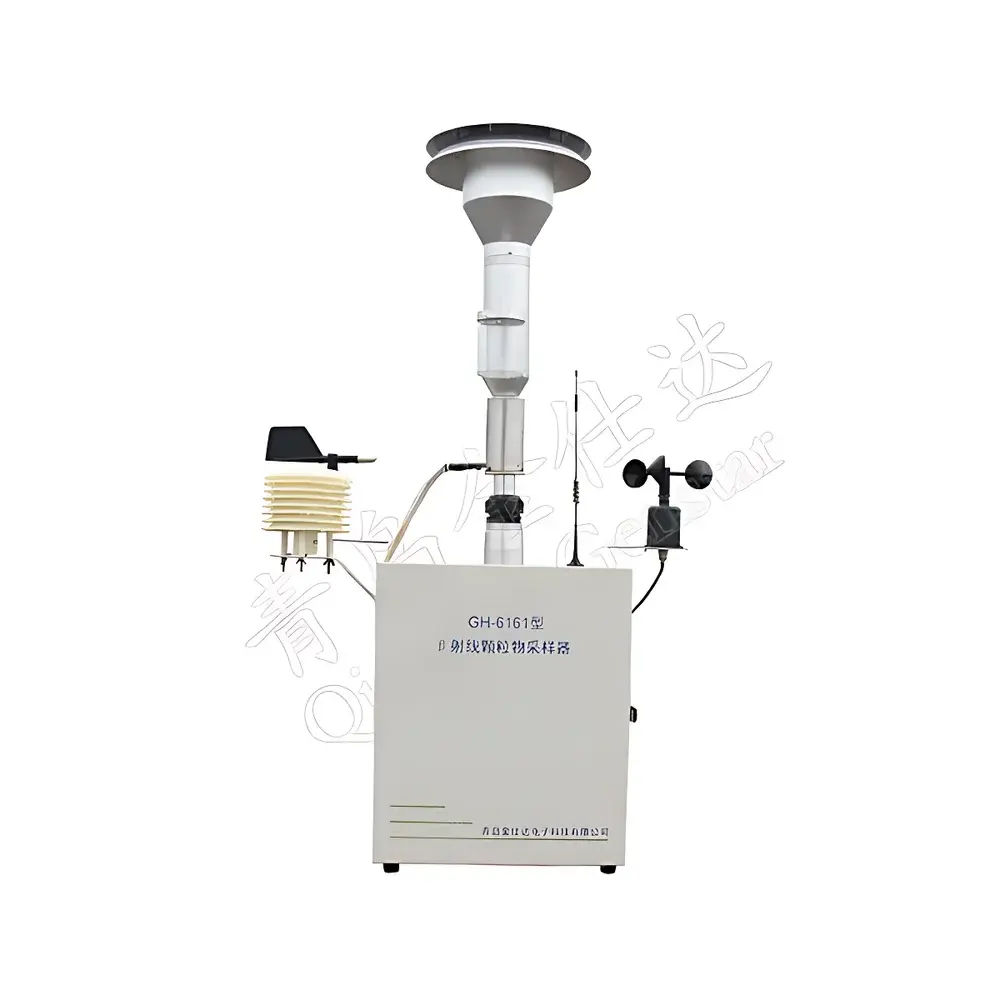
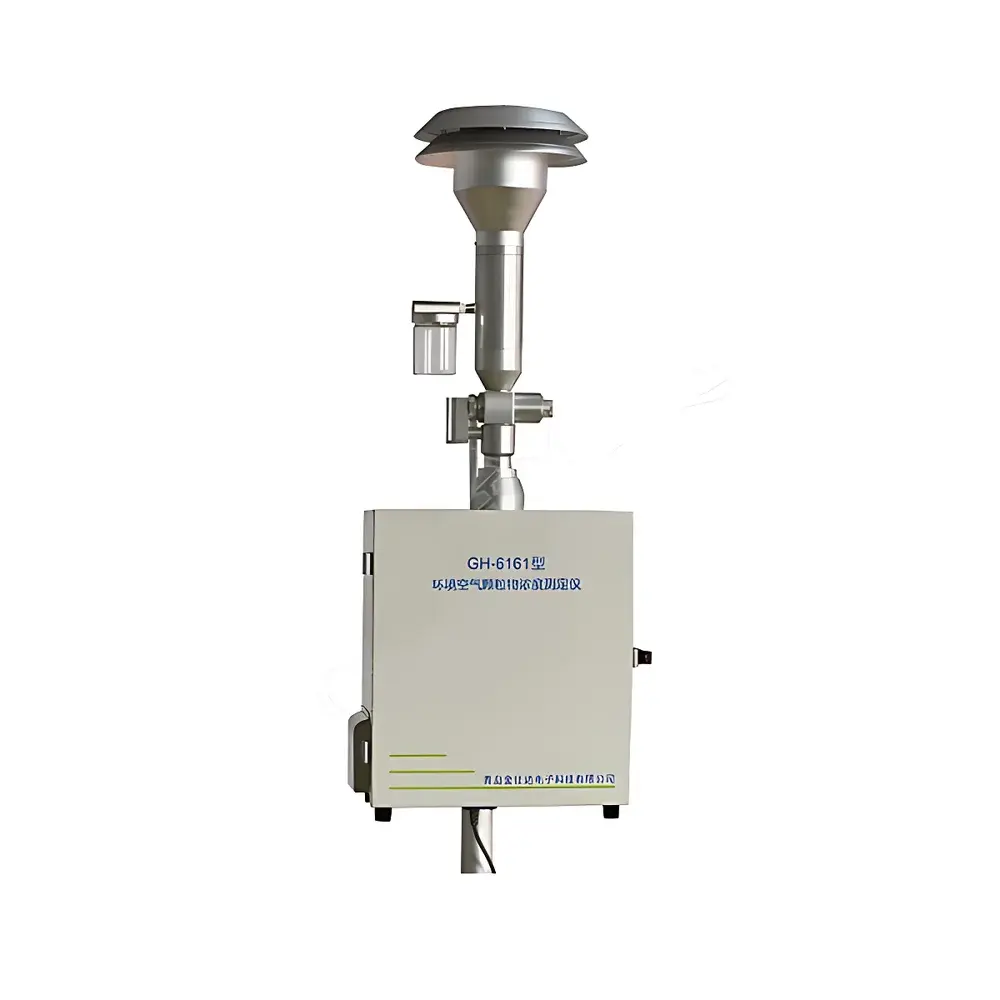
Genetec GH-6161 Beta-Ray & Optical Scattering Integrated Ambient Dust Monitoring System
| Brand | Genetec |
|---|---|
| Origin | Shandong, China |
| Manufacturer Type | Direct Manufacturer |
| Country of Origin | China |
| Model | GH-6161 |
| Instrument Type | Online Continuous Monitor |
| Measurement Principle | Beta-Ray Absorption (¹⁴C source) + Nephelometric Light Scattering |
| Measured Parameters | PM₁₀ and/or PM₂.₅ mass concentration |
| Beta Source | Low-energy ¹⁴C (≤3.7 kBq) |
| Sampling Flow Rate | 16.7 L/min |
| Detection Method | Photomultiplier Tube (PMT) with Filter Tape Collection |
| Compliance | GB 3095–2016, HJ 653–2013 |
| Environmental Rating | IP55 (Dust- and Rain-Resistant) |
| Data Output | Standard HJ 212–2017 protocol |
| Data Storage | Internal non-volatile memory + USB export |
| Operating Mode | Unattended, 24/7 continuous operation |
Overview
The Genetec GH-6161 is a certified online ambient particulate matter monitoring system engineered for regulatory-grade, long-term measurement of PM₁₀ and PM₂.₅ mass concentrations in ambient air. It integrates dual physical measurement principles—beta-ray absorption (using a low-activity ¹⁴C source) and nephelometric optical scattering—to deliver high-fidelity, traceable mass concentration data under real-world environmental conditions. Unlike single-principle instruments, the GH-6161 employs co-located sampling and detection: particles are collected directly onto a moving filter tape at the same position where beta attenuation is measured, eliminating spatial uncertainty introduced by transport mechanisms (e.g., paper tape displacement or flow path mismatch). This architecture ensures metrological traceability to gravimetric reference methods per HJ 653–2013. The system operates continuously without manual intervention, supporting unattended deployment across urban, industrial, roadside, and rural monitoring networks.
Key Features
- Co-located beta attenuation measurement: Real-time mass loading quantification on the same filter segment used for sampling—no correction for tape transit delay or positional drift.
- Dynamic Heating System (DHS): Heats inlet air to controlled temperature (typically 30–50 °C) to volatilize semi-volatile compounds (e.g., ammonium nitrate, organic aerosols), minimizing positive artifact and improving comparability with reference TEOM/FDMS systems.
- Integrated dynamic temperature/humidity compensation: Onboard sensors measure ambient T/RH/pressure; all volumetric flow and mass calculations are automatically normalized to standard reference conditions (25 °C, 101.325 kPa).
- Low-activity ¹⁴C beta source (≤3.7 kBq): Certified for Class V radioactive material handling; fully shielded, compliant with national radiation safety regulations (GB 18871); requires no special licensing beyond routine facility registration.
- Modular hardware architecture: Separable sampling head, analyzer unit, and power/data module—enabling rapid field maintenance, component-level replacement, and future sensor expansion (e.g., NO₂, SO₂ add-ons).
- Intelligent diagnostics: Self-calibration verification, tape break detection, filter exhaustion alert, motor stall sensing, and PMT gain drift monitoring—all logged with timestamps and accessible via local interface or remote command.
Sample Compatibility & Compliance
The GH-6161 is validated for continuous monitoring of ambient airborne particulate matter in accordance with China’s national ambient air quality standards and method validation protocols. It meets the performance requirements specified in HJ 653–2013 for PM₁₀ and PM₂.₅ continuous monitoring systems, including precision (≤10% RSD), accuracy (±10% vs. reference gravimetric method), and lower limit of detection (LLD) stability over 30-day field operation. Optional PM-selective inlets (EN 12341 cut-points) allow configuration for either PM₁₀ or PM₂.₅ compliance monitoring. All internal firmware and data handling logic comply with GB/T 35273–2020 (information security) and support audit-ready logging for GLP-aligned environmental laboratories. Radiation shielding design conforms to GBZ 117–2015 for fixed beta-emitting instrument installations.
Software & Data Management
The embedded Linux-based controller runs Genetec’s proprietary EEMS v4.2 firmware, supporting full HJ 212–2017 communication protocol stack for seamless integration with provincial and national environmental monitoring platforms (e.g., CNEMC Cloud). Local data storage retains ≥180 days of 1-minute averaged records (PM mass, flow, T/RH/P, beta counts, diagnostic flags) in SQLite format. Historical datasets can be exported via USB 2.0 to industry-standard CSV or XML schemas compatible with EPA AQS, AirQo, or custom GIS analytics pipelines. Remote access is enabled via TLS-secured HTTP API or Modbus TCP; all commands and parameter changes are time-stamped and logged with user ID for 21 CFR Part 11–compliant audit trails. Firmware updates are signed and verified to prevent unauthorized modification.
Applications
- Regulatory ambient air quality monitoring networks (national, provincial, municipal)
- Construction site and industrial boundary dust compliance verification
- Long-term trend analysis of secondary aerosol formation (e.g., nitrate volatility studies using DHS-enabled mode)
- Mobile monitoring deployments (vehicle-mounted or tripod-based) due to IP55 enclosure and <15 kg total mass
- Research-grade field campaigns requiring simultaneous PM mass and meteorological parameter synchronization
- Calibration transfer studies between beta-ray and optical reference instruments
FAQ
What is the typical lower limit of detection (LLD) for PM₂.₅ under standard conditions?
The LLD is instrument- and site-dependent; typical field values range from 1.2 to 2.5 µg/m³ (1-hour average) when operated at 16.7 L/min with 15-minute integration cycles.
Is the ¹⁴C source subject to periodic replacement?
No—the half-life of ¹⁴C is 5730 years; activity decay is negligible over the instrument’s operational lifetime (≥10 years). Source integrity is verified annually via background count rate and attenuation linearity checks.
Can the GH-6161 operate without network connectivity?
Yes—it functions autonomously with full local data logging, internal clock synchronization, and scheduled self-diagnostics. Network connection is required only for remote data retrieval or platform integration.
Does the system support co-location with other gas analyzers (e.g., O₃, CO)?
Yes—modular mounting brackets and shared power/data interfaces enable synchronized multi-parameter deployments; external analog/digital I/O supports trigger-based coordinated sampling.
How often does the filter tape need replacement?
At nominal 16.7 L/min flow and moderate urban PM levels (~25 µg/m³), a 10-m tape roll lasts approximately 30 days. The system alerts users 72 hours prior to exhaustion and pauses sampling if no action is taken.
Related Products







