
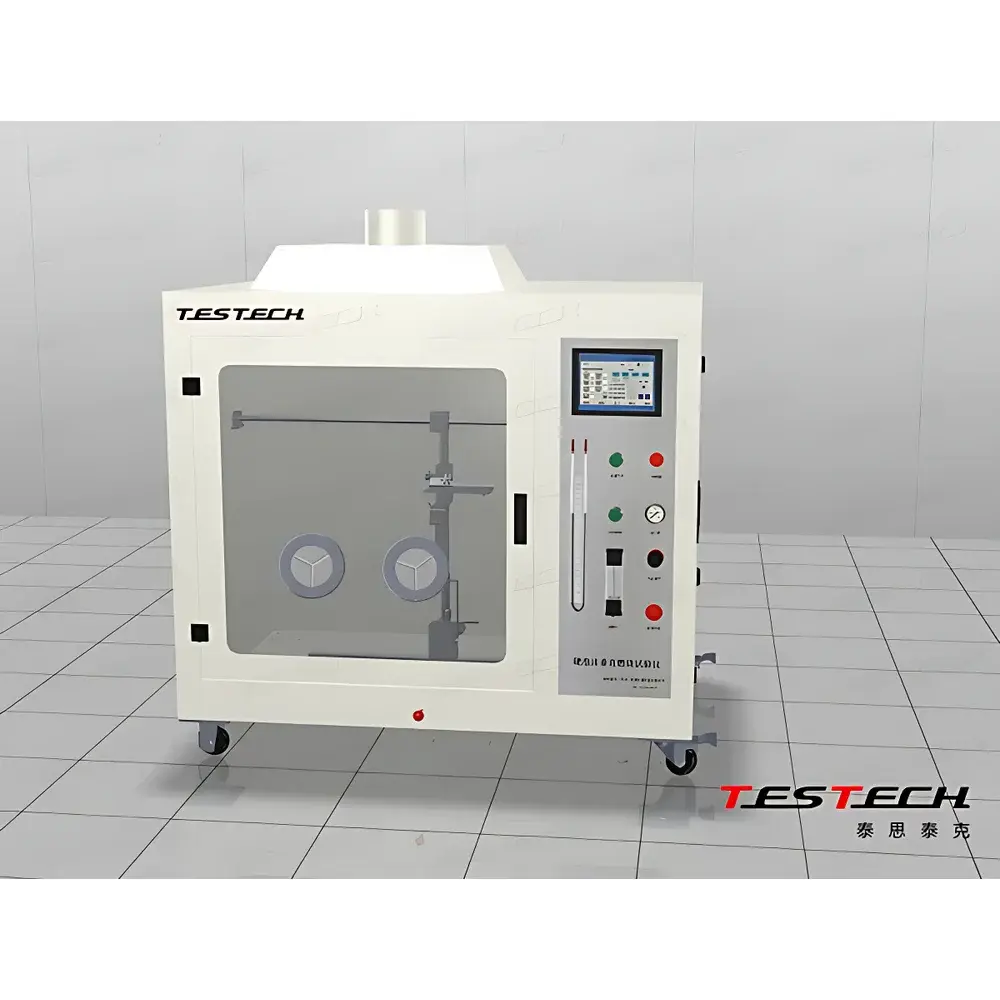
TESTech TTech-GBT8333 Vertical Burning Test Chamber for Rigid Foam Plastics (Compliant with GB/T 8333–2008)
| Brand | TESTech |
|---|---|
| Model | TTech-GBT8333 |
| Standard Compliance | GB/T 8333–2008 |
| Burner Specification | Bunsen burner per ISO 10093:1998 (tube length 100±10 mm, inner diameter 9.5±0.3 mm) |
| Flame Height | 25–35 mm (adjustable blue inner cone) |
| Gas Flow Range | 0–1000 mL/min (mass flow controlled) |
| Operating Environment | 10–35 °C, ≤75% RH |
| Power Supply | AC 220 V ±10 V, 50 Hz |
| Fuel Compatibility | ≥95% purity propane or natural gas |
| Control System | PLC + industrial touchscreen HMI |
| Ignition | Pulse high-voltage electronic auto-ignition |
| Pressure Monitoring | Digital pressure gauge + touchscreen display |
| Data Logging | Auto-timestamped test duration, flame application time, and event-triggered storage |
| Temperature Monitoring | LCD-displayed ambient and flame-zone thermal feedback (100–1000 °C range) |
Overview
The TESTech TTech-GBT8333 Vertical Burning Test Chamber is an engineered solution for evaluating the relative vertical burning behavior of rigid cellular plastic materials—specifically designed to meet the procedural and apparatus requirements defined in GB/T 8333–2008, China’s national standard for flammability testing of rigid foam plastics. This chamber implements a standardized small-flame ignition method using a calibrated Bunsen burner positioned vertically beneath a vertically mounted specimen. The test assesses critical fire performance indicators including after-flame time, after-glow time, extent of charring, and whether flaming droplets ignite cotton indicator below the specimen. Its measurement principle relies on controlled thermal exposure under reproducible gas flow, flame geometry, and timing parameters—ensuring consistency across laboratories and alignment with internationally referenced combustion assessment frameworks.
Key Features
- Integrated structural design: Combines test chamber, burner assembly, control electronics, and observation system into a single compact unit—minimizing field installation complexity and ensuring mechanical stability during repeated thermal cycling.
- Large-dimension tempered observation window: Provides unobstructed real-time visual monitoring of flame propagation, melt dripping, charring progression, and post-ignition behavior without compromising operator safety or chamber integrity.
- Ergonomic access layout: Front-facing burner positioning and specimen holder enable safe, tool-free sample insertion and post-test residue handling—even with protective gloves.
- Motorized burner translation mechanism: Allows precise horizontal repositioning of the burner relative to the specimen edge while the chamber door remains closed—eliminating airflow disturbance and improving repeatability.
- ISO 10093-compliant Bunsen burner: Manufactured to strict dimensional tolerances (100 ±10 mm tube length; 9.5 ±0.3 mm inner diameter) with adjustable blue inner cone height (25–35 mm), ensuring consistent heat flux profile per standard specification.
- PLC-based control architecture with industrial touchscreen HMI: Enables intuitive configuration of flame application duration (0–999 s), total test timer, automatic ignition sequence, and real-time display of gas pressure and mass flow rate.
- Dual-stage gas regulation: High-precision imported needle valve paired with thermal mass flow controller ensures stable, repeatable fuel delivery across the full 0–1000 mL/min range—critical for inter-laboratory comparability.
Sample Compatibility & Compliance
The TTech-GBT8333 accommodates standard GB/T 8333–2008 specimens: rigid foam plastic bars measuring 250 mm × 20 mm × 10 mm, conditioned at 23 ±2 °C and 50 ±5% RH for ≥48 h prior to testing. Specimens are clamped vertically with the lower edge positioned 10 mm above the burner tip. The chamber meets all physical and functional criteria outlined in Clause 5 (Apparatus) and Annex A (Verification Procedures) of GB/T 8333–2008. While primarily aligned with Chinese national standards, its burner geometry and operational parameters are traceable to ISO 10093:1998 (flammability test—ignitability—apparatus for small-flame ignition), facilitating cross-referencing in multi-standard validation workflows. The system supports documentation practices compatible with GLP and internal quality audit requirements—including timestamped event logs, parameter setting records, and manual override tracking.
Software & Data Management
The embedded PLC firmware records all timed events—including ignition confirmation, flame-on initiation, flame-off signal, after-flame termination, and after-glow cessation—with millisecond-level resolution. All timestamps, user-defined parameters (e.g., flame duration), and measured values (gas pressure, flow rate) are stored locally in non-volatile memory and exportable via USB to CSV format. The touchscreen interface displays live pressure (kPa) and flow (mL/min) readings synchronized with the test timeline. No proprietary software installation is required for data retrieval; exported files conform to spreadsheet-compatible structures for integration into LIMS or QA reporting systems. Audit trail functionality includes operator ID entry (optional), session start/stop stamps, and change logs for critical parameters—supporting traceability under internal quality management systems.
Applications
This test chamber serves quality assurance laboratories in polyurethane (PU), polystyrene (PS), phenolic, and polyisocyanurate (PIR) foam manufacturing facilities—where raw material screening, batch release verification, and formulation development require consistent flammability classification. It is routinely deployed in third-party certification labs conducting GB-compliant fire safety assessments for building insulation, transportation interior components (e.g., automotive headliners, rail seating foams), and packaging materials subject to regulatory fire performance thresholds. Academic researchers utilize the system for comparative studies on flame-retardant additive efficacy, char-forming mechanisms, and thermal degradation kinetics under standardized small-flame exposure conditions.
FAQ
Does the TTech-GBT8333 comply with any international standards beyond GB/T 8333–2008?
Yes—the burner design and calibration methodology align with ISO 10093:1998, enabling technical correlation with other small-flame ignitability tests.
Can the system be used for non-foam materials such as thermoplastics or composites?
No. The apparatus and test procedure are explicitly validated only for rigid cellular plastics per GB/T 8333–2008. Other material classes require different test configurations (e.g., UL 94, IEC 60695-11-10).
Is gas flow calibration traceable to national metrology institutes?
Mass flow controllers are supplied with factory calibration certificates; end-user recalibration using certified reference gases and NIST-traceable flow standards is recommended annually.
What safety interlocks are implemented?
The system includes door-position sensing, flame-out detection via thermocouple feedback, over-pressure shutoff, and emergency power cutoff—all integrated into the PLC logic with fault logging.
How is ambient temperature and humidity monitored during testing?
While the chamber does not include built-in environmental sensors, GB/T 8333–2008 mandates external verification of lab conditions (10–35 °C, ≤75% RH) prior to each test series; documented environmental logs must accompany final reports.



