
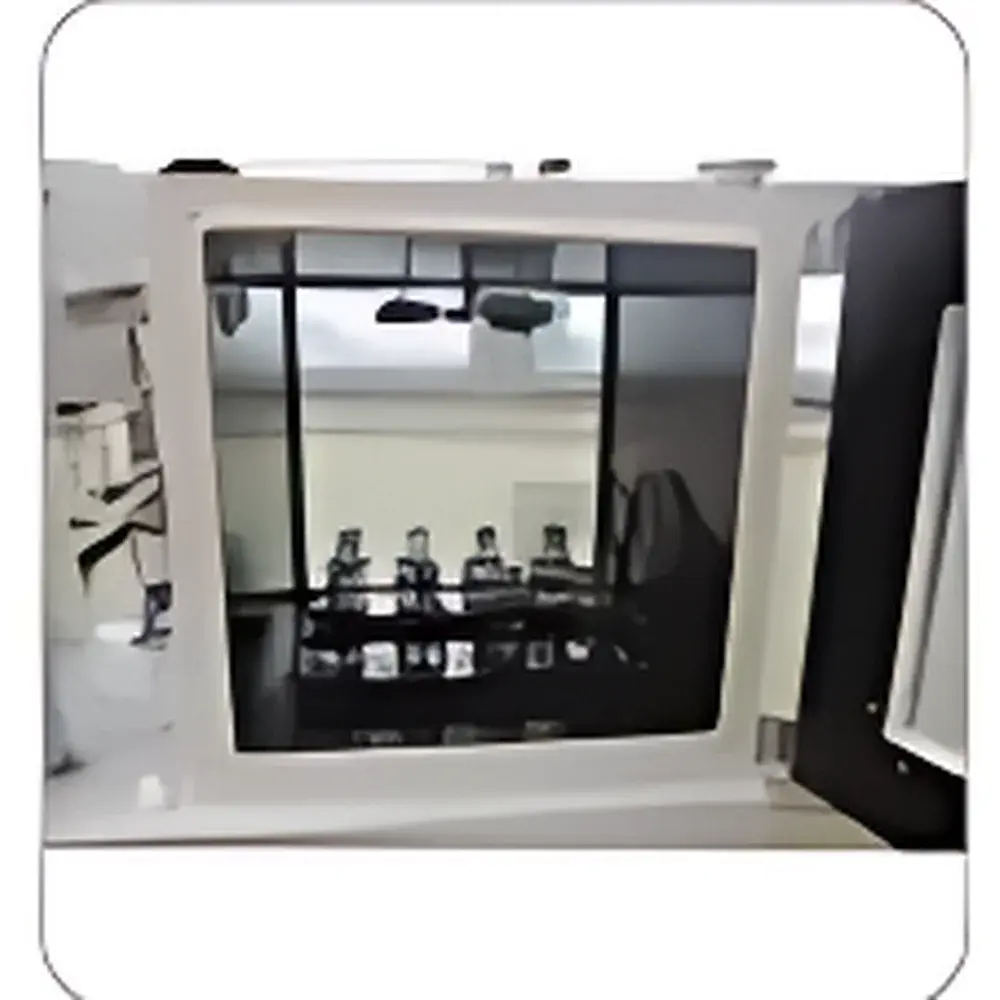
TESTech TTech-NES713 Smoke Toxicity Test Chamber
| Brand | TESTech |
|---|---|
| Model | TTech-NES713 |
| Compliance | NES 713 (Naval Engineering Standard) |
| Chamber Volume | 0.7 m³ |
| Construction | Stainless steel frame with fire-retardant polypropylene chamber walls |
| Viewing Window | Reinforced polycarbonate, laminated for impact resistance |
| Ignition System | Spark-ignition burner with auto-reignition on flameout |
| Sample Capacity | 15 positions |
| Gas Supply | Methane or propane (user-selectable), regulated via integrated mass flow controllers |
| Air & Fuel Control | Built-in independent air/methane mixing and flow regulation |
| Ventilation | 50 L/s forced exhaust with timer-synchronized activation |
| Internal Mixing | Axial fan for homogeneous gas distribution |
| Operating Modes | Manual, Automatic, and Cyclic recirculation mode |
| Power Supply | AC 220 V, 50/60 Hz, 10 A |
| Dimensions (W×D×H) | 1185 × 700 × 2100 mm |
| Weight | ~150 kg |
| Accessories | Calibration gas ports, exhaust duct interface, compressed air inlet, vacuum port for soot sampling |
Overview
The TESTech TTech-NES713 Smoke Toxicity Test Chamber is a precision-engineered apparatus designed to quantify the acute toxicity of combustion gases emitted from cable insulation, sheathing, and other polymer-based materials under controlled pyrolysis conditions. It implements the Naval Engineering Standard NES 713 — a rigorous, small-scale test method developed by the UK Ministry of Defence to assess the hazard potential of smoke generated during fire scenarios in confined maritime and naval environments. The test measures the cumulative toxic potency of combustion effluents (e.g., CO, HCN, HCl, HF, NOx, SO2) using either colorimetric detector tubes or portable gas analyzers calibrated per ISO 19702 and ASTM E1590. Toxicity Index (TI) is calculated as the sum of fractional effective doses (FED) for each identified toxicant, normalized to human exposure thresholds defined in ISO 13571 and NFPA 92. This chamber operates on the principle of stoichiometric, diffusion-controlled flaming combustion within a sealed, thermally stable enclosure — ensuring reproducible gas-phase chemistry and minimizing wall effects.
Key Features
- 0.7 m³ stainless steel–framed chamber with seamless, fire-retardant polypropylene interior lining — optimized for low outgassing and chemical resistance to acidic combustion byproducts
- Reinforced laminated polycarbonate observation window (impact-rated per EN 12600 Class P2A) enabling real-time visual monitoring without compromising containment integrity
- Spark-ignited methane/propane burner with fail-safe reignition logic — maintains consistent ignition energy and eliminates manual relight procedures
- Integrated control console housing digital timer, dual-channel mass flow controllers (air + fuel), and electro-pneumatic valve sequencing for precise stoichiometry
- 15-position sample holder compatible with standardized 25 mm × 25 mm × 3 mm specimens per NES 713 Clause 6.2
- Programmable cyclic recirculation mode: enables repeated sampling of the same gas batch over time to evaluate temporal toxicity evolution
- Forced-draft exhaust system (50 L/s) triggered automatically at test termination — compliant with NES 713 Clause 8.4 for rapid post-test decontamination
- Internal axial mixing fan (variable-speed DC motor) ensures uniform gas composition prior to sampling — critical for analytical repeatability across replicate runs
- Dual-mode operation: fully manual override for method development and fully automated sequence execution for routine QA/QC testing
Sample Compatibility & Compliance
The TTech-NES713 accommodates solid polymeric specimens including PVC, LSZH, cross-linked polyolefins, fluoropolymers, and elastomeric cable compounds. Specimen preparation follows NES 713 Section 5 requirements: conditioning at 23 °C ± 2 °C and 50 % RH ± 5 % for ≥48 h prior to testing. The system meets full mechanical and procedural conformance to NES 713:2017 Edition 3, and supports alignment with broader regulatory frameworks including IMO FTP Code Annex 1 (for marine applications), BS EN 60332-3, and IEC 60754-2. All internal surfaces are non-catalytic and inert to halogenated acid gases, preventing artifact formation during analysis. Optional traceable calibration certificates (NIST-traceable gas standards) and audit-ready log files support GLP/GMP compliance and FDA 21 CFR Part 11–aligned data integrity workflows.
Software & Data Management
While the base TTech-NES713 operates via embedded hardware controls, optional TESTech DataLink™ software (v3.2+) provides PC-based test orchestration, real-time parameter logging (flow rates, temperature, elapsed time), and TI calculation automation. Raw sensor outputs (e.g., from electrochemical gas detectors or FTIR spectrometers) can be imported in CSV or XML format. Audit trails record operator ID, method version, calibration status, and timestamped event logs — supporting ISO/IEC 17025 accreditation requirements. Export formats include PDF test reports with embedded digital signatures and Excel-compatible datasets for statistical process control (SPC) integration.
Applications
- Qualification testing of low-smoke zero-halogen (LSZH) cables for naval vessels, offshore platforms, and underground transit systems
- R&D screening of flame-retardant additives (e.g., metal hydroxides, phosphinates, intumescents) for toxicity trade-off assessment
- Comparative toxicity profiling of alternative polymer formulations under identical thermal insult conditions
- Supporting fire safety engineering models (e.g., CFAST, PyroSim) with experimentally derived TI inputs
- Third-party certification testing per DNV GL SE-0339, LR Rules for Naval Ships, and ABS Guide for Fire Safety Assessment
FAQ
What gases does NES 713 specifically target for toxicity quantification?
NES 713 does not prescribe mandatory analytes; rather, it defines a methodology to determine the aggregate toxicity index based on measured concentrations of all acutely hazardous combustion products — commonly including carbon monoxide (CO), hydrogen cyanide (HCN), hydrogen chloride (HCl), hydrogen fluoride (HF), nitrogen oxides (NOx), sulfur dioxide (SO2), and formaldehyde (CH2O).
Can the chamber be used with Fourier Transform Infrared (FTIR) spectrometers?
Yes — the chamber includes a dedicated 6 mm OD stainless steel sampling port with Swagelok® VCR fitting, compatible with heated transfer lines and standard FTIR gas cells. Optional heated filter housings mitigate condensation for accurate quantification of semi-volatiles.
Is calibration verification required between tests?
Per NES 713 Clause 7.3, a blank run (no specimen) must be performed before each test series to confirm background gas levels remain below detection thresholds. Detector tube systems require daily span checks using certified reference gases traceable to NIST SRM 1625.
Does the system meet electromagnetic compatibility (EMC) requirements for shipboard installation?
The TTech-NES713 complies with IEC 60533:2016 (Electromagnetic compatibility in ships) and MIL-STD-461G RS103 for radiated emissions, validated via third-party EMC testing report (available upon request).



