
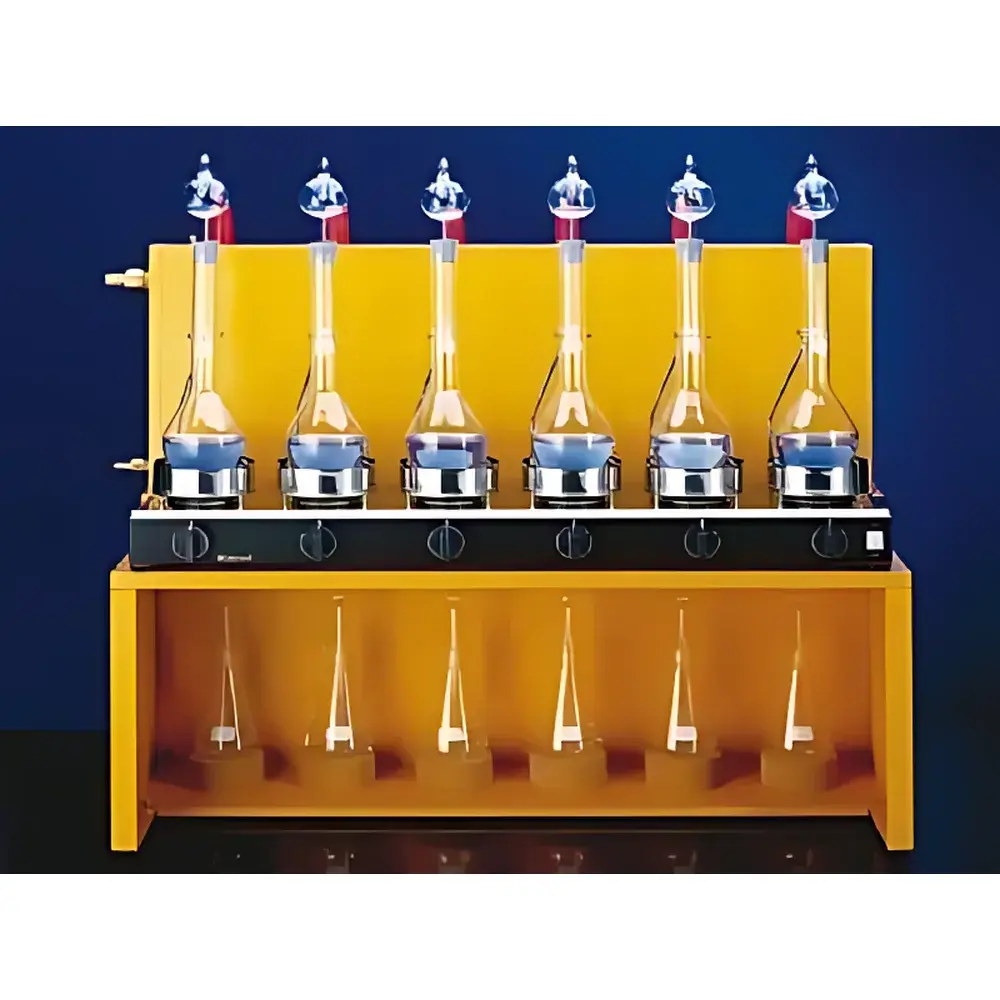
Gerhardt KI 12/24 and KI 9/16 Classical Distillation Apparatus for Kjeldahl Nitrogen Determination
| Brand | C. Gerhardt |
|---|---|
| Origin | Germany |
| Model | KI 12/24 / KI 9/16 |
| Max. Heating Temperature | 650 °C / 600 °C |
| Heating Block Capacity | 4 × 500–750 mL flasks / 6 × 50–250 mL flasks |
| Voltage | 230 V AC |
| Frequency | 50–60 Hz |
| Power | 2320 W / 1800 W |
| Dimensions (W×D×H) | 650 × 380 × 950 mm |
| Weight | 35 kg / 25 kg |
| Compliance | Designed for ASTM D1142, ISO 5983-1, AOAC 984.13, and USP <467> residual solvent workflows |
Overview
The Gerhardt KI 12/24 and KI 9/16 Classical Distillation Apparatus are benchtop, manually operated Kjeldahl distillation systems engineered for precision nitrogen quantification in accordance with standardized wet-chemical digestion–distillation–titration workflows. These instruments implement classical steam distillation principles: after acid digestion of organic samples (e.g., food, feed, soil, or pharmaceuticals), the liberated ammonium ions are converted to ammonia under strongly alkaline conditions and subsequently volatilized by saturated steam. The ammonia is swept from the reaction chamber into a boric acid receiving solution, where it is quantified via back-titration. Unlike automated variants (e.g., VAP series), the KI series relies on operator-controlled steam generation, condensate flow management, and endpoint detection—offering full procedural transparency, method flexibility, and direct alignment with pharmacopeial and regulatory reference methods.
Key Features
- Robust dual-zone heating block with independent temperature control for digestion and distillation stages; KI 12/24 supports up to four large-format Kjeldahl flasks (500–750 mL), while KI 9/16 accommodates six smaller vessels (50–250 mL) — enabling parallel processing across diverse sample matrices and throughput requirements.
- High-stability nickel-chromium heating elements rated for continuous operation at up to 650 °C (KI 12/24) or 600 °C (KI 9/16), ensuring reproducible steam generation and thermal uniformity across all flask positions.
- Steam generator with integrated pressure regulation and visual water-level indicator; no external boiler required — simplifies installation and reduces footprint in GLP-compliant laboratories.
- Condenser with precisely angled cooling jacket and optimized internal bore geometry to minimize carryover and ensure quantitative ammonia recovery (>99.5% recovery verified per AOAC 984.13).
- Mechanically reinforced borosilicate glassware set (including Kjeldahl flasks, condensers, and receivers) certified to DIN 12331 and ISO 3585 standards for chemical resistance and thermal shock tolerance.
- Full electrical safety compliance: IP20 enclosure rating, double-pole switching, thermal cut-off fuses, and grounding continuity verified per IEC 61010-1.
Sample Compatibility & Compliance
The KI series is validated for use with solid, semi-solid, and liquid samples requiring total nitrogen determination—including cereals, dairy products, meat, fertilizers, wastewater sludge, and active pharmaceutical ingredients (APIs). Its open architecture supports method adaptation for non-standard matrices (e.g., high-fat or high-sugar content) through manual adjustment of alkali addition volume, steam duration, and distillation rate. The system meets core regulatory and standardization requirements including ASTM D1142 (crude protein in petroleum products), ISO 5983-1 (animal feeding stuffs), AOAC Official Method 984.13 (food and feed), and USP Class 3 residual solvent analysis where nitrogen-bearing impurities must be excluded. While not intrinsically 21 CFR Part 11 compliant (lacking electronic audit trails), its manual operation ensures full traceability when paired with paper-based SOPs and signed analyst logs — a documented approach accepted under FDA GLP inspections for reference laboratory applications.
Software & Data Management
The KI 12/24 and KI 9/16 operate without embedded firmware or digital interfaces; all operational parameters — steam onset time, distillation duration, titrant volume, and blank correction — are recorded manually in laboratory notebooks or LIMS-integrated worksheets. This analog design eliminates cybersecurity vulnerabilities, firmware obsolescence risks, and validation overhead associated with electronic systems. For labs implementing digital workflows, Gerhardt provides optional Excel-based calculation templates (validated per ISO/IEC 17025 Clause 5.4.2) that accept raw titration data and auto-generate final %N results with uncertainty propagation based on burette calibration, reagent molarity, and sample mass variability. All documentation — including factory calibration certificates for heating block thermocouples and condenser flow-rate verification reports — is supplied in English and traceable to DAkkS-accredited national standards.
Applications
- Crude protein quantification in agricultural commodities and animal feed formulations per EU Regulation No. 657/2005.
- Verification of nitrogen content in fertilizer grade certification (ISO 8157, ISO 11301).
- Quality control of dairy powders and infant formula under Codex Alimentarius STAN 251-2006.
- Environmental monitoring of total Kjeldahl nitrogen (TKN) in municipal wastewater and sediment per EPA Method 351.2.
- Pharmaceutical excipient testing where nitrogen impurities must be ruled out prior to API synthesis (ICH Q5C).
- Academic teaching laboratories requiring hands-on instruction in classical wet chemistry methodology and stoichiometric principle validation.
FAQ
Is the KI apparatus compatible with automatic titrators?
Yes — the distillate receiver outlet is standardized to ISO 385 taper (14/23), allowing direct coupling to Metrohm, Hanna, or Thermo Fisher autotitrators equipped with universal adapter modules.
Can I use the same KI unit for both macro- and micro-Kjeldahl procedures?
The KI 9/16 model is optimized for micro-scale work (50–250 mL flasks); KI 12/24 is intended for macro applications. Cross-use is technically feasible but compromises thermal efficiency and steam distribution uniformity — not recommended for accredited testing.
Does Gerhardt supply certified reference materials for system verification?
Yes — NIST-traceable ammonium sulfate CRM (SRM 2965a) and certified Kjeldahl blanks are available under catalog numbers GER-CRM-N-01 and GER-BLK-02, with CoA specifying recovery limits ±0.8% RSD.
What maintenance intervals are specified for long-term reliability?
Heating block thermocouple recalibration every 12 months; condenser descaling with 10% HNO₃ every 200 runs; gasket replacement (silicone, FDA-grade) every 18 months or after visible compression set.
Is CE marking applicable to both models?
Yes — both KI 12/24 and KI 9/16 bear CE marking under Directive 2014/30/EU (EMC) and 2014/35/EU (LVD), with technical documentation archived per EN 61000-6-3 and EN 61000-6-4.
Related Products




