
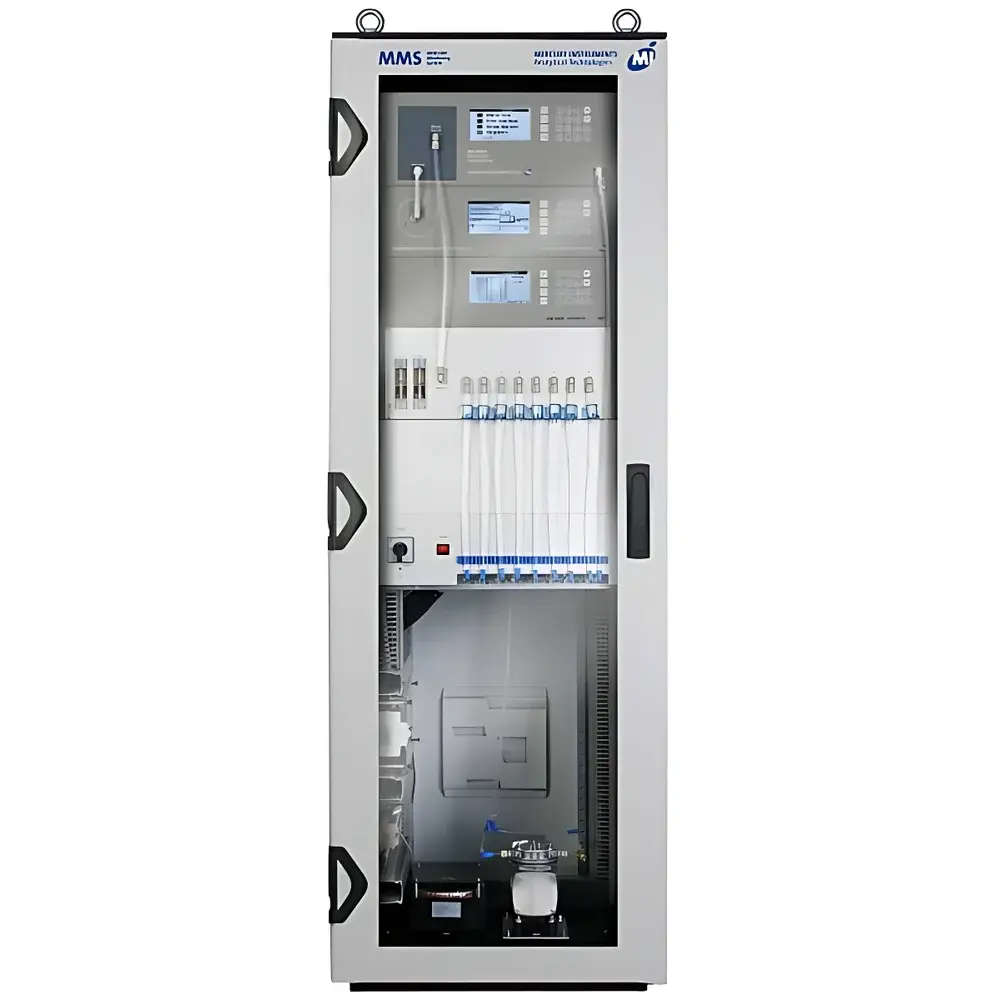
German MI MMS Mercury Analyzer
| Origin | Germany |
|---|---|
| Manufacturer Type | Distributor |
| Origin Category | Imported |
| Model | MMS |
| Instrument Type | Online |
| Measurement Principle | Cold Vapor Atomic Absorption Spectrometry (CVAAS) |
| Detection Limit | ≤10 ng/m³ (CVAAS) |
| Repeatability | ≤1.0% (CVAAS) |
| Linearity Error | ±1% (CVAAS) |
| Sampling Points | 2–24 |
| Sample Line Purge Flow | 40–80 L/h per line |
| Measurement Cycle | 45 s–99 min (individually configurable per channel) |
| Standard Detector | VM-3000 (Range: 0.1–100, 1–1000, or 1–2000 µg/m³) |
| Trace Detector Option | UT-3000 (Range: 0.01–50 µg/m³) |
| Sample Flow Rate | ~80 L/h |
| Optical Wavelength | 253.7 nm UV absorption |
| Enclosure Rating | IP55 / NEMA 4X |
| Dimensions (W×H×D) | 553×600×500 mm to 800×2000×600 mm (configurable) |
| Weight | 35–175 kg (configuration-dependent) |
| Communication Interfaces | RS-232, Modbus RTU, Ethernet, optional fiber-optic cable |
Overview
The German MI MMS Mercury Analyzer is an online, multi-point continuous monitoring system engineered for high-reliability quantification of elemental mercury vapor (Hg⁰) in ambient air, industrial process streams, and stack emissions. It operates on the principle of Cold Vapor Atomic Absorption Spectrometry (CVAAS) at the resonant wavelength of 253.7 nm — a technique standardized under EPA Method 101A, ASTM D6784-22 (Ontario Hydro), and EN 13211:2022 for mercury speciation in gaseous matrices. Unlike batch-mode laboratory analyzers, the MMS integrates automated multi-channel sampling with real-time optical detection, enabling unattended operation across up to 24 discrete locations. Its design prioritizes long-term stability in harsh industrial environments — including chlor-alkali plants, metal smelters, fluorescent lamp recycling facilities, battery reprocessing units, and natural gas processing sites — where mercury contamination poses acute occupational, environmental, and regulatory risks.
Key Features
- Multi-point sampling architecture with 2–24 independently controllable channels, each equipped with temperature-stabilized switching valves (70 °C) and low-dead-volume actuation for minimal carryover.
- Continuous purge of all sample lines (40–80 L/h per line) using inert carrier gas, eliminating moisture-induced adsorption artifacts and reducing system response time to <60 seconds — critical for transient emission event capture.
- Dual-detector configuration support: standard VM-3000 detector (0.1–2000 µg/m³, three selectable ranges) and optional UT-3000 ultra-trace detector (0.01–50 µg/m³) for sub-microgram compliance monitoring.
- Robust IP55/NEMA 4X-rated enclosure with corrosion-resistant metal housing; optional integrated climate control unit for operation in ambient temperatures ranging from −20 °C to +50 °C.
- Flow integrity assurance via calibrated mass flow meters with integrated alarm sensors — triggering automatic fault logging and status notification upon deviation >±5% from setpoint (~80 L/h).
- No chemical reagents or consumable catalysts required; maintenance intervals exceed 6 months under typical industrial duty cycles.
Sample Compatibility & Compliance
The MMS accepts gaseous samples with particulate loading <1 mg/m³ (filtered inline) and relative humidity <95% non-condensing. Water vapor has no measurable interference due to heated sample path design (valve manifold and optical cell maintained above dew point). The system complies with EU Industrial Emissions Directive (IED) 2010/75/EU Annex VII requirements for mercury CEMS, supports GLP/GMP data integrity workflows, and enables full audit trail generation for FDA 21 CFR Part 11–compliant deployments when paired with validated software configurations. All measurement outputs are traceable to NIST SRM 1641d (Mercury in Nitric Acid).
Software & Data Management
MI’s proprietary MMS Control Suite runs on Windows XP/Vista (legacy deployment) or modern Windows 10/11 (via virtualization layer). It provides real-time concentration display, time-concentration trend visualization, automatic calibration logging (zero/span), and configurable alarm thresholds (e.g., TWA, STEL, excursion limits). Data export is supported in CSV, XML, and MODBUS-compatible formats. Remote access is enabled via secure Ethernet or fiber-optic link, supporting integration into SCADA, DCS, or cloud-based environmental data management platforms (EDMP). All raw spectra, calibration coefficients, and instrument metadata are stored with timestamped digital signatures for regulatory submission readiness.
Applications
- Continuous mercury emission monitoring (CEMS) in chlor-alkali electrolysis units (mercury-cell technology phase-out compliance).
- Process gas surveillance in base metal smelting (zinc, lead, copper) and precious metal refining.
- Off-gas monitoring during fluorescent lamp and button battery recycling operations.
- Natural gas dehydration and sulfur recovery unit (SRU) feed gas screening (see MMS-NG variant for hydrocarbon matrix adaptation).
- Indoor air quality assessment in dental clinics, laboratories, and coal-fired power plant control rooms.
FAQ
Does the MMS require periodic lamp replacement or optical recalibration?
The xenon arc UV source has a rated lifetime of ≥5,000 hours; no user-accessible optical recalibration is needed. Factory verification is recommended every 12 months or after major service events.
Can the system operate reliably in high-humidity or dusty environments?
Yes — heated sample lines (70 °C), continuous nitrogen purge, and NEMA 4X-rated enclosure ensure stable performance even in coastal or desert industrial settings. Optional particulate filtration extends operational uptime in high-dust applications.
Is the MMS compatible with third-party data acquisition systems?
Yes — native Modbus RTU and Ethernet TCP/IP protocols enable seamless integration with Siemens Desigo, Honeywell Experion, ABB 800xA, and custom Python/Node-RED middleware stacks.
What validation documentation is provided with shipment?
Each unit ships with Factory Acceptance Test (FAT) report, UV lamp spectral certification, flow meter calibration certificate (NIST-traceable), and ISO/IEC 17025-accredited performance verification data per EN 15267-3.
Related Products





