
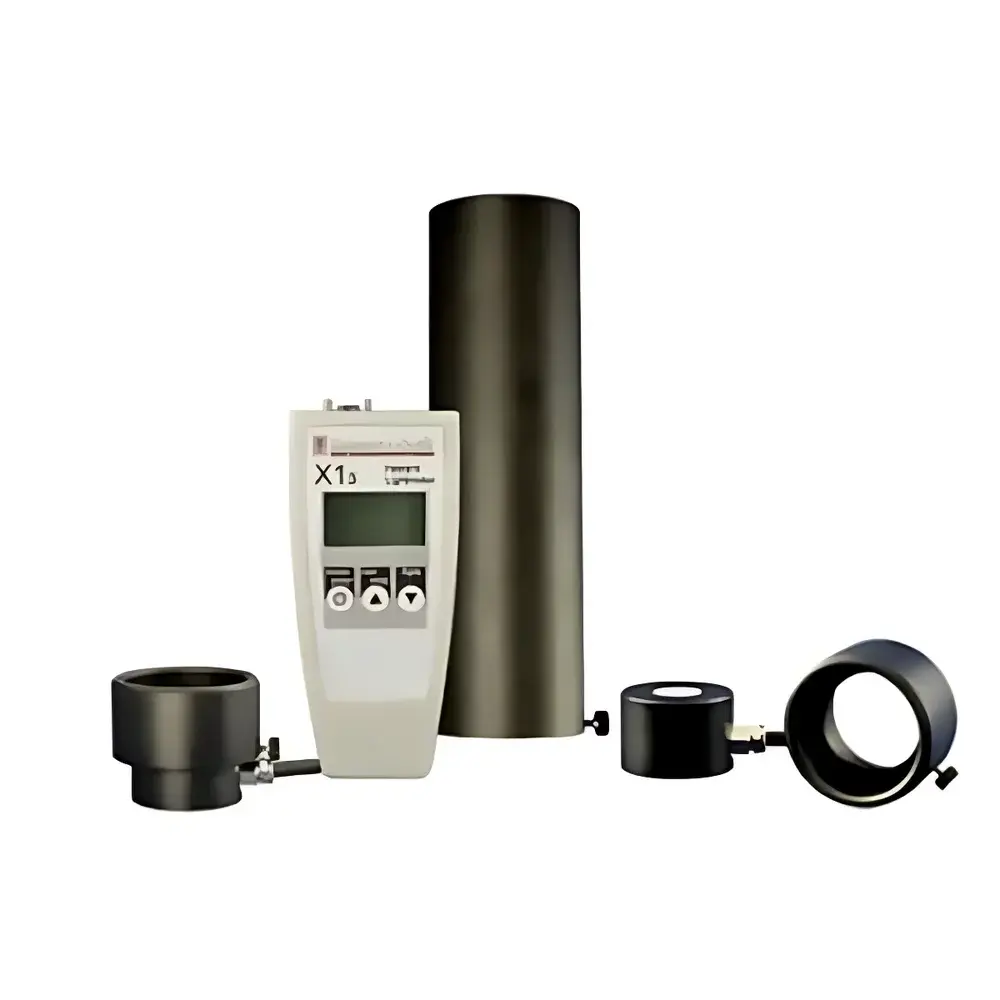
Gigahertz Optik X1-3 UV and Blue Light Hazard Meter
| Brand | Gigahertz Optik |
|---|---|
| Origin | Germany |
| Model | X1-3 |
| Detector Options | XD-45-HB (Blue Light Hazard), XD-45-HUV (UV Hazard) |
| Display | 97×32-pixel LCD, 4-line alphanumeric, LED-backlit |
| Dynamic Range | 0.1 pA to 200 µA |
| Resolution | 0.1 pA |
| Operating Temperature | 5–40 °C |
| Storage Temperature | −10–50 °C |
| Power | 2×AA batteries (≈250 h, no backlight) or USB bus power |
| Weight (XD-45-HUV + cable + FOV adapter) | 250 g |
| Compliance | IEC 62471:2006, EN 62471:2008, IEC TR 62778:2014, EN 14255-1, 2006/25/EC |
Overview
The Gigahertz Optik X1-3 UV and Blue Light Hazard Meter is a portable, handheld photobiological safety instrument engineered for quantitative assessment of optical radiation hazards in the ultraviolet (200–400 nm) and blue-light (300–700 nm, weighted per IEC TR 62778 spectral action function) spectral ranges. It operates on the principle of spectrally weighted radiometric measurement—converting incident optical radiation into photocurrent via calibrated, multi-sensor detector heads (XD-45-HUV and XD-45-HB), then applying real-time, standard-compliant weighting functions to compute effective irradiance (Eeff, W/m²) and effective radiance (Leff, W·sr⁻¹·m⁻²) as defined in IEC 62471 and EN 62471. Unlike broadband meters with fixed filters, the X1-3 integrates detector-specific spectral responsivity data and applies digital correction algorithms to ensure traceable, high-fidelity hazard evaluation—critical for regulatory classification of lamps, luminaires, displays, and industrial lighting systems under EU Directive 2006/25/EC and occupational exposure limits outlined in EN 14255-1.
Key Features
- Compact, ergonomic handheld design optimized for field deployment and repetitive workplace measurements
- Dual-detector compatibility: XD-45-HUV for UV hazard (200–400 nm, erythemal & photokeratitis weighting) and XD-45-HB for blue-light hazard (300–700 nm, retinal photochemical hazard per IEC TR 62778)
- Four-channel analog front-end with auto-ranging transimpedance amplifiers (0.1 pA–200 µA), enabling seamless measurement across six orders of magnitude without manual gain switching
- Low-noise electronics achieving 0.1 pA current resolution—essential for detecting sub-threshold exposure levels near regulatory limits
- Integrated EEPROM storage for persistent user calibration offsets, detector identification, and configuration parameters
- Backlit 97×32-pixel graphical LCD with four-line alphanumeric display; menu-driven interface accessible via front-panel buttons or optional IR remote
- Extended battery life: ≈250 hours on two AA cells (backlight off); also operable via USB 5 V bus power for lab or benchtop use
- USB interface supporting firmware updates, data export (CSV), and remote control via Gigahertz Optik’s proprietary software suite
Sample Compatibility & Compliance
The X1-3 is validated for use with artificial light sources—including LED modules, OLED panels, fluorescent tubes, HID lamps, and UV-C germicidal emitters—as well as natural daylight under controlled conditions. Its detector heads feature cosine-corrected input optics with field-of-view (FOV) adapters to meet the angular response requirements of IEC 62471 Annex B and EN 14255-1. All detectors are factory-calibrated against NIST-traceable standards at Gigahertz Optik’s ISO/IEC 17025-accredited calibration laboratory (DAkkS certificate available). The system complies fully with photobiological safety assessment protocols required for CE marking (per EN 62471), workplace risk assessment (per 2006/25/EC and DIN EN 14255-1), and lamp classification per IEC TR 62778. It supports GLP-aligned documentation workflows, including timestamped measurement logs and detector serial-number traceability.
Software & Data Management
The X1-3 interfaces with Gigahertz Optik’s StrayLight PC software (Windows-based), enabling advanced post-processing, spectral weight visualization, exposure time calculation, and compliance reporting. Raw current and weighted irradiance values are logged with millisecond timestamps and stored internally (≥10,000 records). Export formats include CSV and XML for integration into LIMS or enterprise QA/QC databases. Software features include configurable alarm thresholds, batch averaging, statistical summary (min/max/mean/std dev), and generation of PDF reports compliant with ISO/IEC 17025 documentation requirements. USB communication supports full bidirectional control—including detector selection, zeroing, range override, and firmware updates—without requiring external power supplies.
Applications
- Photobiological safety testing of LED lighting products during R&D and pre-market conformity assessment
- Ongoing occupational health monitoring in manufacturing facilities, cleanrooms, and medical device assembly lines where high-intensity UV or blue-rich lighting is deployed
- Verification of labeling claims (e.g., “low blue light”, “UV-free”) for consumer displays, automotive lighting, and architectural luminaires
- Field validation of lighting installations against EN 12464-1 (lighting of work places) and EN 62471 exposure categories (Exempt, Risk Group 1–3)
- Academic and clinical research on circadian photoreception, retinal stress modeling, and UV-induced skin photodamage kinetics
- Third-party certification laboratories performing accredited testing per ISO/IEC 17025 scope
FAQ
Does the X1-3 measure absolute spectral irradiance?
No—the X1-3 performs weighted photobiological hazard assessment only. It does not output full spectra; spectral weighting is applied digitally using embedded detector-specific responsivity curves and standard action functions.
Can it be used for daylight measurements?
Yes, provided the detector head is equipped with appropriate FOV limiting optics and the measurement geometry complies with EN 14255-1 outdoor exposure conditions (e.g., horizontal plane, unobstructed sky view).
Is the instrument suitable for FDA 21 CFR Part 11 compliance?
While the X1-3 itself is not Part 11–certified, its audit-trail-capable software (StrayLight) supports electronic signatures, user access controls, and immutable data logging—enabling implementation within a validated Part 11–compliant quality management system.
How often does the detector require recalibration?
Gigahertz Optik recommends annual recalibration for ISO/IEC 17025 traceability; stability data show typical drift <±2% per year under normal handling and storage conditions.
What accessories are required for basic operation?
The base system includes the X1-3 display unit, one detector head (XD-45-HB or XD-45-HUV), calibration certificate, USB cable, and AA batteries. Optional accessories include FOV adapters, tripod mounts, carrying case, and IR remote control.






