
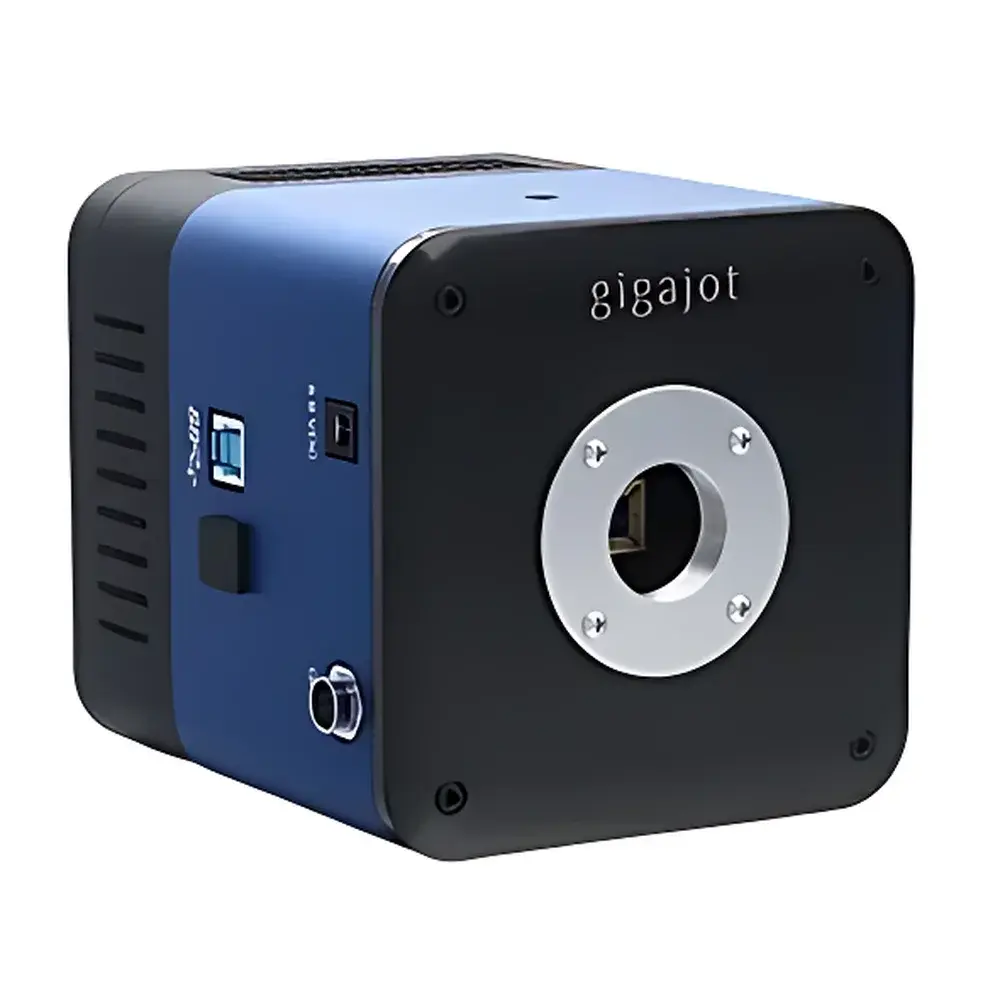
Gigajot QIS Series High-Resolution CMOS Photon-Counting Camera
| Origin | Imported |
|---|---|
| Manufacturer Type | Authorized Distributor |
| Model | Gigajot QIS16TS / QIS16C / QIS4TS / QIS4C |
| Price Range | USD $25,000 – $38,000 (FOB) |
| Sensor Architecture | Stacked Backside-Illuminated (BSI) Quantum Image Sensor (QIS) |
| Pixel Count | 4.0 MP / 16.7 MP |
| Pixel Size | 2.2 µm / 1.1 µm |
| Max Frame Rate | 2,784 fps (QIS4) / 15,974 fps (QIS16) |
| Read Noise | ≤0.33 e⁻ (QIS4) / ≤0.19 e⁻ (QIS16) |
| Dark Current | 0.002 e⁻/pix/s @ 10 °C (QIS16TS) |
| Quantum Efficiency | >85% (peak, 500–900 nm) |
| Operating Temperature | Thermoelectrically stabilized at 10 °C (±0.1 °C) |
| Interface | USB 3.2 Gen 1 (10 Gbps) with GPIO and ROI support |
| Dynamic Range | 80 dB (single-shot, QIS16) / 96 dB (single-shot, QIS4) |
| Software | Native SDK (C/C++, Python), MATLAB & LabVIEW drivers, GUI for acquisition and real-time histogramming |
Overview
The Gigajot QIS Series represents a paradigm shift in low-light imaging technology through the implementation of Quantum Image Sensor (QIS) architecture—a fundamentally new class of solid-state image sensor engineered for deterministic photon counting at room temperature. Unlike conventional CMOS sensors relying on analog integration or EMCCD/ICCD technologies requiring cryogenic cooling or intensifier gain, the QIS operates on the principle of stochastic photon arrival sampling using ultra-small, high-fill-factor “jots” (junction-optimized transistors) arranged in dense, scalable pixel arrays. Each jot functions as an independent binary photon detector with sub-electron read noise and no multiplicative gain noise—enabling true linear photon number resolution across all intensity regimes. This architecture eliminates amplifier glow, fixed-pattern noise, and readout nonlinearity inherent in traditional sensors, making it uniquely suited for quantitative scientific imaging where photon statistics, temporal fidelity, and radiometric accuracy are critical.
Key Features
- True photon-number-resolving capability: Delivers calibrated digital output proportional to incident photon count per pixel per frame—enabling absolute intensity metrology without calibration drift.
- Multi-resolution platform: Available in 4.0 MP (QIS4 series) and 16.7 MP (QIS16 series) configurations, both supporting full-frame and region-of-interest (ROI) readout modes for optimized speed-sensitivity trade-offs.
- Sub-electron read noise performance: Achieves ≤0.19 e⁻ RMS read noise (QIS16) and ≤0.33 e⁻ (QIS4), validated via correlated double sampling (CDS) and on-chip temporal oversampling.
- Thermoelectric stabilization: Integrated Peltier cooler maintains sensor die at precisely 10 °C ±0.1 °C, suppressing dark current to 0.002 e⁻/pix/s—critical for long-exposure quantitative applications.
- High quantum efficiency across visible-NIR: Stacked BSI design achieves >85% peak QE from 500 nm to 900 nm with minimal etaloning and no microlens-induced angular sensitivity.
- USB 3.2 Gen 1 interface with deterministic timing: Sustains sustained throughput up to 1.2 GB/s; supports hardware-triggered acquisition, GPIO synchronization, and precise exposure control down to 1 µs resolution.
Sample Compatibility & Compliance
The Gigajot QIS camera is designed for integration into regulated and research-grade optical systems compliant with ISO/IEC 17025, ASTM E1548 (standard guide for quantitative imaging), and USP General Chapter <1058> (Analytical Instrument Qualification). Its deterministic photon response, traceable linearity (R² > 0.99999 over 1–10⁵ photons/pixel/frame), and audit-ready metadata logging (exposure time, temperature, gain state, firmware version) support GLP/GMP-aligned workflows. The absence of analog gain stages and amplifier glow ensures compatibility with quantitative fluorescence lifetime imaging (FLIM), single-molecule localization microscopy (SMLM), quantum optics experiments, and laser-induced breakdown spectroscopy (LIBS) where signal integrity and shot-noise-limited detection are mandatory.
Software & Data Management
Gigajot provides a comprehensive, cross-platform SDK supporting C/C++, Python (NumPy/Pandas-integrated), MATLAB, and LabVIEW. The native acquisition GUI includes real-time photon histogramming, spatial binning, dark frame subtraction, and non-uniformity correction (NUC) with user-defined calibration tables. All acquired frames embed EXIF-compliant metadata—including sensor temperature, exposure timestamp (µs resolution), and photon-count scaling factor—enabling reproducible reprocessing and FAIR data principles. For enterprise deployment, the SDK supports TLS-encrypted remote configuration and integrates with HDF5-based data pipelines compliant with NIH BD2K and NIH Common Fund standards. Audit trails for acquisition parameters and calibration history are exportable in CSV/JSON for FDA 21 CFR Part 11 compliance when used in regulated environments.
Applications
- Quantum optics & quantum imaging: Hanbury Brown–Twiss interferometry, Bell-state measurements, ghost imaging, and entangled photon correlation mapping.
- Life sciences: Single-molecule tracking (SMT), super-resolution microscopy (PALM/STORM), FLIM-FRET, and low-dose cryo-fluorescence tomography.
- Defense & aerospace: Low-SWaP active imaging under starlight conditions, LIDAR return signal analysis, and secure quantum key distribution (QKD) receiver modules.
- Industrial metrology: Plasma diagnostics in semiconductor process chambers, laser ablation monitoring, and ultrafast pump-probe reflectometry.
- Astronomy: Wavefront sensing for adaptive optics, exoplanet transit photometry, and faint-object spectroscopy in ground-based observatories.
FAQ
What distinguishes QIS from EMCCD or sCMOS in photon-counting applications?
QIS eliminates stochastic gain noise and clock-induced charge (CIC) by avoiding multiplication registers entirely—delivering deterministic photon counts with Poisson-limited uncertainty, unlike EMCCD’s excess noise factor (ENF ≈ 1.4) or sCMOS’s read-noise floor limitations.
Is the camera suitable for time-resolved measurements?
Yes—sub-microsecond shutter control, hardware trigger latency < 100 ns, and frame-to-frame jitter < 5 ns enable synchronization with pulsed lasers, streak cameras, or time-correlated single-photon counting (TCSPC) systems.
Can the QIS operate without active cooling?
While thermoelectric stabilization at 10 °C is standard for optimal dark current suppression, the QIS16C and QIS4C variants are rated for continuous operation at 25 °C with quantified dark current specifications—enabling compact OEM integration where cooling mass is constrained.
Does the SDK support real-time processing pipelines?
Yes—the SDK exposes low-level memory-mapped frame buffers and supports CUDA-accelerated histogramming, centroid fitting, and online drift correction via user-defined kernels.
Are calibration certificates available for metrological use?
Traceable NIST-calibrated responsivity curves, linearity reports, and dark current characterization datasets are provided with each unit upon request for ISO/IEC 17025-compliant installations.



