
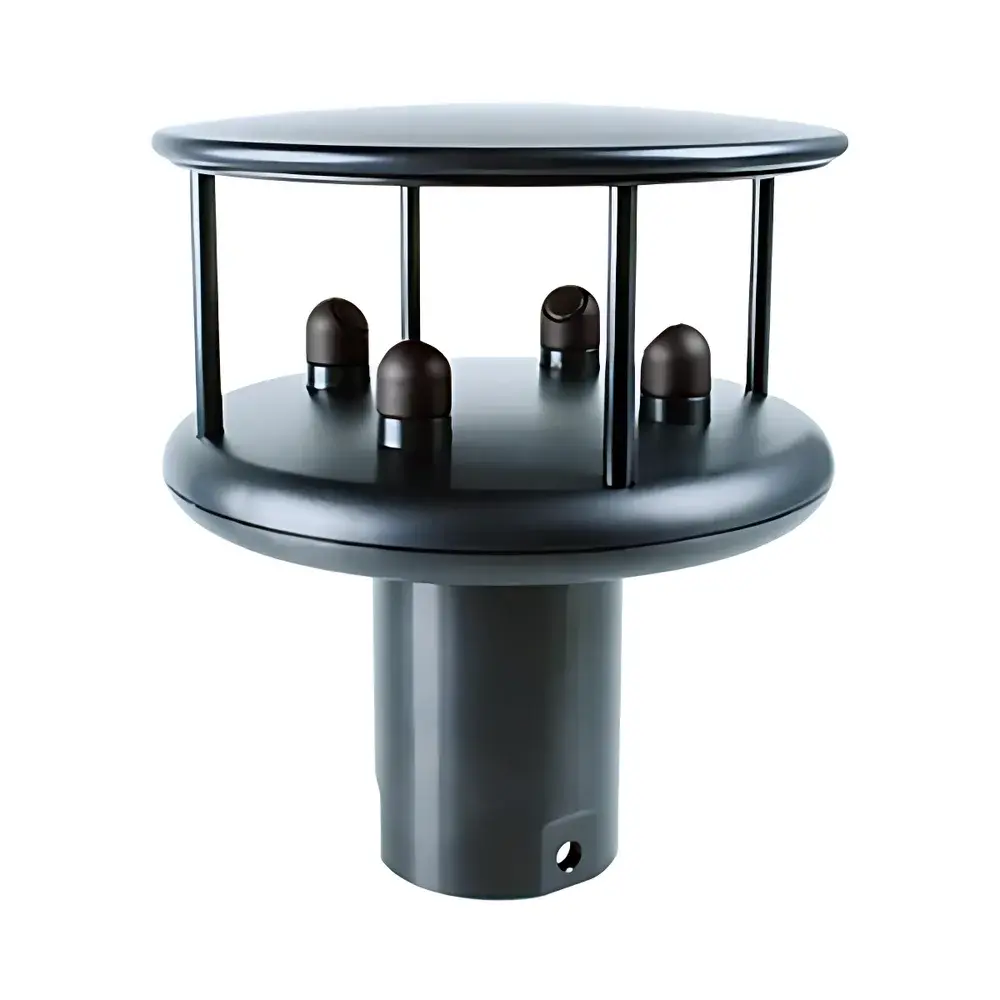
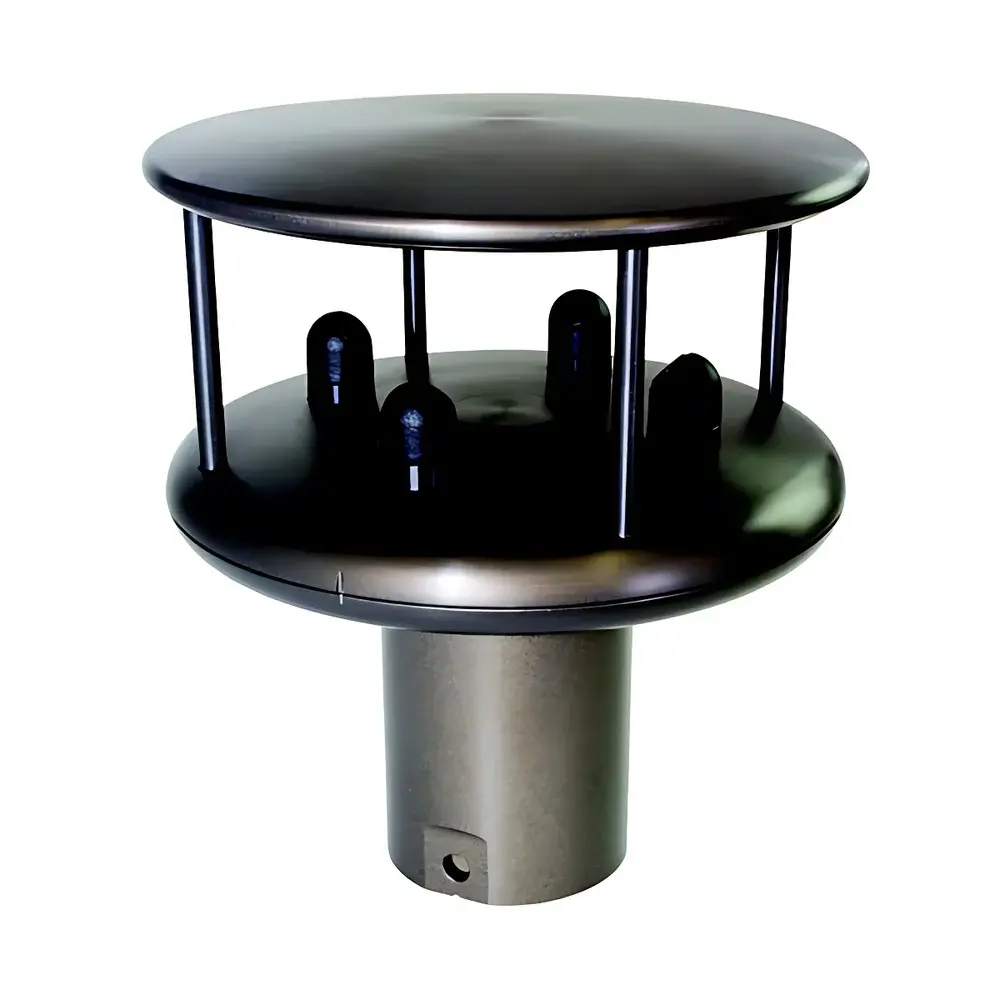
Gill WindSonic M Ultrasonic Anemometer
| Brand | Gill |
|---|---|
| Origin | United Kingdom |
| Model | WindSonic M |
| Instrument Type | Ultrasonic Anemometer |
| Resolution | 0.01 m/s |
| Measurement Range | 0–60 m/s |
| Accuracy | ±2% |
| Operating Temperature | −40 °C to +70 °C |
| Operating Humidity | 0–100% RH |
| Ingress Protection | IP66 |
| Vibration Compliance | BS EN 60945:2002 |
| Impact Resistance | UL 2218 Class 1 |
| Output Protocols | NMEA 0183 (standard), Analog Output (optional) |
Overview
The Gill WindSonic M is a compact, two-dimensional ultrasonic anemometer engineered for continuous, high-reliability wind speed and wind direction measurement in demanding environmental monitoring applications. Based on Gill’s proven time-of-flight ultrasonic principle, the sensor calculates wind velocity by precisely measuring the differential transit times of high-frequency acoustic pulses between opposing transducer pairs. This solid-state architecture eliminates mechanical moving parts—removing wear mechanisms associated with cup-and-vane or propeller-based systems—and delivers intrinsic long-term stability, minimal drift, and immunity to icing-induced mechanical seizure. Designed and manufactured in the UK, the WindSonic M integrates seamlessly into meteorological networks requiring robust, low-maintenance sensing across maritime, terrestrial, and infrastructure environments—including offshore platforms, coastal observatories, tunnel ventilation control systems, and mobile weather units.
Key Features
- True solid-state design: No rotating components, bearings, or gears—enabling maintenance-free operation over extended deployment cycles.
- Hard-anodized aluminum housing: Provides exceptional corrosion resistance, structural rigidity, and thermal stability across extreme ambient conditions.
- Optional integrated heater: Enables reliable operation down to −40 °C by preventing frost accumulation on transducer surfaces—critical for polar, alpine, and marine deployments.
- IP66-rated enclosure: Ensures full protection against dust ingress and powerful water jets, validated per IEC 60529.
- Compliance-certified mechanical robustness: Meets BS EN 60945:2002 for marine vibration endurance and UL 2218 Class 1 impact resistance—suitable for shipboard, buoy-mounted, and roadside installations.
- Standard NMEA 0183 output: Compatible with industry-standard marine navigation, data logging, and SCADA systems without protocol conversion.
- Optional analog voltage/current outputs (0–5 V, 0–10 V, 4–20 mA): Facilitates integration with legacy PLCs, building management systems (BMS), and analog input modules.
Sample Compatibility & Compliance
The WindSonic M is optimized for open-air atmospheric sampling in unobstructed flow regimes typical of meteorological masts, rooftop installations, buoys, and vehicle-mounted platforms. Its low-profile geometry minimizes flow distortion, while its calibrated response ensures traceable performance across the full 0–60 m/s range. The sensor conforms to international standards relevant to environmental instrumentation: it supports data integrity requirements aligned with ISO/IEC 17025 for accredited monitoring laboratories; its digital output structure complies with NMEA 0183 v4.10 for interoperability; and its construction adheres to RoHS 2011/65/EU and REACH (EC) No. 1907/2006 directives. While not intrinsically rated for hazardous areas, its non-sparking housing and absence of internal combustion elements make it suitable for Zone 2/22 classified environments when installed per IEC 60079-14 guidelines.
Software & Data Management
The WindSonic M operates as a self-contained sensor node—requiring no embedded firmware updates or host-side drivers for basic operation. Raw wind vector data (speed in m/s, direction in degrees true) is streamed continuously via ASCII-formatted NMEA sentences (e.g., $WIMWV, $WIMWD) at user-selectable update rates (1 Hz standard, configurable up to 4 Hz). When integrated into larger environmental monitoring networks, the device interfaces natively with data acquisition systems supporting serial RS-232/RS-485 (with optional converter) or TTL-level UART. For audit-trail compliance in regulated sectors (e.g., airport weather reporting under ICAO Annex 3 or port authority environmental reporting), timestamped NMEA logs can be ingested into time-synchronized database architectures supporting ISO 8601-compliant metadata tagging and 21 CFR Part 11–compatible electronic signature workflows—provided the host system implements requisite access controls and change logging.
Applications
- Remote telemetry weather stations for national meteorological services and research campaigns
- Real-time ventilation control in road and rail tunnels (per EN 1991-1-4 wind load modeling inputs)
- Marine data buoys and autonomous surface vehicles (ASVs) operating in open-ocean conditions
- Coastal and offshore wind resource assessment and turbine site monitoring
- Environmental compliance monitoring at ports, terminals, and industrial perimeters
- Mobile meteorological platforms—including aircraft hangar aprons, helicopter landing zones, and emergency response vehicles
- Building energy management systems requiring localized wind-driven natural ventilation logic
FAQ
Does the WindSonic M require periodic calibration?
No scheduled recalibration is required under normal operating conditions. Gill provides factory calibration traceable to NPL (UK National Physical Laboratory) standards, and the sensor’s ultrasonic time-of-flight measurement principle exhibits negligible long-term drift. Field verification using known reference wind sources (e.g., calibrated wind tunnels or co-located reference sensors) is recommended annually for critical applications.
Can the WindSonic M operate submerged or in heavy rain?
It is not submersible. However, its IP66 rating ensures uninterrupted operation during torrential rainfall, sea spray exposure, and high-humidity coastal fog—provided mounting orientation avoids direct vertical water column impingement on transducer faces.
Is heating available as a retrofit option?
The heater is factory-integrated only; it cannot be added post-purchase due to thermal interface design and power supply routing constraints.
What is the minimum detectable wind speed?
The specified resolution of 0.01 m/s applies across the entire 0–60 m/s range, but practical detection threshold under turbulent or low-SNR conditions is typically ~0.1 m/s—consistent with industry-standard ultrasonic anemometer performance benchmarks.
Does the device support Modbus or SDI-12 protocols?
No. Native communication is limited to NMEA 0183 and optional analog outputs. Protocol translation requires external gateway hardware compatible with RS-232/485 serial interfaces.







