
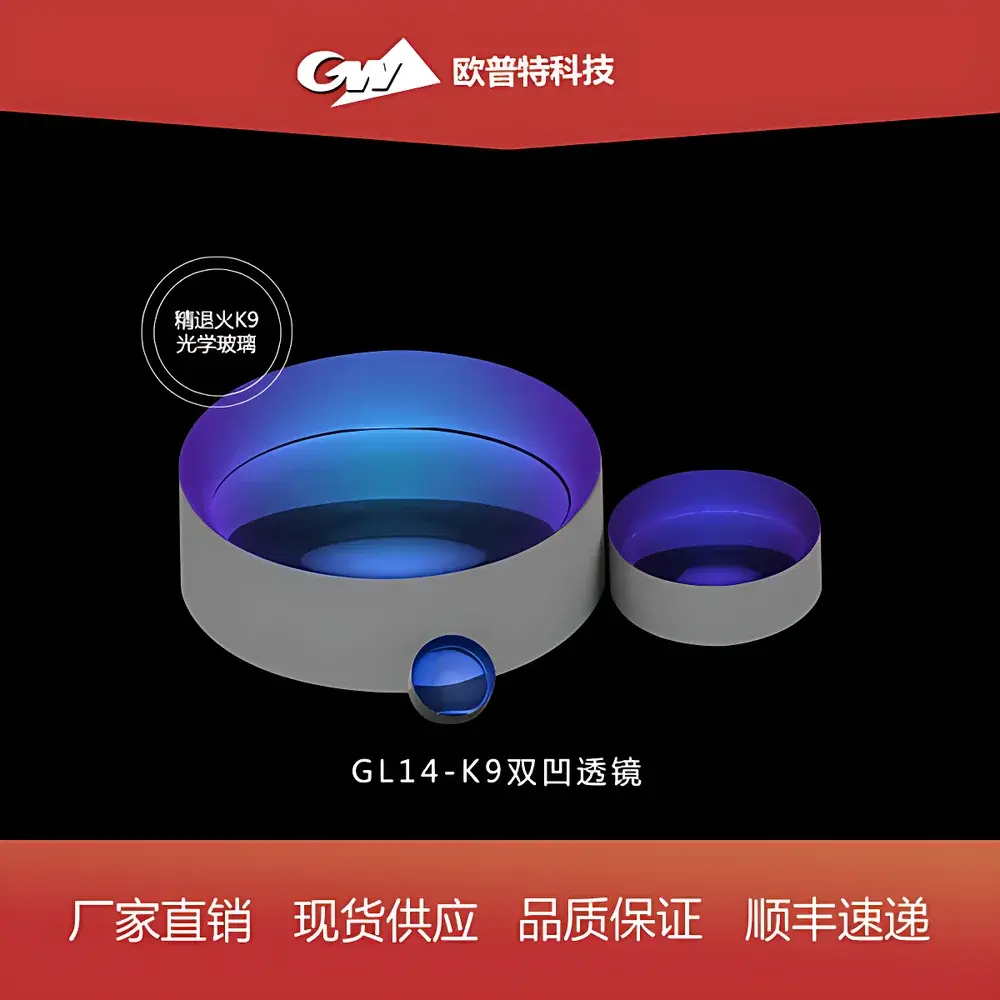
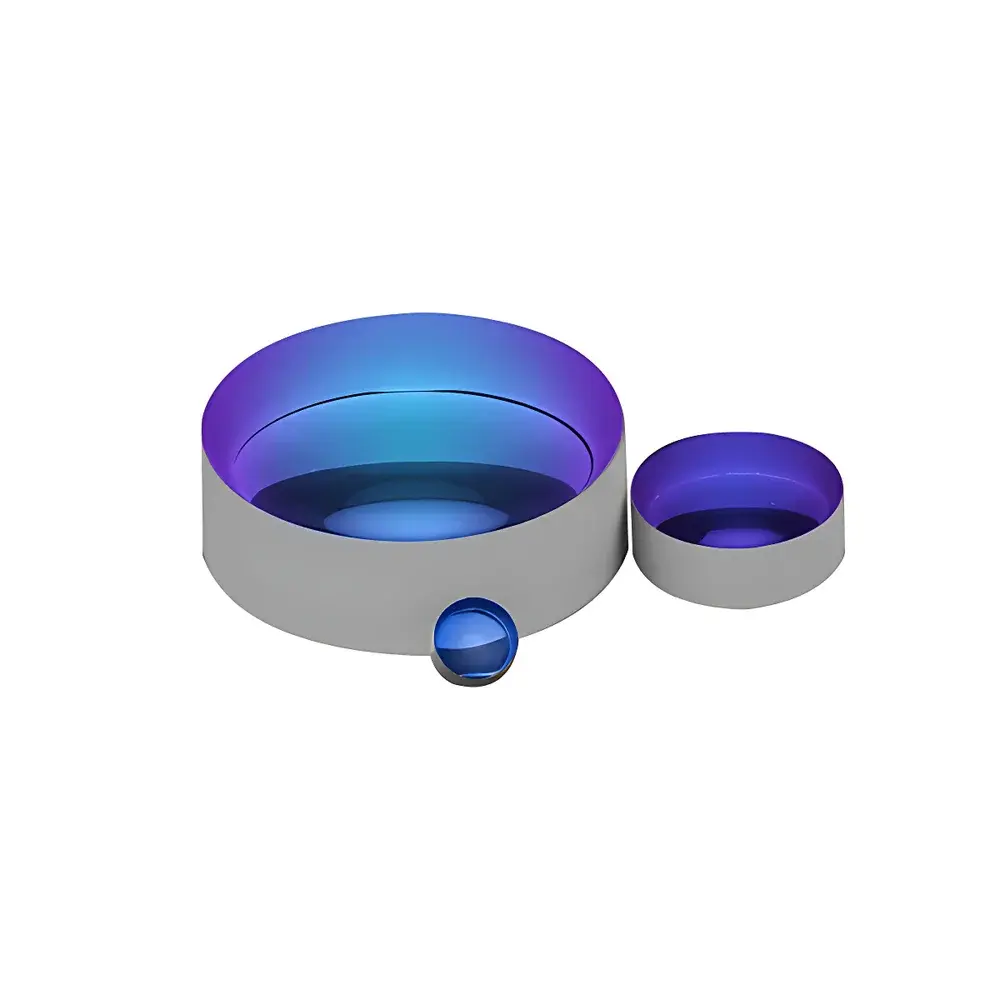
GL14-VIS Dual-Concave Lens with Broadband Anti-Reflection Coating (400–700 nm)
| Diameter | 2–50 mm |
|---|---|
| Focal Length (EFL) | –2.0 to –50.0 mm |
| Surface Radius (R₁) | –2.22 to –52.15 mm |
| Center Thickness (T₁) | 1.00–3.00 mm |
| Edge Thickness (T₂) | 1.22–15.77 mm |
| Coating | MgF₂-based broadband AR, Rₐᵥg < 0.5% @ 400–700 nm |
| Material | N-BK7 (Schott) |
| Surface Quality | 40–20 scratch-dig |
| Clear Aperture | ≥90% of diameter |
Overview
The GL14-VIS Dual-Concave Lens is a precision optical component engineered for beam expansion, divergence control, and negative focal length correction in visible-light optical systems. Manufactured from high-homogeneity N-BK7 optical glass (Schott), each lens features symmetric biconcave geometry with precisely controlled surface curvatures derived from paraxial design principles. The lens operates on the principle of divergent refraction: incident collimated light rays are refracted outward at both surfaces, producing a virtual focus located on the incident side of the lens. Its optical performance is optimized across the visible spectrum (400–700 nm) via a single-layer magnesium fluoride (MgF₂) broadband anti-reflection coating—applied using vacuum thermal evaporation—to minimize Fresnel losses and suppress ghosting in multi-element assemblies. Designed for integration into laser alignment setups, spectroscopic beam paths, interferometric reference arms, and educational optics kits, the GL14-VIS series adheres to ISO 10110-1 (general tolerances) and ISO 10110-3 (surface form tolerances), ensuring traceable metrological consistency across production lots.
Key Features
- Symmetric dual-concave geometry with matched radii of curvature (R₁ = R₂) for minimized spherical aberration in low-numerical-aperture applications
- Broadband MgF₂ anti-reflection coating: average reflectance < 0.5% over 400–700 nm; measured per MIL-C-48497A spectral verification protocol
- N-BK7 substrate with refractive index nd = 1.5168 @ 587.6 nm and Abbe number νd = 64.2, enabling predictable chromatic behavior in VIS-band systems
- Surface quality rated to 40–20 scratch-dig per ANSI/OEOSC OP1.002, verified via automated dark-field inspection
- Wavefront error ≤ λ/4 @ 633 nm (HeNe wavelength), confirmed by Zygo GPI interferometric testing on 100% of shipped units
- Diameter range from 2.0 mm to 50.0 mm, supporting compact micro-optics integration as well as macro-scale collimation stages
- Standardized mechanical mounting compatibility: all diameters align with industry-standard SM-threaded lens mounts referenced in catalog page 100 (e.g., SM05, SM1, SM2 series)
Sample Compatibility & Compliance
The GL14-VIS lens is compatible with standard optomechanical platforms including Thorlabs, Newport, and Edmund Optics mounting hardware. Its N-BK7 substrate exhibits excellent thermal stability (dn/dT ≈ +2.3 × 10⁻⁶ /°C) and low moisture absorption (< 0.1 wt%), making it suitable for operation in ambient laboratory environments and sealed optical enclosures. All lenses are manufactured under cleanroom conditions (ISO Class 7) and undergo final cleaning per ISO 10110-7 specifications. RoHS Directive 2011/65/EU compliance is certified for all materials and coating processes. While not classified as medical or aerospace-grade hardware, the lens meets baseline requirements for ISO 9001-certified optical component suppliers and supports traceability through individual product numbering (e.g., GL14-025-025-VIS).
Software & Data Management
No embedded firmware or proprietary software is associated with this passive optical component. However, full optical prescription data—including exact EFL, BFL, surface radii, center thickness, and coating spectral curves—is provided in machine-readable CSV and Zemax-compatible .ZMX format upon request. Spectral reflectance data (400–700 nm, 1 nm resolution) is supplied with each batch in accordance with ASTM E308-19 for colorimetric and photometric modeling. Traceability documentation includes interferometric test reports, coating spectrophotometry certificates, and material lot trace sheets—all archived for 10 years per ISO 9001:2015 clause 8.5.2.
Applications
- Laser beam expansion in HeNe (633 nm), diode (405–670 nm), and white-light LED illumination systems
- Negative focal elements in Galilean telescope configurations for compact collimator design
- Divergence compensation in fiber-coupled free-space interfaces (e.g., correcting over-collimation from aspheric collimators)
- Reference optics in Michelson and Mach–Zehnder interferometers operating within the visible band
- Optical training modules for undergraduate physics laboratories covering thin-lens theory, ray tracing, and aberration analysis
- Component-level validation in ISO/IEC 17025-accredited calibration labs performing optical path length verification
FAQ
Is the GL14-VIS lens suitable for high-power laser applications?
No — this lens is designed for low-to-moderate irradiance applications (< 1 W/cm² continuous wave at 532 nm). It is not certified for laser-induced damage threshold (LIDT) testing per ISO 21254 and should not be used in pulsed or amplified laser systems without independent LIDT validation.
Can I request custom coating specifications outside the 400–700 nm band?
Yes — NIR (650–1050 nm) and SWIR (1000–1650 nm) variants are available under separate part numbers (e.g., GL14-xxx-NIR). Custom V-coatings or ultra-low-reflectance designs require minimum order quantities and extended lead times.
What is the maximum operating temperature range?
The lens maintains optical integrity from –20 °C to +70 °C. Thermal cycling beyond this range may induce stress birefringence or coating delamination due to CTE mismatch between N-BK7 and MgF₂.
Are mounting adapters included with purchase?
No — lens retaining rings and kinematic mounts (e.g., SM05RR, LM1XY) are sold separately. Mounting compatibility details are listed in the Mechanical Interface Guide (Catalog Pg. 100).
Do you provide ISO/IEC 17025 calibration certificates?
Not applicable — as a passive component, the GL14-VIS does not require calibration. However, dimensional and surface form verification reports conforming to ISO 10110 are provided with every shipment.




