
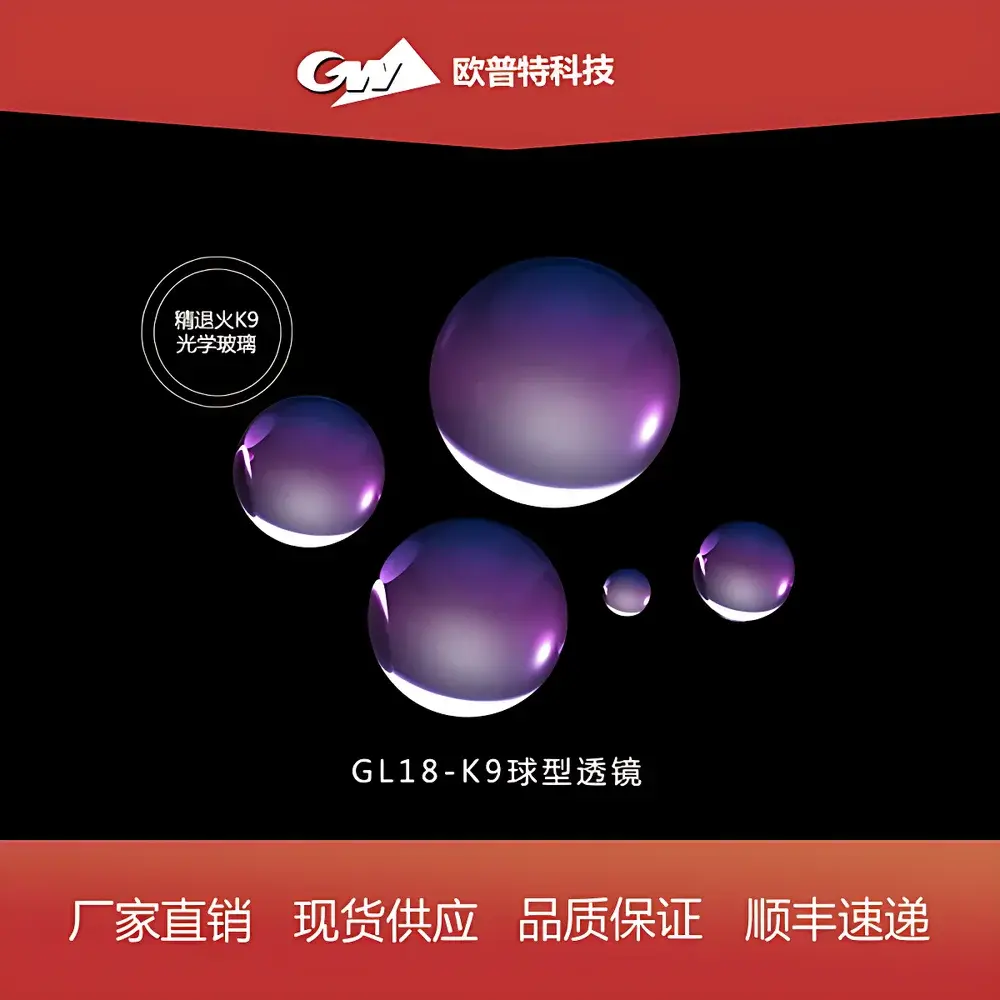
GL18-K9 Spherical Lens (Uncoated)
| Origin | Beijing, China |
|---|---|
| Manufacturer Type | Distributor |
| Origin Category | Domestic |
| Model | GL18 |
| Price Range | USD 0.15–75.00 |
| Component Category | Optical Element |
| Material | K9 Borosilicate Crown Glass |
| Surface Quality | 40-20 Scratch-Dig |
| Clear Aperture | ≥90% Diameter |
| Coating | None (Uncoated) |
| Tolerance | Diameter ±0.05 mm, EFL ±2%, BFL ±2% |
| Refractive Index (nd) | 1.5163 @ 587.6 nm |
| Abbe Number (Vd) | 64.2 |
Overview
The GL18-K9 Spherical Lens is a precision-ground optical component fabricated from high-homogeneity K9 borosilicate crown glass—a material widely specified in industrial and research-grade optical systems for its excellent transmission across the visible spectrum (350–2000 nm), low thermal expansion coefficient (7.1 × 10⁻⁶ /°C), and compatibility with standard cleaning and handling protocols. Unlike aspheric or gradient-index lenses, spherical lenses operate on classical paraxial optics principles, where focal length (EFL) is determined by surface curvature radius and refractive index via the lensmaker’s equation. The GL18 series is engineered specifically for coupling efficiency optimization in free-space-to-fiber and emitter-to-detector interfaces—leveraging its short back focal length (BFL) to minimize alignment sensitivity and reduce optical path length between active components. Its uncoated surface preserves maximum design flexibility, allowing integration into custom broadband or wavelength-selective assemblies where anti-reflection coatings may introduce phase distortion or spectral narrowing.
Key Features
- Precision ground and polished surfaces meeting ISO 10110-3 standards for surface form accuracy (λ/4 @ 633 nm) and surface roughness (≤5 nm RMS)
- Consistent dimensional tolerances: diameter ±0.05 mm, effective focal length (EFL) ±2%, back focal length (BFL) ±2%
- K9 glass substrate certified to ASTM F265-22 for optical glass homogeneity and striae classification (Class A)
- No residual stress birefringence (verified via crossed-polarizer inspection per MIL-PRF-13830B)
- Available in ten standardized diameters (1.0–10.0 mm), each with corresponding EFL and BFL values traceable to NIST-calibrated interferometric measurement
- Edge finish: fine ground with protective chamfer (0.1–0.2 mm × 45°) to prevent chipping during mounting
Sample Compatibility & Compliance
The GL18-K9 lens is compatible with standard kinematic mounts (e.g., SM1-threaded lens tubes, Ø1/2″ post holders) and fiber alignment stages used in OEM photonic modules. It meets mechanical and environmental requirements for Class I laser product integration per IEC 60825-1:2014. While uncoated, its surface quality supports subsequent thin-film deposition—including broadband AR (BBAR), V-coat, or dichroic layers—without adhesion failure. All units undergo 100% visual inspection under controlled illumination (ISO 14644-1 Class 5 cleanroom environment) and are supplied with individual test reports documenting surface quality, transmitted wavefront error (TWE < λ/8 PV), and spectral transmittance curves (200–2500 nm). Documentation conforms to ISO 9001:2015 manufacturing traceability protocols.
Software & Data Management
No embedded firmware or proprietary software is associated with this passive optical component. However, lens performance data—including measured EFL, BFL, and center thickness—is provided in machine-readable CSV format upon request, enabling direct import into optical design platforms such as Zemax OpticStudio, CODE V, or Thorlabs’ OptoSim. Each batch includes a calibration certificate referencing NIST-traceable interferometric verification, supporting GLP-compliant documentation workflows in regulated environments (e.g., medical device R&D per ISO 13485).
Applications
- Fiber-optic coupling in telecom transceivers, silicon photonics interposers, and quantum dot laser diode packages
- Collimation and focusing elements in miniature endoscopic imaging systems (outer diameter ≤2.5 mm)
- Pre-form blanks for diamond-turning of aspheric or hybrid lenses in IR and visible bands
- Beam shaping in barcode scanner engines and industrial position sensors
- Reference optics in educational optics labs for teaching Gaussian beam propagation and ABCD matrix analysis
- Input/output windows in MEMS-based spectrometers and environmental gas sensors
FAQ
What is the refractive index and Abbe number of K9 glass used in the GL18 series?
K9 glass exhibits a nominal refractive index (nd) of 1.5163 at the sodium D-line (587.6 nm) and an Abbe number (Vd) of 64.2, indicating low dispersion and suitability for achromatic doublet pairing.
Can these lenses be cleaned using standard optical solvents?
Yes—K9 glass is chemically resistant to isopropyl alcohol (IPA), acetone, and mild detergent solutions; ultrasonic cleaning is permitted at frequencies ≤40 kHz with deionized water rinse.
Is there a specification for transmitted wavefront error (TWE)?
Each lens is tested per ISO 10110-5; typical TWE is ≤λ/8 peak-to-valley (PV) at 632.8 nm, with full test data available upon request.
Are custom diameters or focal lengths available?
Standard offerings cover diameters from 1.0 mm to 10.0 mm; non-standard sizes require minimum order quantities (MOQ = 50 pcs) and extended lead time (8–12 weeks).
Do you provide mounting fixtures or alignment adapters?
While the GL18 lens itself is a standalone component, compatible SM1-threaded lens cells, kinematic mounts, and fiber alignment sleeves are available separately under part numbers LCP1, KM100, and ADAF-FC.





