
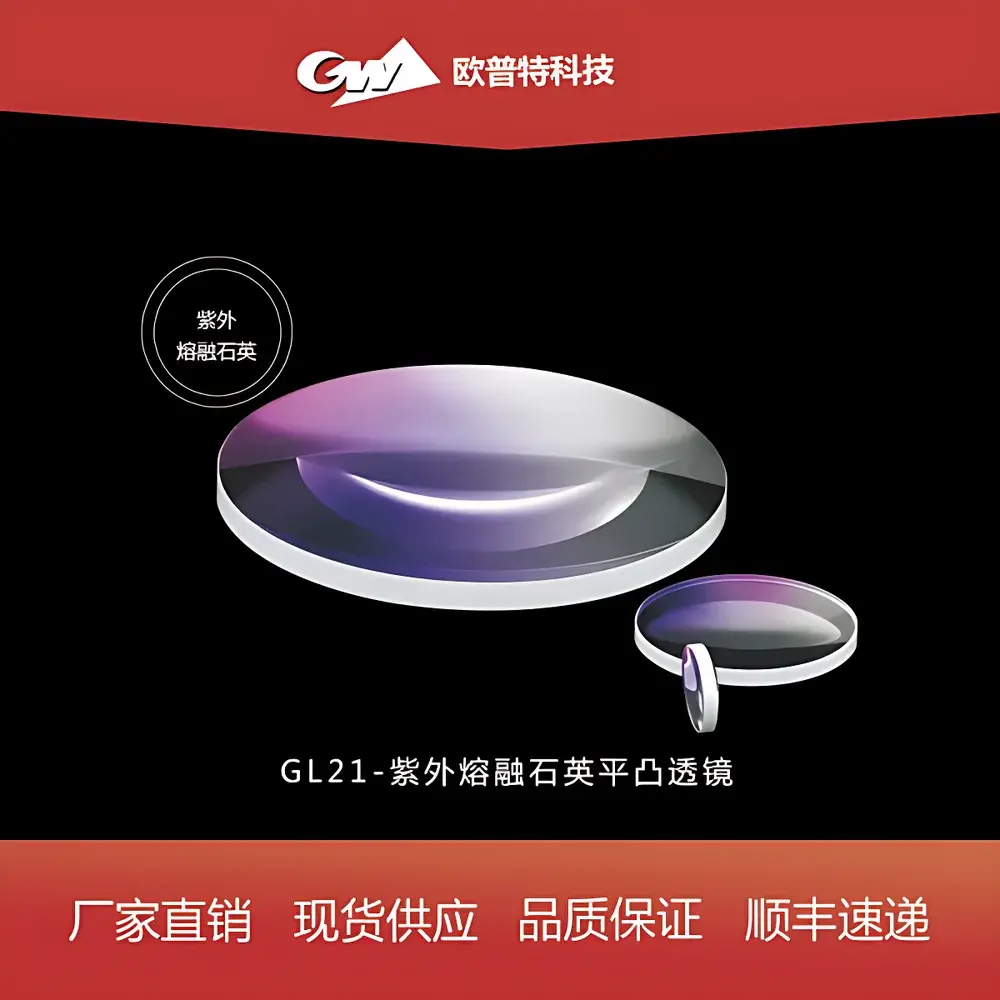
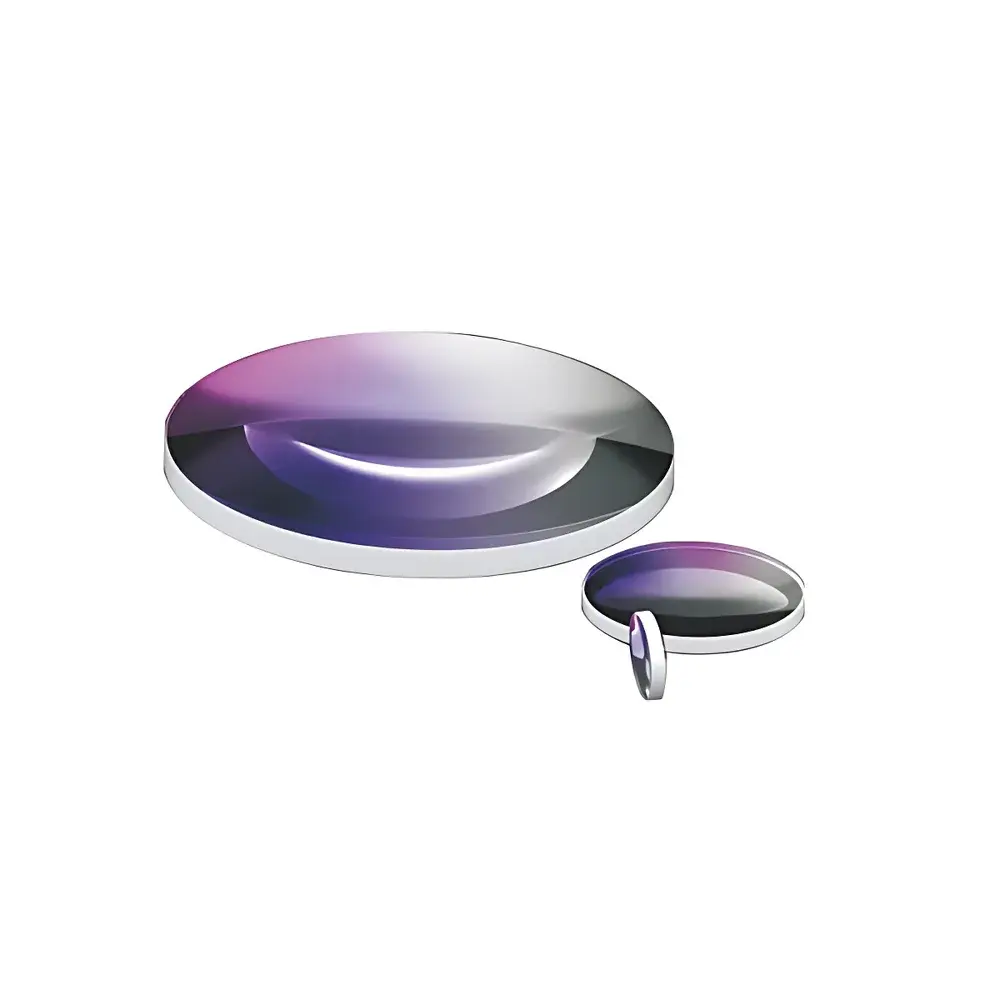
GL21 UV-Fused Silica Plano-Convex Lens (Uncoated & UV Broadband AR-Coated)
| Origin | Beijing, China |
|---|---|
| Manufacturer Type | Distributor |
| Regional Origin | Domestic (China) |
| Model | GL21 |
| Price Range | USD 0.15–75.00 |
| Component Category | Optical Element |
| Diameter Options | 4.0 mm & 6.3 mm |
| Focal Lengths (EFL) | 3 mm to 40 mm |
| Substrate Material | UV-Fused Silica (Synthetic Quartz, Grade 7980 or equivalent) |
| Coating Options | Uncoated or UV Broadband Anti-Reflection (AR) Coating (250–400 nm) |
| Surface Quality | 40–20 scratch-dig (per MIL-PRF-13830B) |
| Surface Flatness (Plano Side) | λ/4 @ 633 nm |
| Surface Power (Convex Side) | ≤3λ @ 633 nm |
| Centration | ≤3 arcmin |
| Clear Aperture | ≥90% of diameter |
| Damage Threshold | ≥5 J/cm² @ 355 nm, 10 ns, 20 Hz |
Overview
The GL21 series comprises precision-engineered plano-convex lenses fabricated from high-purity UV-grade fused silica (SiO₂), optimized for demanding ultraviolet optical applications where transmission stability, low thermal expansion, and minimal fluorescence are critical. These lenses operate on the fundamental principle of refraction—bending incident collimated light to a single focal point along the optical axis—making them indispensable in beam focusing, collimation, imaging, and illumination systems within UV spectroscopy, laser material processing, photolithography alignment, and fluorescence microscopy setups. Unlike standard BK7 or N-BK7 glass lenses, UV-fused silica exhibits exceptional transmission down to 185 nm and negligible solarization under prolonged UV exposure, ensuring long-term radiometric integrity in rigorous laboratory and industrial environments.
Key Features
- High-transmission UV-fused silica substrate (OH⁻ content < 1 ppm, refractive index homogeneity Δn ≤ ±5 × 10⁻⁶)
- Two coating variants: uncoated for maximum UV reflectivity control or broadband anti-reflection (BBAR) coating optimized for 250–400 nm spectral range (average R < 0.5% per surface)
- Precision-polished surfaces meeting MIL-PRF-13830B 40–20 scratch-dig specification
- Plano side flatness specified at λ/4 @ 633 nm; convex surface power ≤3λ @ 633 nm
- Tight centration tolerance (≤3 arcmin) ensures minimal beam deviation in multi-element assemblies
- Clear aperture ≥90% of nominal diameter, supporting efficient light throughput in space-constrained optical mounts
- Compatible with industry-standard lens mount families including PN3036-LM040-S (for 4.0 mm lenses) and PN3034-LM063-S (for 6.3 mm lenses)
Sample Compatibility & Compliance
The GL21 lenses are designed for integration into ISO/IEC 17025-accredited optical test benches and comply with dimensional and material specifications referenced in ISO 10110-1 (optical element drawing standards) and ISO 10110-7 (surface imperfection requirements). Their UV-fused silica composition meets ASTM F2525-06 (Standard Specification for Fused Silica for Optical Applications) and is suitable for use in Class 100 cleanroom environments. While not inherently certified to FDA 21 CFR Part 11 or EU Annex 11, the lenses support traceable calibration workflows when paired with metrology-grade interferometers (e.g., Zygo Verifire™) and are routinely deployed in GMP-aligned UV spectrophotometer validation protocols per USP and Ph. Eur. 2.2.25.
Software & Data Management
As passive optical components, GL21 lenses do not incorporate embedded firmware or digital interfaces. However, their geometric and material parameters—including EFL, BFL, radius of curvature (R₁), center thickness (Tc), edge thickness (Te), and refractive index dispersion data (Sellmeier coefficients)—are fully compatible with industry-standard optical design software such as Zemax OpticStudio®, CODE V®, and Synopsys LightTools®. All published specifications are traceable to manufacturer-provided test reports (including interferometric wavefront maps and spectral transmittance curves measured on PerkinElmer Lambda 950 UV/VIS/NIR spectrophotometers), enabling full integration into digital twin models and automated optical system documentation pipelines compliant with ASME Y14.5 GD&T conventions.
Applications
- Focusing excitation beams in UV Raman spectroscopy systems (244 nm, 266 nm, 325 nm lasers)
- Coupling UV laser diodes (e.g., 375 nm GaN-based sources) into single-mode fibers
- Collimating output from UV LEDs in semiconductor inspection and wafer metrology tools
- Constructing compact UV microscope objectives and relay optics for synchrotron beamlines
- Aligning optical paths in vacuum-compatible UV photolithography steppers (where outgassing rate < 1.0 × 10⁻⁹ g/cm²·s per ASTM E595)
- Calibrating radiometric sensors in NIST-traceable UV irradiance standards (e.g., for ISO 17025 accredited photobiological safety testing)
FAQ
Are GL21 lenses suitable for high-power pulsed UV lasers?
Yes—UV-fused silica’s high laser-induced damage threshold (LIDT ≥5 J/cm² at 355 nm, 10 ns pulse width, 20 Hz repetition rate) makes them appropriate for nanosecond-pulsed Nd:YAG harmonics and frequency-tripled Ti:sapphire systems, provided beam diameters exceed the clear aperture and proper thermal management is implemented.
What mounting options are recommended for 4.0 mm and 6.3 mm GL21 lenses?
For 4.0 mm diameter variants, the PN3036-LM040-S kinematic lens mount (stainless steel, SM05-threaded) is specified; for 6.3 mm variants, the PN3034-LM063-S mount (SM1-threaded, with integrated retaining ring) ensures secure, stress-free fixation without inducing wavefront distortion.
Is the UV AR coating durable under repeated cleaning with IPA or acetone?
The broadband UV AR coating is ion-assisted electron-beam deposited and qualified for >100 cycles of gentle wipe cleaning using lint-free wipes (e.g., Texwipe TX609) and spectroscopic-grade isopropanol, per MIL-C-48497A cleaning protocol.
Can custom focal lengths or diameters be manufactured?
Yes—custom geometries (including non-standard EFLs, aspheric corrections, or wedge-controlled substrates) are available under OEM agreements, subject to minimum order quantities and extended lead times; contact engineering support for feasibility assessment and ISO 10110-compliant drawing review.



