
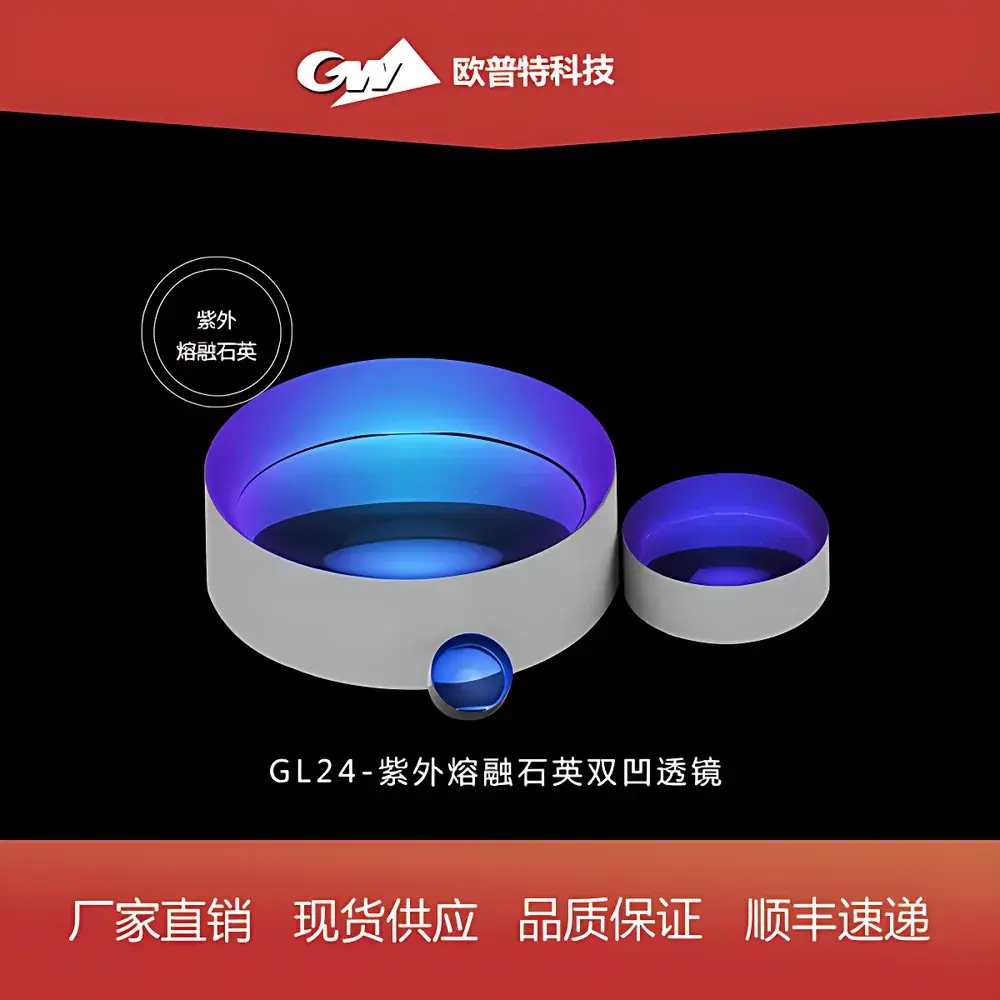
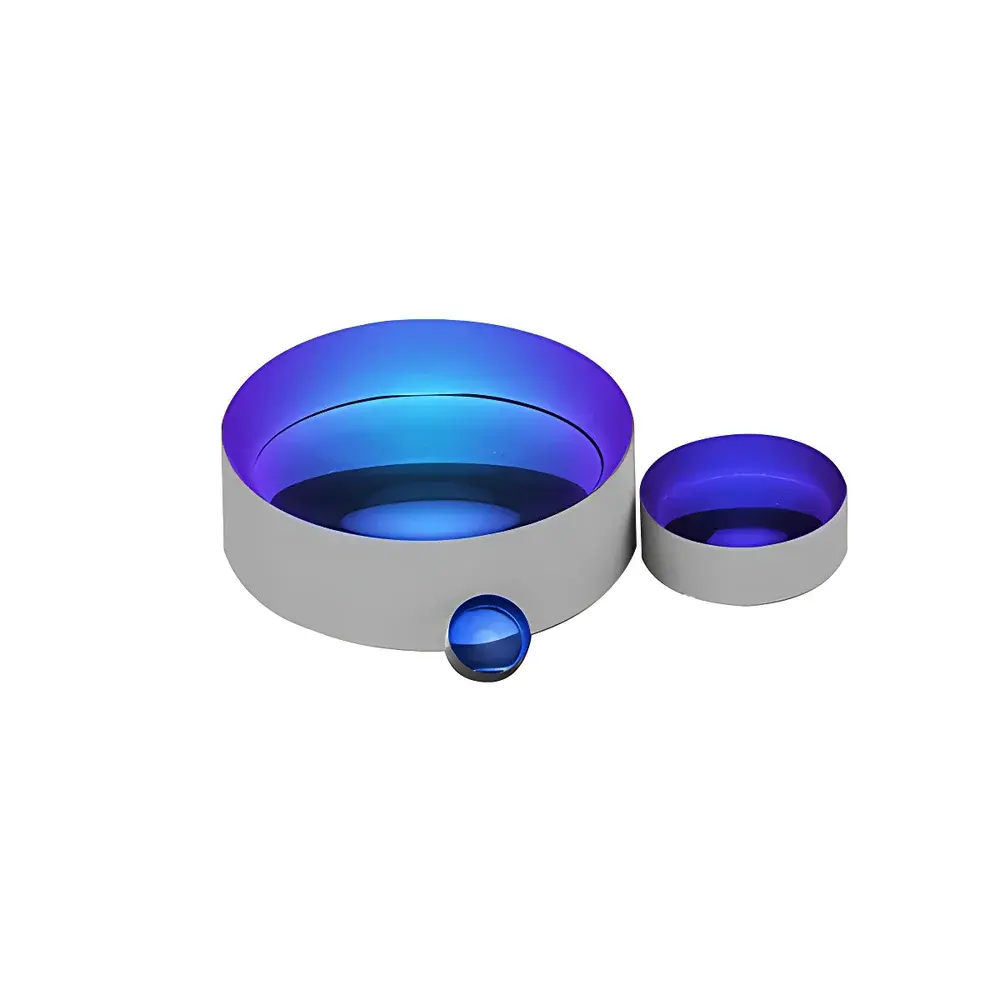
GL24 UV Fused Silica Double-Concave Lens (Uncoated, UV-Grade)
| Origin | Beijing |
|---|---|
| Manufacturer Type | Distributor |
| Origin Category | Domestic |
| Model | GL24 |
| Price Range | USD 0.15–75.00 |
| Component Category | Optical Element |
Overview
The GL24 UV Fused Silica Double-Concave Lens is a precision optical component engineered for demanding ultraviolet (UV) and deep-UV spectral applications where high transmission, low fluorescence, and exceptional thermal and chemical stability are required. Fabricated from synthetic fused silica (SiO₂) with <0.5 ppm metallic impurity content and OH⁻ concentration optimized for UV transparency (typically 85% at 193 nm (uncoated). Its double-concave geometry introduces negative focal power, enabling beam expansion, divergence control, and correction of spherical aberration in collimated or convergent light paths. The lens adheres to ISO 10110-1 surface form tolerances (λ/4 @ 632.8 nm) and is manufactured under cleanroom conditions (ISO Class 5) to minimize subsurface damage and particulate contamination—critical for excimer laser systems, UV spectroscopy, and semiconductor photolithography alignment optics.
Key Features
- Material: High-purity synthetic fused silica (UV-grade), certified per MIL-O-13830A scratch-dig specification (20–10)
- Surface Quality: λ/4 wavefront accuracy at 633 nm; surface roughness <5 Å RMS measured by AFM
- Coating Status: Uncoated standard configuration; optional MgF₂ or Al₂O₃ single-layer AR coatings available upon request for specific UV bands
- Environmental Stability: Coefficient of thermal expansion (CTE) = 0.55 × 10⁻⁶ /°C; zero bubble/inclusion grade per ASTM F2620
- Mechanical Robustness: Vickers hardness ≥580 kgf/mm²; compressive strength >1.1 GPa
- Traceability: Each lens carries engraved serial number and conforms to ISO 9001 traceability protocols; full material certification (COA) provided
Sample Compatibility & Compliance
The GL24 series is compatible with standard optomechanical mounts (e.g., SM1-threaded lens tubes, kinematic lens holders) and integrates seamlessly into OEM UV imaging systems, Raman spectrometers, and laser cavity designs. All lenses meet RoHS Directive 2011/65/EU and REACH Annex XVII compliance requirements. For regulated environments—including pharmaceutical analytical instrumentation and clinical UV dosimetry systems—the components support documentation packages aligned with FDA 21 CFR Part 11 (electronic records) and ISO/IEC 17025 calibration traceability when paired with NIST-traceable interferometric verification reports. No hazardous substances per IEC 62474 (V1.4) are present in raw material or processing stages.
Software & Data Management
While the GL24 lens itself is a passive optical element, its performance parameters are fully integrated into industry-standard optical design software libraries—including Zemax OpticStudio (v23+), CODE V (v12.5+), and FRED (v17.0+). Pre-validated material dispersion data (Sellmeier coefficients for Corning 7980 fused silica) and surface tolerance models are embedded in each part number’s metadata. Customers receive downloadable .ZAR files and STEP AP214 CAD models with GD&T annotations. For quality management systems, lens-specific test reports—including spectral transmittance curves (200–1100 nm, 1 nm resolution), interferometric wavefront maps, and surface defect logs—are archived in secure cloud repositories with AES-256 encryption and audit trail logging compliant with ISO 13485 clause 7.5.10.
Applications
- Excimer laser beam shaping (ArF 193 nm, KrF 248 nm) in microlithography steppers and mask aligners
- UV-VIS spectrophotometer collimation and focusing optics, especially in compliance with ASTM E275 and ISO 6254
- Fluorescence microscopy illumination pathways requiring minimal autofluorescence background
- Deep-UV ellipsometers and reflectometers used in thin-film metrology (e.g., SiO₂ on Si wafers)
- Space-qualified UV sensors (e.g., solar blind detectors) where radiation-induced darkening must be minimized
- Custom laser cavity optics for tunable OPOs and frequency-doubled Ti:sapphire systems operating below 300 nm
FAQ
What is the maximum permissible power density for continuous-wave UV exposure at 244 nm?
For uncoated GL24 lenses operated at ambient temperature and with clean air convection cooling, the recommended CW power density limit is ≤1.5 W/cm² at 244 nm (measured over 1 mm² spot size). Higher fluences require active cooling or pulsed operation per ISO 21254-1 damage threshold testing.
Can these lenses be cleaned using piranha solution (H₂SO₄:H₂O₂)?
No. Piranha etch severely degrades fused silica surfaces. Recommended cleaning follows ISO 10110-7: use acetone followed by methanol rinses, then nitrogen blow-dry; for stubborn organics, dilute NH₄OH:H₂O₂:H₂O (1:1:5) may be applied briefly with strict time control (<30 s) and immediate DI water rinse.
Is there batch-to-batch variation in UV transmission below 200 nm?
Yes—minor variation occurs due to intrinsic hydroxyl content and trace metal dopants. Each production lot undergoes spectral verification at 185 nm; lot-specific transmittance data is supplied with COA. For critical 193 nm applications, specify “low-OH” variant (≤5 ppm OH⁻) at order entry.
Do you provide mounting adapters or kinematic cells for GL24 lenses?
Yes. Standard SM1-threaded lens mounts (e.g., LMR1, KM100) and UV-stable anodized aluminum kinematic cells (KCB1P/M) are available as accessory SKUs. Custom CNC-machined mounts with alignment fiducials can be quoted separately.
Are these lenses suitable for vacuum UV (VUV) applications below 185 nm?
Not without modification. Native fused silica exhibits strong absorption below 160 nm due to electronic band-edge effects. For VUV use (e.g., 121.6 nm Lyman-α), magnesium fluoride (MgF₂) substrates are recommended; consult engineering support for hybrid design options.





