
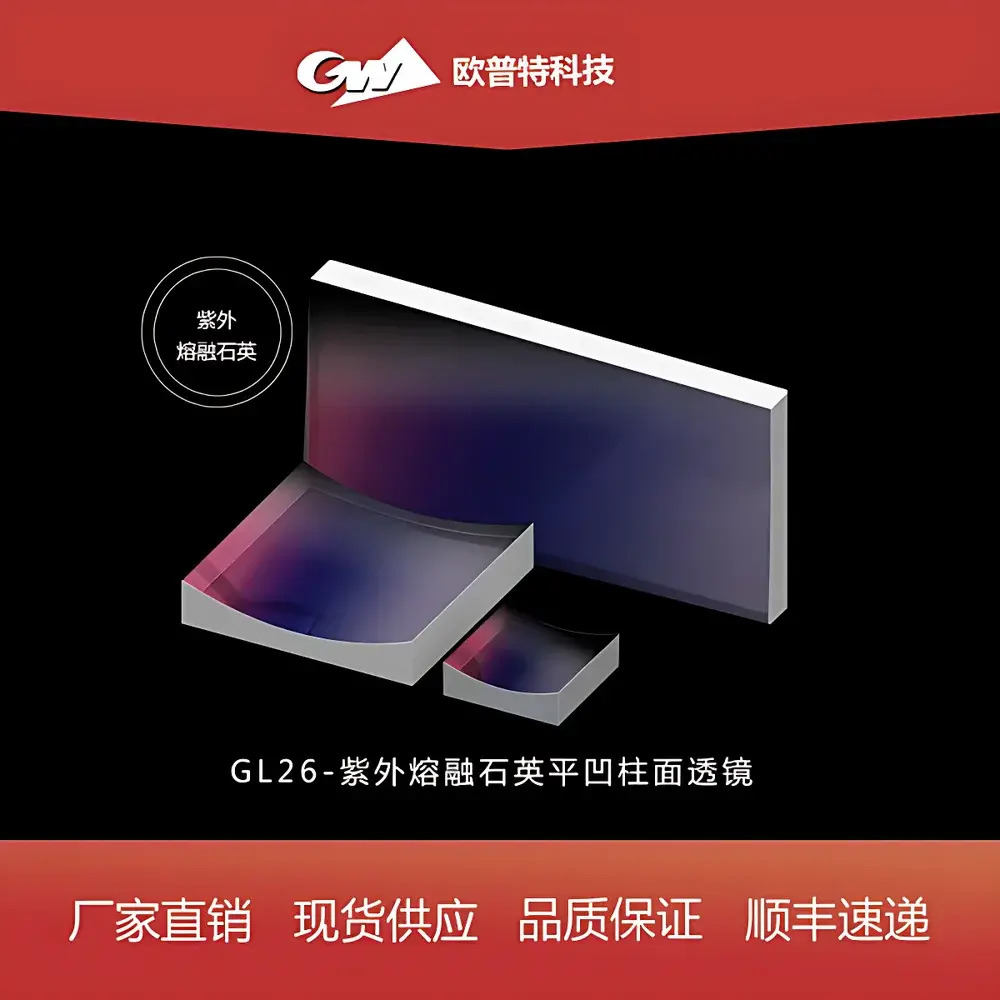
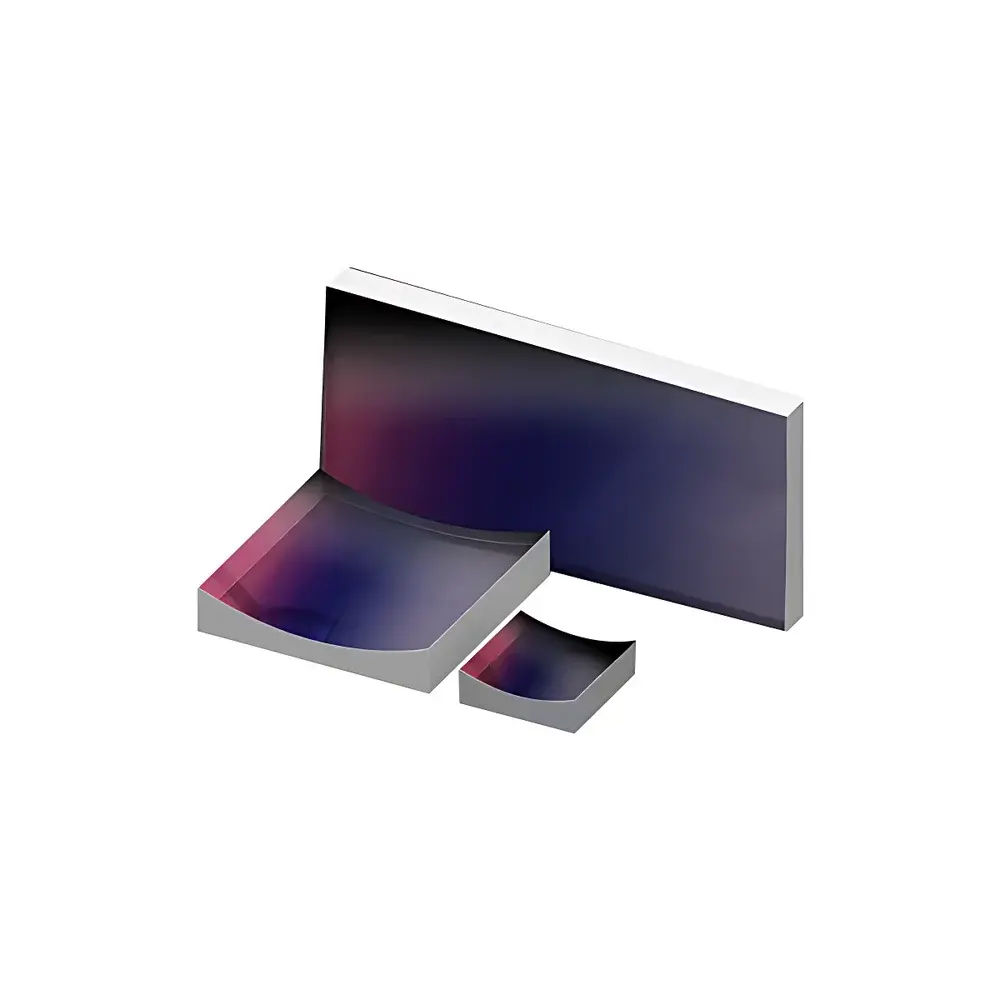
GL26 UV-Grade Fused Silica Plano-Concave Cylindrical Lens (Uncoated & UV Broadband AR-Coated)
| Origin | Beijing, China |
|---|---|
| Manufacturer Type | Authorized Distributor |
| Product Origin | Domestic (China) |
| Model | GL26 |
| Component Category | Optical Element |
| Price Range | USD 0.15–75.00 (per piece, volume-dependent) |
| Material | UV-grade fused silica (SiO₂), OH⁻ < 1 ppm, transmission > 80% @ 190 nm |
| Surface Quality | 40–20 scratch-dig |
| Surface Flatness | λ/4 @ 633 nm (flat side) |
| Clear Aperture | ≥ 90% of nominal dimension |
| Dimensional Tolerance | ±0.1 mm (X/Y), ±0.2 mm (thickness) |
| Focal Length Tolerance | ±2% |
| Coating Options | Uncoated (bare fused silica) or UV Broadband Anti-Reflection (AR) coating (Ravg < 1.0% @ 250–400 nm, 0° AOI) |
Overview
The GL26 series comprises precision-engineered plano-concave cylindrical lenses fabricated from high-purity UV-grade fused silica—optimized for demanding ultraviolet optical systems where deep-UV transmission, low thermal expansion (α = 0.55 × 10⁻⁶ /°C), and exceptional homogeneity are critical. Unlike standard optical glass, UV-grade fused silica exhibits minimal solarization under prolonged 190–250 nm exposure and maintains transmission >80% down to 190 nm (per ASTM F738-22). As a cylindrical lens, the GL26 introduces astigmatic focusing: it collimates or focuses light in only one meridian (e.g., horizontal), while leaving the orthogonal axis unaffected—enabling beam shaping in laser line generation, anamorphic correction, optical pumping cavities, and spectroscopic slit illumination. The plano surface is polished to λ/4 flatness at 633 nm, and the concave cylindrical surface is generated via deterministic diamond turning followed by ion-beam finishing to ensure wavefront error < λ/8 RMS over clear aperture.
Key Features
- UV-grade fused silica substrate with certified transmittance data per MIL-PRF-174A and ISO 10110-3 compliance
- Two coating configurations: uncoated (for maximum LIDT in pulsed UV applications) and broadband AR coating optimized for 250–400 nm (Ravg < 1.0%, measured per ISO 9211-3)
- Multiple dimensional formats: rectangular clear apertures including 10.0 × 10.0 mm, 20.0 × 10.0 mm, and 30.0 × 20.0 mm, all with uniform center thickness (2.0 mm ±0.1 mm)
- Nominal focal lengths ranging from –12.7 mm to –300 mm (concave sign convention), with tight tolerance of ±2% on effective focal length (EFL)
- Back focal length (BFL) and radius of curvature (R₁ = –R₂) provided for each variant to support paraxial ray tracing in Zemax OpticStudio and Code V
- Surface quality rated 40–20 scratch-dig per ISO 10110-7; no coating-induced stress birefringence (verified via crossed-polarizer inspection)
Sample Compatibility & Compliance
The GL26 lens family is compatible with standard kinematic mounts (e.g., Thorlabs LM1XY, Newport UMB10) and vacuum-compatible optical tables (UHV-rated when uncoated). All UV-coated variants undergo environmental durability testing per MIL-C-48497A: adhesion verified by tape test (ASTM D3359), humidity resistance (95% RH, 40°C, 240 h), and thermal cycling (–40°C to +70°C, 10 cycles). The uncoated version meets laser-induced damage threshold (LIDT) requirements for nanosecond pulsed lasers at 266 nm (≥ 5 J/cm², 10 ns, 20 Hz, Ø0.5 mm spot). Documentation includes RoHS 2015/863/EU and REACH SVHC declarations; full traceability to raw material lot and polishing batch is available upon request for GLP/GMP-aligned labs.
Software & Data Management
Each GL26 lens shipment includes a digital calibration certificate (PDF) containing measured surface figure (interferometric map), spectral transmittance curve (200–1100 nm, PerkinElmer Lambda 950), and coating reflectance data (Agilent Cary 7000). These files conform to ASTM E2917-20 Annex A1 metadata standards and are embeddable into LabArchives ELN or Benchling via CSV/JSON export. For integration into automated optical alignment workflows, the product database supports direct import into Synopsys CODE V via .LEN file templates (available upon request). No proprietary software is required—optical design parameters are fully interoperable with open-format ray-tracing engines.
Applications
- UV laser beam expansion and line generation in LIBS (Laser-Induced Breakdown Spectroscopy) excitation optics
- Anamorphic correction in ultrafast Ti:sapphire amplifier compressors operating below 200 nm after frequency conversion
- Slit illumination optics in vacuum UV monochromators (e.g., McPherson 234/302 series) requiring <0.1% scatter at 121.6 nm (Lyman-α)
- Collimation of LED arrays in UV-curable resin photolithography systems (365 nm/385 nm)
- Reference elements in NIST-traceable radiometric calibration chains for UV radiometers (per ISO/IEC 17025:2017 clause 7.7)
- Optical cavity mode control in narrow-linewidth HeCd lasers (325 nm) and nitrogen lasers (337.1 nm)
FAQ
What is the maximum permissible incident angle for the UV AR coating without significant reflectance shift?
The UV broadband AR coating is designed for 0° ±5° angle of incidence; reflectance remains <1.5% across 250–400 nm up to 8° AOI, but exceeds 2% beyond 10°—verify angular usage via thin-film modeling in Essential Macleod.
Can GL26 lenses be used in ultra-high vacuum (UHV) environments?
Yes—the uncoated variants are bakeable to 150°C and exhibit outgassing rates <1×10⁻¹⁰ Torr·L/s·cm² (per ASTM E595), making them suitable for UHV optical benches and synchrotron beamlines.
Is there a difference in wavefront error between uncoated and UV-coated versions?
No measurable difference: coating-induced deformation is <0.005 waves PV (633 nm), confirmed by Zygo GPI interferometry before and after coating deposition.
Do you provide custom focal lengths or non-standard dimensions?
Yes—custom geometries (e.g., 50.0 × 10.0 mm, f′ = –65 mm) are available under NRE agreement; lead time is 6–8 weeks with full metrology report.
How is certification traceable to national standards?
Transmittance measurements are referenced to NIST SRM 2036 (fused silica reference); surface flatness is calibrated against Zygo ET+ interferometer certified to ISO 10110-5:2022.




