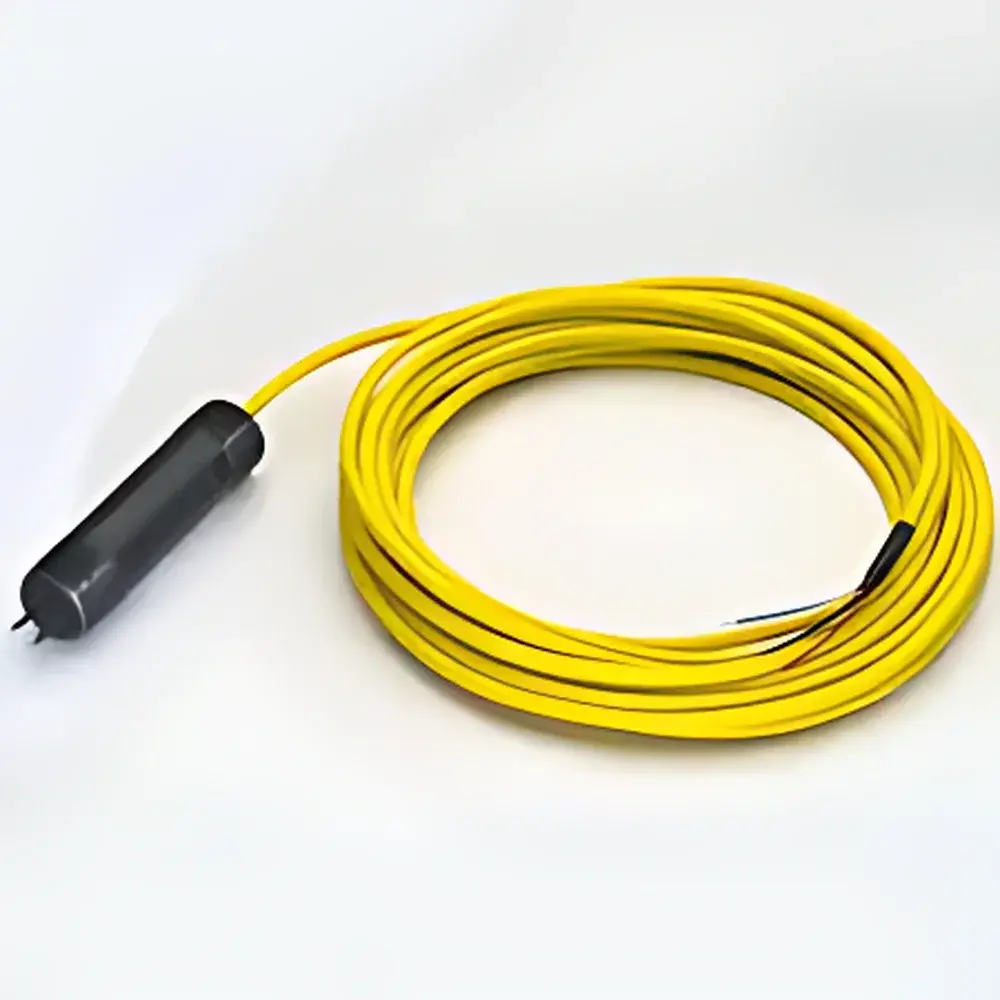
Global Water WA600 Conductive Liquid Level Alarm Sensor
| Brand | Global Water |
|---|---|
| Origin | Germany |
| Manufacturer Status | Authorized Distributor |
| Origin Category | Imported |
| Model | WA600 |
| Price Range | USD 2,700 – 13,500 (est. based on EUR/USD conversion & typical B2B pricing tiers) |
| Operating Voltage | 12–36 VDC |
| Quiescent Current | 4 mA |
| Alarm Current Draw | 44 mA |
| Relay Output | Galvanically Isolated SPST, 250 mA @ 100 VDC max switching capacity, 400 mA continuous load rating |
| Electrode Material | AISI 304 Stainless Steel |
| Enclosure | Epoxy-potted solid-state electronics |
| Cable | 4-conductor shielded, standard 7.5 m (custom lengths up to 150 m available) |
| Dimensions | Ø25 mm × 130 mm |
| Weight | 170 g |
| Detection Principle | Conductivity-based liquid presence sensing |
| Mounting | Submersible, point-level detection |
| Reset Mode | Automatic dry-state reset |
| Alarm Logic | Configurable wet-closed or dry-closed output |
Overview
The Global Water WA600 Conductive Liquid Level Alarm Sensor is an industrial-grade, submersible point-level detection device engineered for reliable, maintenance-free monitoring of conductive liquids—primarily water and aqueous solutions—in open channels, tanks, sumps, stormwater basins, and flood-prone infrastructure. Unlike ultrasonic or float-based systems, the WA600 operates on a robust conductivity principle: two insulated stainless steel electrodes form part of a low-energy DC circuit; when immersed in a conductive medium (e.g., water with ≥5 µS/cm conductivity), ionic conduction completes the path, triggering a galvanically isolated relay output. This solid-state architecture eliminates moving parts, mechanical wear, or calibration drift—making it especially suitable for long-term unattended deployment in harsh outdoor or wastewater environments where vibration, sedimentation, or biofouling may compromise alternative technologies.
Key Features
- Galvanically isolated SPST relay output rated for 250 mA switching at ≤100 VDC and 400 mA continuous load—compatible with PLC inputs, audible alarms, pump shutoff circuits, and SCADA telemetry interfaces.
- Full epoxy potting of electronics ensures IP68-rated environmental protection and resistance to moisture ingress, chemical exposure, and thermal cycling across –20 °C to +70 °C operating range.
- Configurable alarm logic: factory-set or field-selectable wet-closed (alarm on liquid contact) or dry-closed (alarm on loss of liquid—ideal for low-level detection or leak detection in pressurized lines).
- Submersible design with 304 stainless steel electrodes enables direct mounting at critical elevation points without auxiliary housings or floats—reducing installation complexity and failure points.
- Auto-reset functionality: relay de-energizes immediately upon electrode drying, requiring no manual intervention or external reset signal—critical for intermittent or transient level events.
- Low-power operation (4 mA standby, 44 mA active) supports solar-powered remote stations and battery-backed monitoring networks compliant with IEC 62040-3 and IEEE 1626 standards.
Sample Compatibility & Compliance
The WA600 is validated for use with tap water, rainwater, surface runoff, treated effluent, and other low-to-moderate conductivity aqueous media (≥5 µS/cm). It is not suitable for non-conductive liquids (e.g., hydrocarbons, distilled water, glycerol) or highly corrosive brines exceeding ASTM D1129 chloride limits without supplemental electrode passivation. The sensor complies with EN 61000-6-2 (immunity) and EN 61000-6-4 (emissions) for industrial environments. Its relay isolation meets IEC 60664-1 reinforced insulation requirements. While not intrinsically safe certified, it may be deployed in Zone 2 hazardous areas when integrated with appropriate barrier systems per IEC 60079-11.
Software & Data Management
As a discrete-level switch, the WA600 does not incorporate onboard data logging or digital communication protocols (e.g., Modbus, SDI-12). However, its clean, noise-immune relay output integrates seamlessly into third-party data acquisition systems—including Campbell Scientific CR-series loggers, Siemens Desigo CC, and Honeywell Experion PKS—enabling time-stamped event recording, alarm escalation workflows, and audit-trail generation. When paired with controllers supporting IEC 62443-3-3 security profiles, the sensor’s binary status contributes to Level 1 asset visibility within OT cybersecurity frameworks. All relay state transitions are compatible with FDA 21 CFR Part 11-compliant electronic record systems when captured via validated DAQ hardware with full audit trail and electronic signature capability.
Applications
- Flood early warning systems in municipal drainage networks and river gauge stations.
- Pump station dry-run protection and overflow containment in wastewater lift stations.
- Tank level verification for potable water storage, fire suppression reservoirs, and chemical dosing vessels.
- Leak detection in secondary containment sumps beneath fuel dispensers or HVAC condensate pans.
- Low-water cutoff for irrigation header tanks and cooling tower make-up systems.
- Marine bilge level monitoring on commercial vessels meeting IMO MSC.1/Circ.1422 guidelines for watertight integrity alarms.
FAQ
Can the WA600 detect oil or diesel?
No. The sensor relies on electrical conductivity; hydrocarbons exhibit insufficient ionic conduction to close the detection circuit.
Is calibration required before or during operation?
No. The WA600 is a fixed-threshold, binary sensor with no adjustable sensitivity—zero calibration or periodic verification needed.
What is the maximum cable length supported?
Standard delivery includes 7.5 m of shielded 4-conductor cable; custom lengths up to 150 m are available with voltage-drop compensated power supply design.
Does the relay support AC loads?
Yes—the isolated contacts are voltage-agnostic and rated for resistive AC loads up to 250 VAC / 250 mA, provided derated per IEC 61810-1 switching category.
How does the WA600 perform in freezing conditions?
The epoxy-encapsulated electronics remain functional down to –20 °C; however, ice formation on electrodes may cause false-negative readings until physical thawing occurs.