
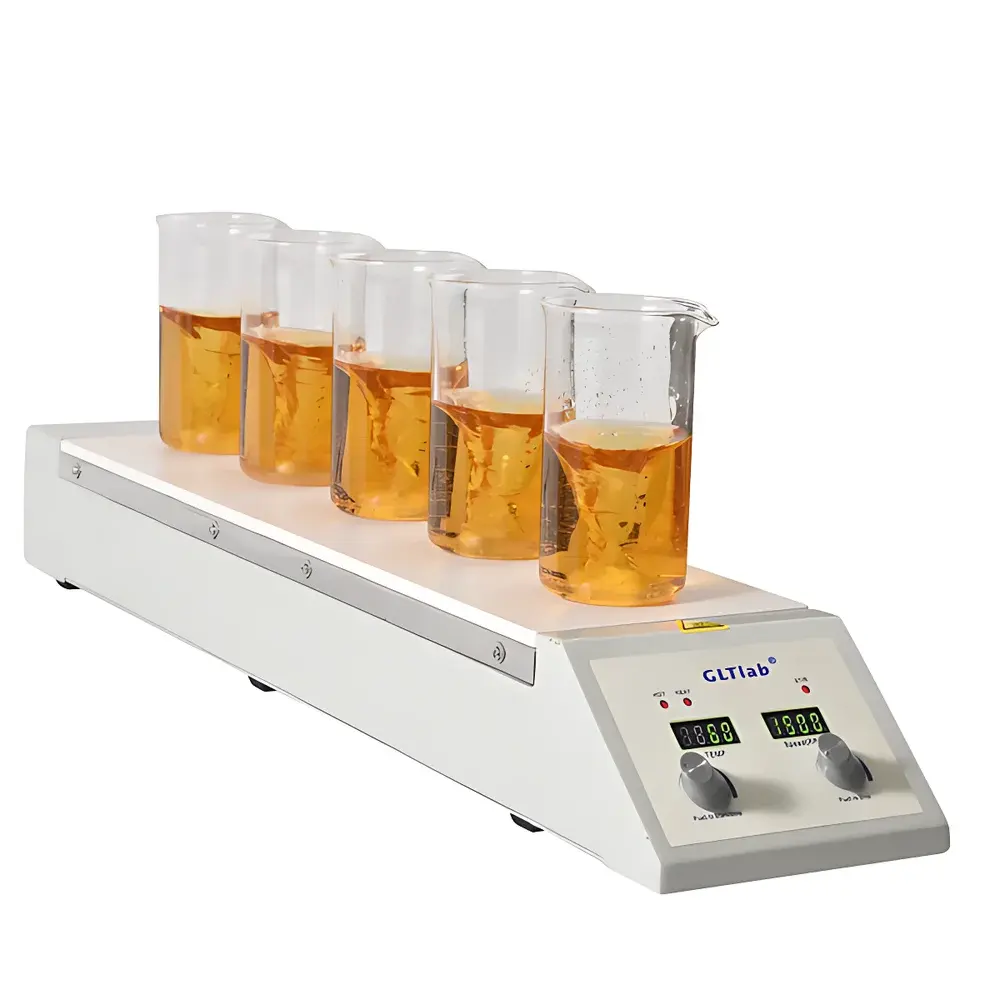
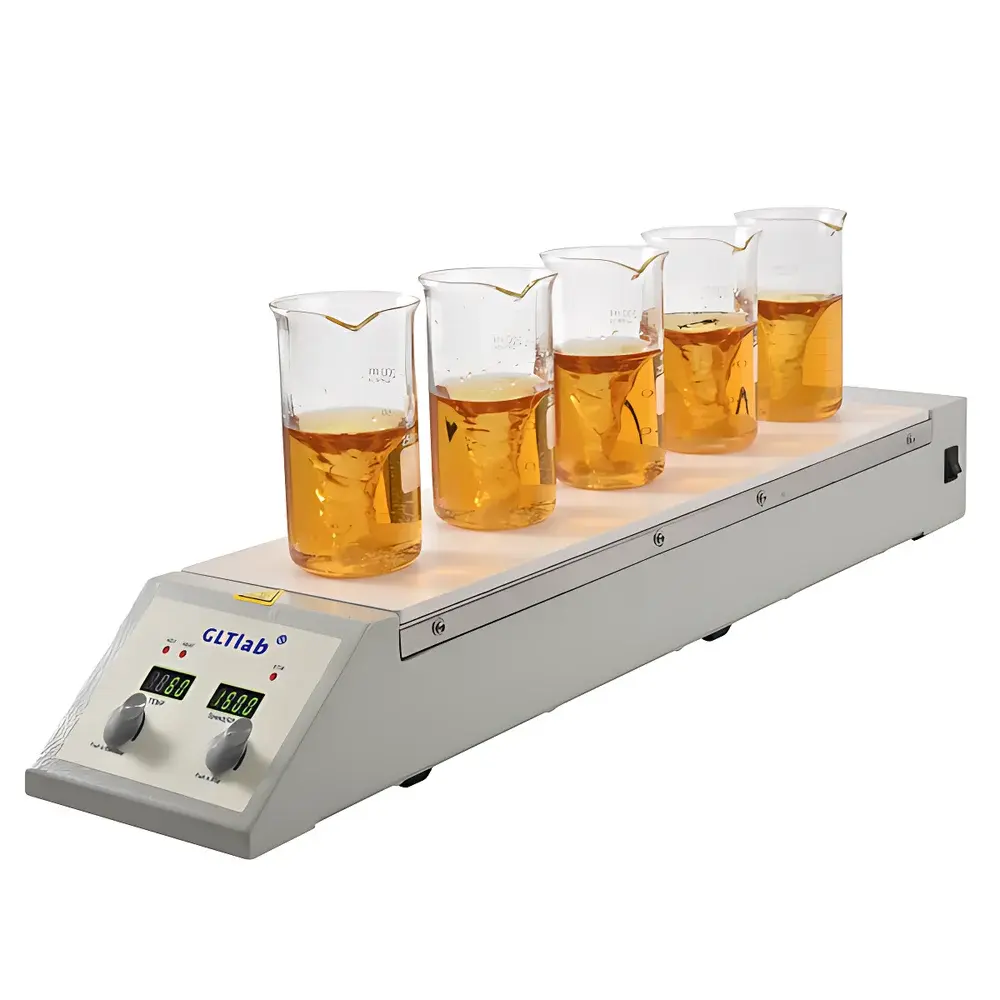
GLTlab SHA-01-5N Multi-Position Heated Magnetic Stirrer
| Brand | GLTlab |
|---|---|
| Origin | Guangdong, China |
| Manufacturer Type | Direct Manufacturer |
| Product Category | Domestic |
| Model | SHA-01-5N |
| Instrument Type | Magnetic Stirrer |
| Max Stirring Volume | 1 L |
| Speed Range | 150–2000 rpm |
| Temperature Control Range | Ambient to 120 °C |
| Heating Power | 250 W |
| Panel Material | Ceramic-Coated Aluminum |
| Dimensions (L×W×H) | 645 × 135 × 84 mm |
| Weight | 5.6 kg |
| Operating Temperature | 5–40 °C |
| Operating Humidity | ≤80% RH |
| IP Rating | IP42 |
| Voltage | 110/115/230 VAC |
| Frequency | 50/60 Hz |
| Display | Dual LED (Speed & Temp) |
| Heating Rate | ~5 °C/min |
| Chemical Resistance | Yes |
| Stirring Position Spacing | 100 mm |
| Stir Bar Length Compatibility | 25–35 mm |
Overview
The GLTlab SHA-01-5N Multi-Position Heated Magnetic Stirrer is an engineered solution for laboratories requiring simultaneous, independent control of temperature and agitation across up to five discrete sample positions. Designed around a robust ceramic-coated aluminum heating plate, the unit delivers uniform thermal distribution and high chemical resistance—critical for applications involving organic solvents, acidic or basic reagents, and long-duration reactions. Its core operating principle relies on rotating magnetic fields generated by precision-controlled permanent magnets beneath the heated surface, which couple with PTFE- or glass-coated stir bars immersed in vessels. Unlike hotplate-only systems, the SHA-01-5N integrates closed-loop digital PID temperature regulation with microprocessor-driven motor control, enabling reproducible kinetic studies, dissolution testing, buffer equilibration, and reagent synthesis under defined thermal and mechanical conditions.
Key Features
- Five independently controllable stirring positions spaced at 100 mm intervals, supporting parallel processing of multiple samples without cross-contamination risk.
- Ceramic-coated aluminum top plate (495 × 130 mm active area) offering exceptional thermal stability, scratch resistance, and compatibility with common laboratory cleaning agents and solvents.
- Dual LED digital display showing real-time speed (rpm) and plate temperature (°C), with intuitive rotary encoder interface for precise parameter entry.
- Brushless DC motor delivering smooth, low-vibration rotation from 150 to 2000 rpm in 1-rpm increments—optimized for both low-shear mixing and vigorous dispersion tasks.
- PID-regulated heating system with 250 W output power, capable of reaching 120 °C from ambient in approximately 12 minutes (typical ramp rate: ~5 °C/min), and maintaining ±1.5 °C accuracy across the full range.
- Integrated thermal safety circuitry including over-temperature cutoff and visual/audible warning indicators to prevent accidental overheating or dry-run damage.
- IP42-rated enclosure ensures protection against solid objects >1 mm and vertically falling water droplets—suitable for standard wet-lab environments compliant with IEC 60529.
Sample Compatibility & Compliance
The SHA-01-5N accommodates standard round-bottom flasks (up to 1 L capacity per position), beakers, and vials compatible with magnetic stir bars 25–35 mm in length. Its non-porous ceramic surface resists etching from HCl, NaOH, acetone, ethanol, and other routinely used reagents—facilitating rapid decontamination between runs. While not certified to ISO/IEC 17025 or FDA 21 CFR Part 11 out-of-the-box, the instrument’s stable thermal and rotational performance supports GLP-compliant workflows when integrated into validated lab protocols. It meets CE marking requirements for electromagnetic compatibility (EMC Directive 2014/30/EU) and low-voltage safety (LVD Directive 2014/35/EU), and operates within Class B emission limits per CISPR 11.
Software & Data Management
The SHA-01-5N operates as a standalone benchtop device with no embedded data logging or PC connectivity. All operational parameters—including setpoints, actual values, and runtime status—are visible via the dual LED display during use. For labs requiring traceability, external USB or RS-232 data loggers may be interfaced using third-party analog voltage outputs (if available via optional accessory module). Users implementing electronic lab notebooks (ELNs) or LIMS systems can manually record timestamps, setpoints, and observed outcomes in accordance with internal SOPs. The absence of networked firmware eliminates cybersecurity concerns related to remote access vulnerabilities—a consideration emphasized in recent NIST SP 800-160 and ISO/IEC 27001-aligned lab infrastructure assessments.
Applications
- Parallel dissolution testing of pharmaceutical formulations under controlled temperature and agitation profiles aligned with USP .
- Buffer preparation and pH equilibration for chromatography mobile phases, where consistent mixing minimizes localized concentration gradients.
- Small-scale catalytic reaction screening in synthetic chemistry, particularly where exothermicity must be managed via precise thermal feedback.
- Cell culture media warming and homogenization prior to sterile filtration—performed below 40 °C to preserve growth factor integrity.
- Environmental sample digestion (e.g., EPA Method 3050B) requiring gentle yet sustained heating and mixing of acid-treated matrices.
- Quality control workflows in food and beverage labs for viscosity-standardized emulsion preparation or titrant stabilization.
FAQ
What is the maximum recommended vessel diameter per position?
Vessels up to 100 mm in outer diameter are optimal; larger diameters may reduce magnetic coupling efficiency and cause stir bar instability at higher speeds.
Can the unit maintain temperature uniformity across all five positions simultaneously?
Yes—the ceramic-coated aluminum plate provides radial thermal conductivity sufficient to hold ±2.0 °C uniformity across the active surface when loaded with identical vessel types and volumes.
Is calibration documentation provided with the instrument?
Factory calibration certificates for temperature and speed sensors are available upon request and may be included in IQ/OQ documentation packages for regulated environments.
Does the SHA-01-5N support external temperature probes for sample-specific feedback control?
No—temperature regulation is based solely on the built-in plate sensor. For bath- or solution-specific control, users should integrate a separate circulator or probe-based controller.
What maintenance is required to ensure long-term performance?
Routine cleaning with isopropanol and soft lint-free cloth; periodic inspection of stir bar magnetism and motor ventilation grilles for dust accumulation; annual verification of thermal accuracy using a NIST-traceable thermometer.



