
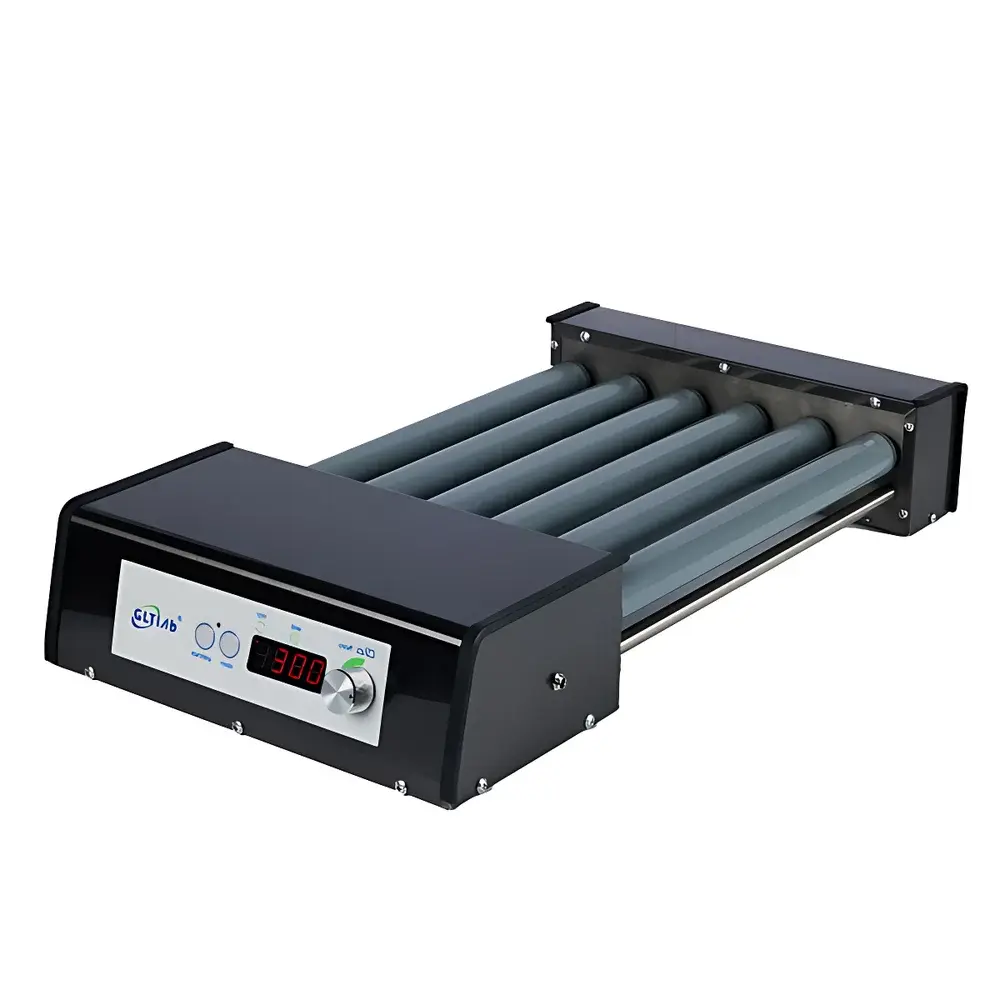
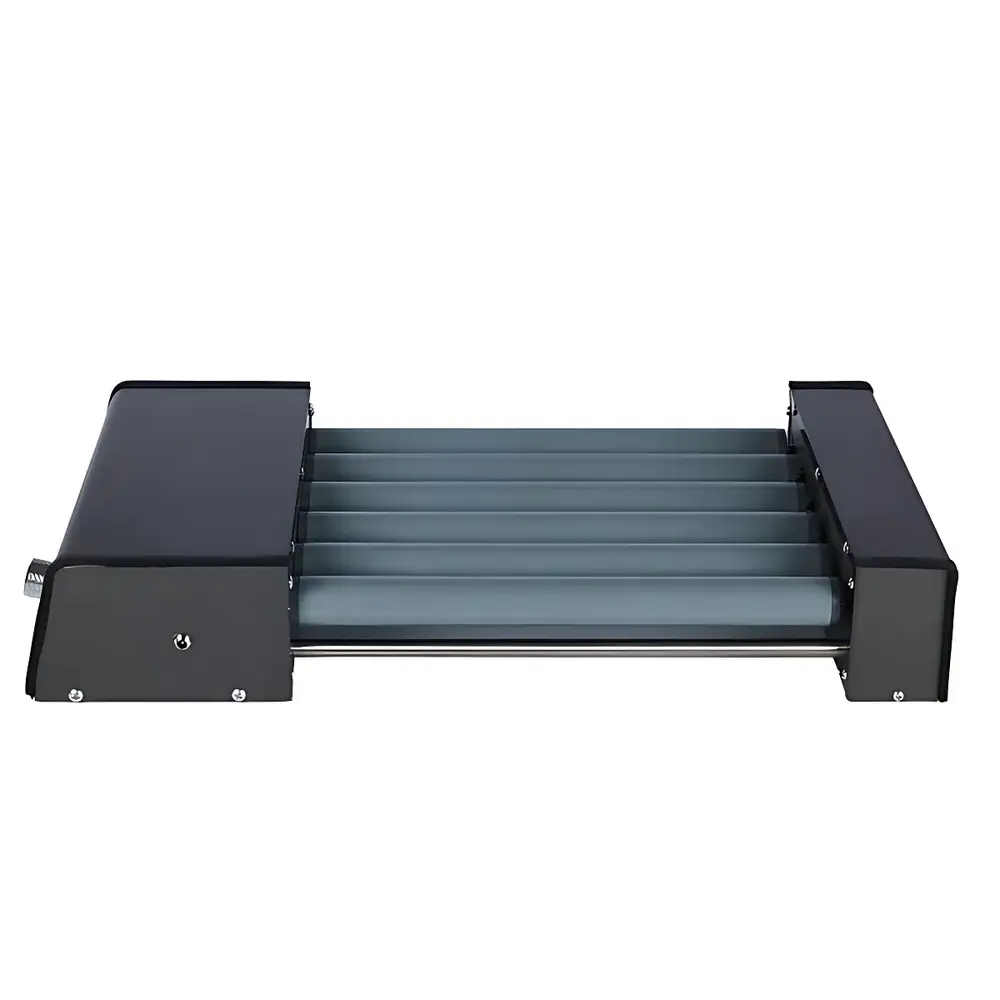
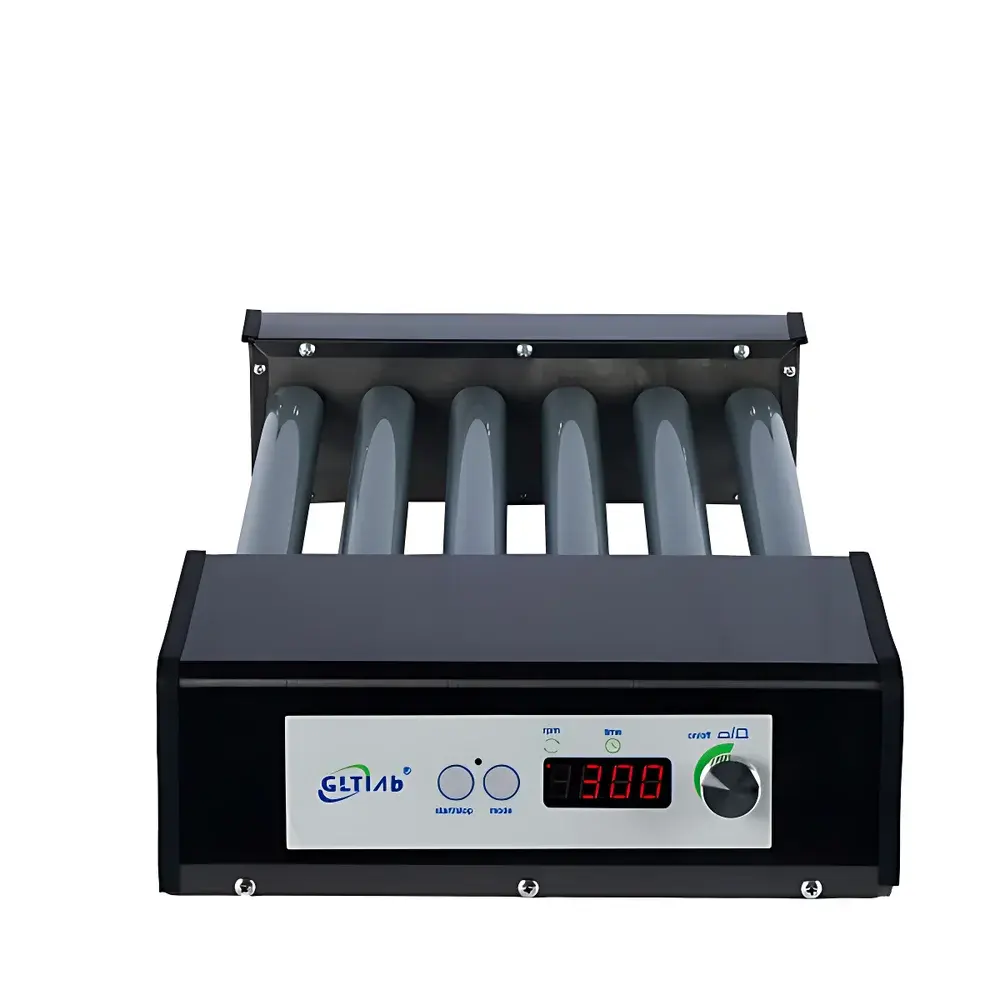
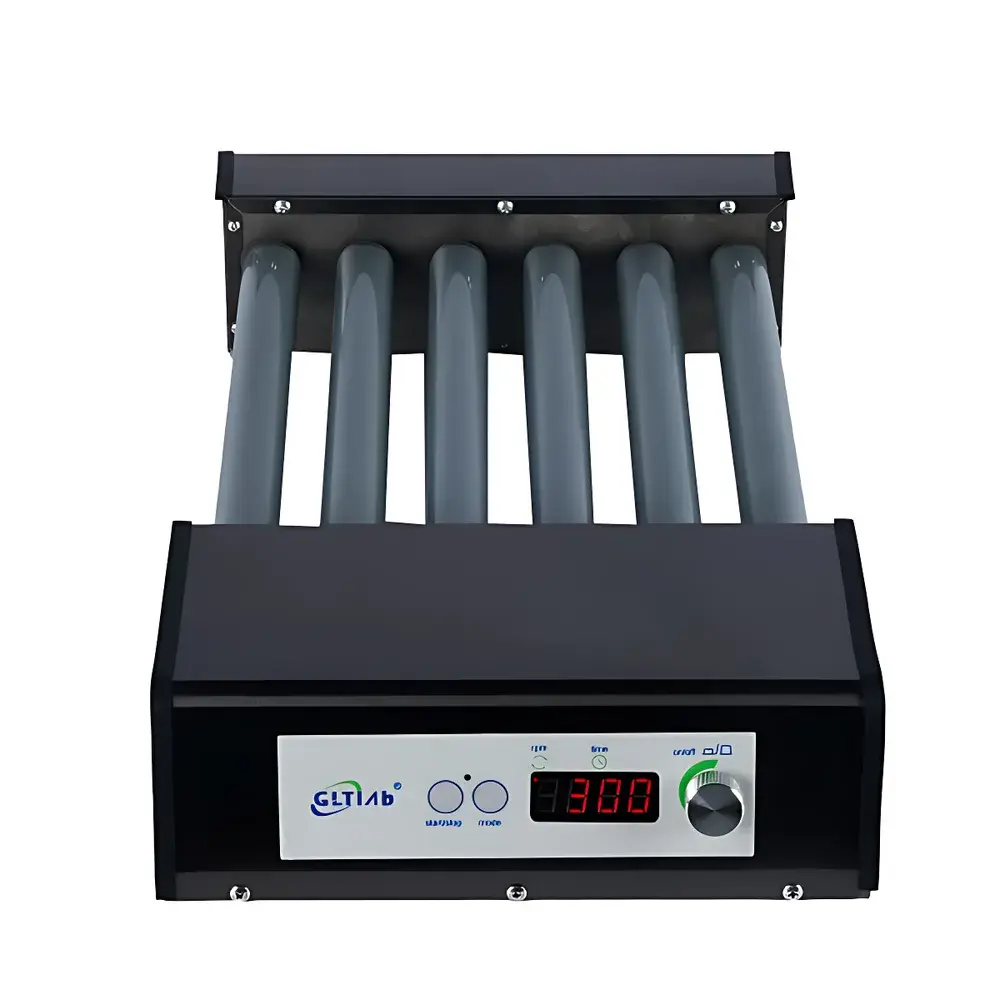
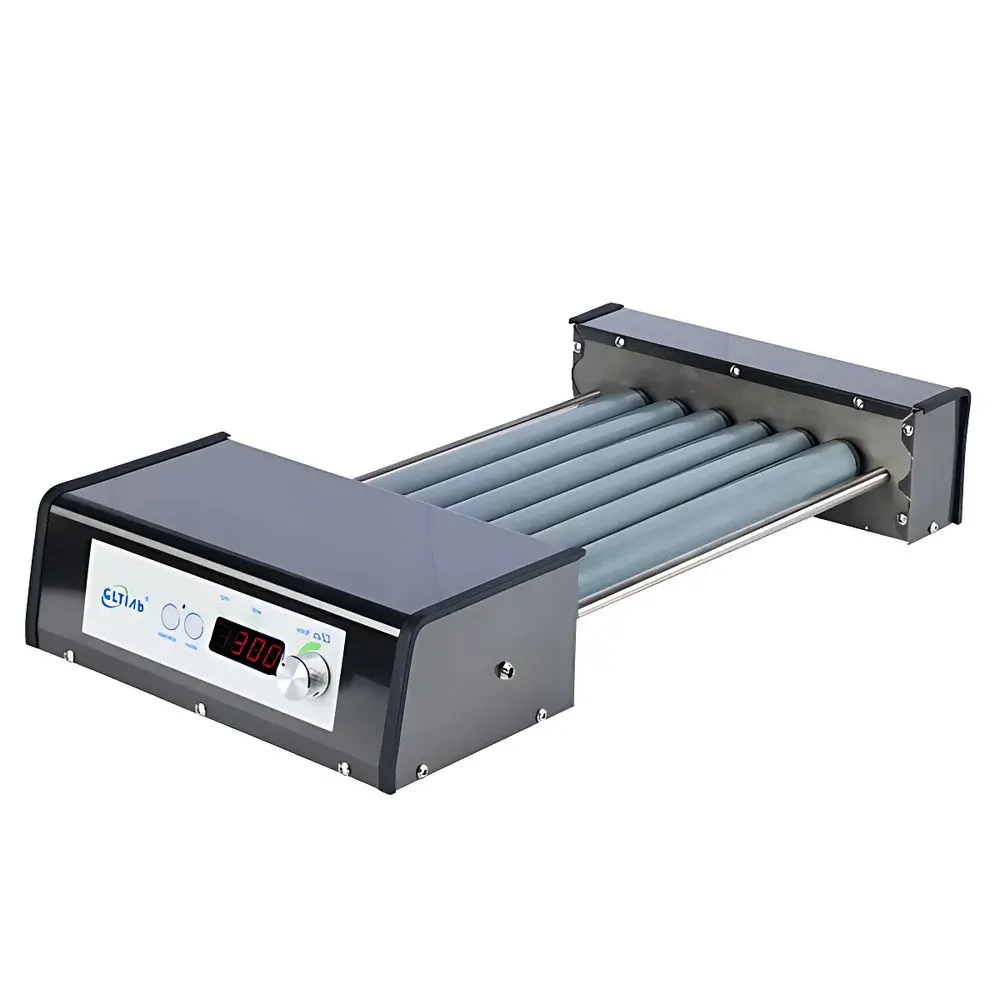
GLTLab TR-6-SS 6-Axis CNC-Controlled Roller Mixer
| Brand | GLTLab |
|---|---|
| Origin | Guangdong, China |
| Manufacturer Type | Direct Manufacturer |
| Product Origin | Domestic (China) |
| Model | TR-6-SS |
| Price | Upon Request |
| Rotation Mode | Rolling |
| Number of Rollers | 6 |
| Speed Range | 5–300 rpm |
| Load Capacity | 10 kg |
| Control Method | CNC Digital Control |
| Timer Range | 1 second to 200 hours |
| Roller Dimensions | 340 × 30 mm |
| External Dimensions (W×D×H) | 556 × 286 × 98 mm |
| Net Weight | 7 kg |
| Construction Material | Full 304 Stainless Steel Body and Hardware |
Overview
The GLTLab TR-6-SS is a precision-engineered 6-axis CNC-controlled roller mixer designed for high-reproducibility blending of heterogeneous materials under demanding industrial and R&D conditions. Unlike conventional orbital or vortex mixers, the TR-6-SS employs synchronized multi-axis rolling motion—where six parallel stainless steel rollers rotate independently yet cohesively—to generate uniform shear distribution across multiple vessels simultaneously. This mechanical architecture ensures consistent tumbling trajectories without axial slippage, minimizing phase segregation in viscous suspensions and preventing sedimentation during prolonged mixing cycles. The device operates on the principle of controlled gravitational displacement combined with rotational inertia, enabling effective homogenization of high-viscosity pastes (up to 106 mPa·s), dry powder blends, and solid–liquid slurries—particularly critical in battery electrode slurry formulation, polymer compounding, and pharmaceutical granulation workflows.
Key Features
- Full 304 stainless steel construction—including frame, rollers, fasteners, and internal PCB housing—for long-term resistance to acidic, alkaline, and high-humidity environments.
- CNC-digital control system with real-time speed adjustment (5–300 rpm) and programmable timer resolution down to 1 second, supporting both continuous and interval-based mixing protocols.
- Optimized roller geometry (340 × 30 mm) with precision-ground surface finish to ensure minimal vessel wear and maximal torque transfer—even with irregularly shaped or heavy-walled containers.
- Dynamic load balancing mechanism accommodates up to 10 kg total payload across six independent roller positions, maintaining mechanical stability at maximum rotational speed.
- Thermally efficient chassis design with enhanced heat dissipation pathways, supporting uninterrupted operation in ambient temperatures up to 40 °C and relative humidity ≤95% non-condensing.
- Tool-free roller access and modular electrical layout simplify preventive maintenance, calibration verification, and field service—reducing mean time to repair (MTTR) by over 40% compared to legacy carbon-steel platforms.
Sample Compatibility & Compliance
The TR-6-SS accepts standard laboratory and industrial containers—including glass vials (10–50 mL), polypropylene bottles (100–500 mL), stainless steel jars (up to 1 L), and custom-shaped battery slurry canisters—without requiring adapters. Its low-vibration rolling kinematics preserve fragile particulates (e.g., graphite flakes, NMC cathode precursors) while achieving homogeneous dispersion. The unit complies with IEC 61000-6-2 (immunity) and IEC 61000-6-4 (emissions) standards for electromagnetic compatibility. All electrical components meet UL/CSA Class II insulation requirements. While not certified for cleanroom ISO 5/Class 100 use out-of-box, optional HEPA-filtered enclosure integration is available for GMP-aligned production environments. Documentation packages support GLP audit readiness, including full traceability of firmware version, calibration history, and operational logs.
Software & Data Management
The TR-6-SS operates via an embedded ARM Cortex-M4 microcontroller running deterministic real-time firmware (v2.3+). No external PC dependency is required for basic operation; however, optional USB-C connectivity enables bidirectional data exchange with Windows/macOS-based LabManager Suite v4.1. This software provides protocol archiving, run-time parameter logging (speed, duration, direction reversal count), and CSV-exportable event timelines compatible with LIMS integration. Audit trails include user ID stamping, timestamped configuration changes, and tamper-evident digital signatures—meeting FDA 21 CFR Part 11 requirements for electronic records when deployed with validated user authentication modules. Firmware updates are delivered via signed binary packages with SHA-256 checksum validation.
Applications
- Battery manufacturing: Homogenization of lithium-ion cathode/anode slurries (NCA, LFP, silicon-carbon composites) with conductive additives and PVDF binders.
- Chemical synthesis: Blending of thixotropic organosilicon gels, pigment dispersions, and catalyst slurries prior to extrusion or coating.
- Materials science: Dry-mixing of metal oxide powders, ceramic precursors, and nanocomposite feedstocks for sintering or additive manufacturing.
- Pharmaceutical development: Low-shear blending of API-excipient blends for direct compression tablets, avoiding attrition-induced polymorphic transition.
- Environmental testing: Preparation of standardized soil–contaminant suspensions for leaching and bioavailability assays per ASTM D3987 and EPA Method 1311.
FAQ
What distinguishes the TR-6-SS from conventional single-axis roller mixers?
The TR-6-SS eliminates unidirectional shear bias through coordinated 6-axis motion, significantly improving blend uniformity in high-viscosity systems where laminar flow dominates.
Can the TR-6-SS be integrated into automated production lines?
Yes—RS-485 Modbus RTU interface (optional) supports PLC-level synchronization with conveyor systems, filling stations, and inline rheometry units.
Is routine calibration required for regulatory compliance?
Speed and timer accuracy are factory-verified against NIST-traceable standards; annual verification using calibrated tachometer and stopwatch is recommended for GLP/GMP applications.
Does the stainless steel construction affect magnetic compatibility for magnetic bead-based extraction?
No—the 304 SS housing exhibits negligible magnetic permeability (μr ≈ 1.02), permitting reliable interaction with standard magnetic separation rods during concurrent mixing and extraction protocols.
What is the expected service life under continuous 24/7 operation?
With scheduled lubrication every 6 months and ambient environmental controls, MTBF exceeds 25,000 operating hours—validated by accelerated corrosion testing per ASTM B117 (500 hr salt spray).



